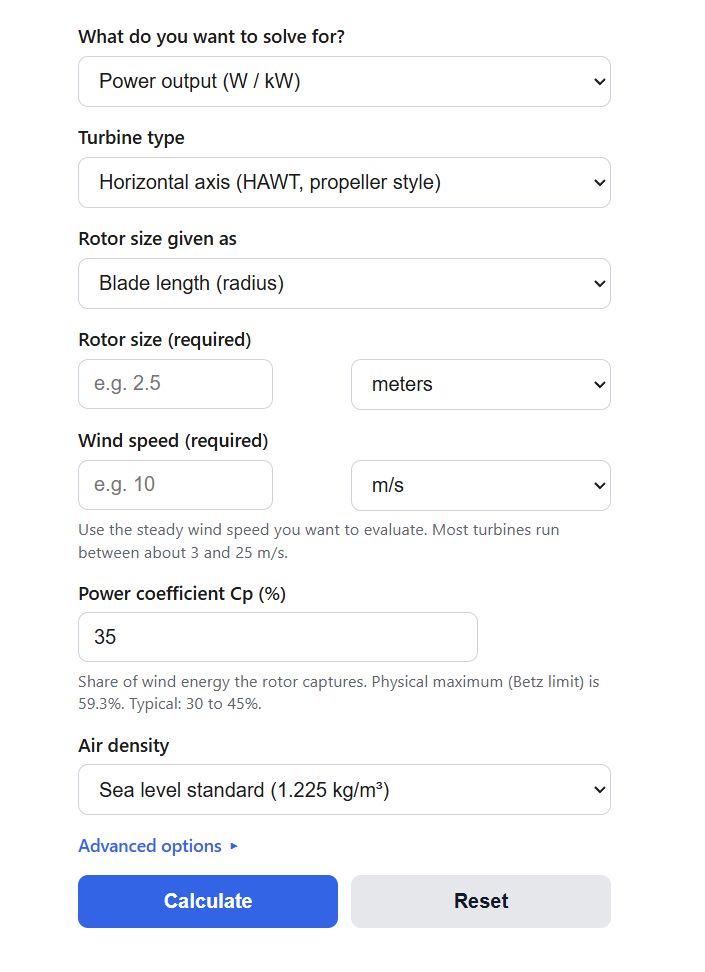
Calculate wind turbine power output from rotor size, wind speed, air density, and efficiency, plus annual kWh and the rotor size needed for a target power.
Wind Turbine Power Output Formula
P = 0.5 * rho * A * Cp * eta * v^3
A = pi * L^2 (HAWT) | A = D * H (VAWT)
E = P * 8760 * CF / 1000
- P = electrical power output (W)
- rho = air density (kg/m^3), 1.225 at sea level and 15 C
- A = swept area of the rotor (m^2)
- Cp = power coefficient, the fraction of wind energy the rotor captures (Betz limit: 0.593)
- eta = combined drivetrain and generator efficiency (typically 0.85 to 0.95)
- v = wind speed (m/s)
- L = blade length, the rotor radius of a horizontal axis turbine (m)
- D = rotor diameter (m); H = rotor height of a vertical axis turbine (m)
- E = annual energy production (kWh); CF = capacity factor; 8760 = hours in a year
The power output mode applies the first formula directly: it computes the swept area from your rotor dimensions, multiplies by the wind power density 0.5 * rho * v^3, then applies the power coefficient and drivetrain efficiency to give the electrical output in watts or kilowatts. The annual energy mode extends that result with the third formula, multiplying the electrical power by the 8,760 hours in a year and your capacity factor to estimate kWh per year and, if you enter an electricity price, the yearly dollar value. The rotor sizing mode rearranges the first formula to A = P / (0.5 * rho * Cp * eta * v^3), which returns the swept area, rotor diameter, and blade length needed to hit a target power at a given wind speed. In every mode you can let the calculator estimate air density from your site elevation and air temperature instead of assuming sea level conditions.
Wind Power Density and Elevation Reference Tables
The table below shows how much power the wind carries per square meter of swept area at sea level air density, and roughly what a typical turbine extracts from it (Cp of 35% with 90% drivetrain efficiency). Because power scales with the cube of wind speed, small speed differences change the result dramatically.
| Wind speed | Equivalent | Available power (W/m^2) | Typical electrical output (W/m^2) |
|---|---|---|---|
| 3 m/s | 6.7 mph | 16.5 | 5.2 |
| 5 m/s | 11.2 mph | 76.6 | 24.1 |
| 7 m/s | 15.7 mph | 210.1 | 66.2 |
| 9 m/s | 20.1 mph | 446.5 | 140.7 |
| 10 m/s | 22.4 mph | 612.5 | 192.9 |
| 12 m/s | 26.8 mph | 1,058.4 | 333.4 |
| 15 m/s | 33.6 mph | 2,067.2 | 651.2 |
| 20 m/s | 44.7 mph | 4,900.0 | 1,543.5 |
| 25 m/s | 55.9 mph | 9,570.3 | 3,014.6 |
Air gets thinner with altitude, and thinner air carries less energy at the same wind speed. The next table shows standard-atmosphere air density by elevation and the power you give up compared with an identical turbine at sea level. If your site sits above roughly 500 meters, use the calculator's elevation and temperature option instead of the default density.
| Elevation | Air density (kg/m^3) | Power vs sea level |
|---|---|---|
| 0 m (sea level) | 1.225 | 100% |
| 500 m (1,640 ft) | 1.167 | -4.7% |
| 1,000 m (3,281 ft) | 1.112 | -9.2% |
| 1,500 m (4,921 ft) | 1.058 | -13.6% |
| 2,000 m (6,562 ft) | 1.007 | -17.8% |
| 2,500 m (8,202 ft) | 0.957 | -21.9% |
| 3,000 m (9,843 ft) | 0.909 | -25.8% |
Wind Turbine Power Output Example Problems
Example 1: power output of a small HAWT. A horizontal axis turbine has a blade length of 2 m and sees a steady 10 m/s wind at sea level (rho = 1.225 kg/m^3). Assume Cp = 35% and drivetrain efficiency = 90%. First find the swept area: A = pi * 2^2 = 12.57 m^2. The power available in the wind is 0.5 * 1.225 * 12.57 * 10^3 = 7,697 W. Applying the power coefficient gives 7,697 * 0.35 = 2,694 W of aerodynamic power, and the drivetrain leaves 2,694 * 0.90 = 2,425 W, so the turbine delivers about 2.42 kW.
Example 2: sizing a rotor for a target power. You want 5 kW of electrical output at 8 m/s from a site at 1,500 m elevation and 10 C. The estimated air density is about 1.044 kg/m^3, so the electrical power density is 0.5 * 1.044 * 8^3 * 0.40 * 0.90 = 96.2 W/m^2 using Cp = 40%. The required swept area is 5,000 / 96.2 = 52 m^2, which corresponds to a rotor diameter of sqrt(4 * 52 / pi) = 8.1 m, or a blade length of about 4.1 m.
Wind Turbine Power Output Frequently Asked Questions
Why does wind turbine power depend on the cube of wind speed? The kinetic energy of moving air grows with the square of its speed, and the amount of air passing through the rotor each second grows linearly with speed. Multiplying the two gives a cubic relationship. The practical consequence is that a site with 10% stronger average wind produces about 33% more power, and doubling the wind speed multiplies output by eight. This is why siting matters more than any other single decision when installing a turbine.
What is the Betz limit and what Cp should I use? The Betz limit is the theoretical maximum share of wind energy any turbine can extract: 59.3%. No rotor can reach it, because the air must keep some velocity to flow past the blades. Modern large turbines achieve Cp values of 40 to 50% near their design wind speed, small residential turbines usually land between 25 and 40%, and simple vertical axis designs can fall below 20%. If you do not know your turbine's coefficient, 35% is a reasonable middle estimate.
Why is my real annual energy lower than the power output suggests? The power formula describes one steady wind speed, but real wind fluctuates, stops, and sometimes exceeds the turbine's safe operating range. The capacity factor accounts for this: it is the fraction of the year's theoretical maximum the turbine actually delivers. Small residential turbines typically achieve 10 to 20%, onshore wind farms 25 to 40%, and offshore farms 40 to 60%. Use the annual energy mode with a capacity factor that matches your situation rather than multiplying peak power by 8,760 hours.