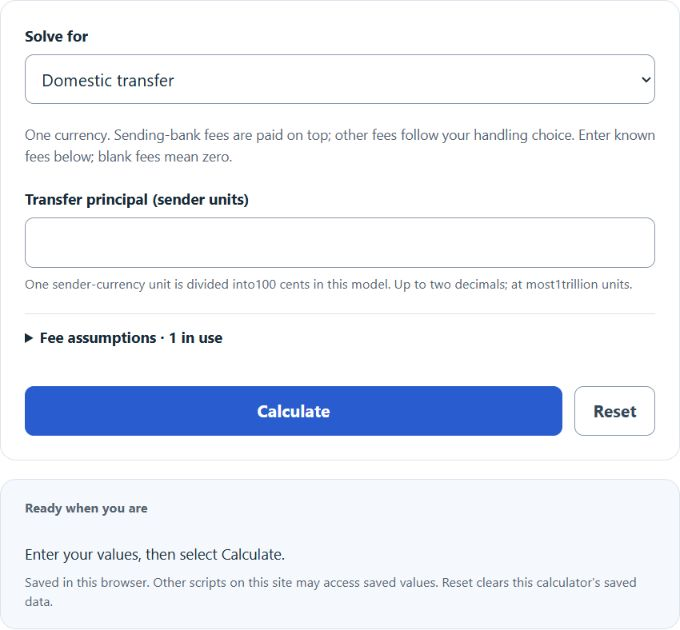
Estimate wire transfer fees and the amount received: enter the transfer amount and bank fees, plus the exchange rate and markup for an international wire.
Wire Transfer Fee Formula
The sender’s cash outlay depends on which fees are paid on top of the transfer. The recipient amount depends on which fees are deducted before delivery.
C = A + Ftop
 N = A - Fdeducted
For an international wire, the entered FX percentage reduces the supplied market exchange rate before the net transfer amount is converted. Rates are recipient units per sender unit. Exact entered decimals are used; money displays round once, half up to0.01unit. Rounded component rows can differ by0.01 from subtracting other displayed rounded values.
r = M * (1 - m)
 Received = N * r
Variables:
- m is the FX rate reduction as a decimal; M is the supplied market rate and r the effective rate. A is principal, C sender cost and N net before FX; Ftop and Fdeducted are the fees paid on top and deducted.
- Market Rate is recipient-currency units per sender-currency unit
- Sending, intermediary, and receiving fees are the stated charges along the wire route
The sending-bank fee is always paid on top. Intermediary and receiving fees either reduce principal before delivery/FX or are paid on top. Enter every fee in sender-currency units; fees charged after conversion need separate treatment. Blank fees or FX reduction mean zero. Zero net delivery is allowed when deductions equal principal; larger deductions are rejected. Editing marks the result stale; Reset clears this calculator’s saved inputs. Actual deductions may be unknown before delivery.
Wire Fee Handling Reference
This table uses a $5,000 transfer with a $30 sending fee, $15 intermediary fee, and $10 receiving fee.
| Fee handling | Sender cash outlay | Amount before any FX conversion | Total stated fees |
|---|---|---|---|
| Intermediary/recipient fees deducted | $5,030 | $4,975 | $55 |
| All fees paid on top | $5,055 | $5,000 | $55 |
Example Problems
Example 1: Domestic wire with deducted fees.
You initiate a $5,000 wire. The sending bank charges $30 on top, while $15 of intermediary fees and a $10 receiving fee are deducted. The sender pays $5,030 and the recipient receives an estimated $4,975.
Example 2: International conversion.
The net amount available for conversion is $4,975. The market rate is 0.92 recipient units per sender unit and the bank markup is 2.5%. The effective rate is 0.92 * 0.975 = 0.897. The recipient gets about 4,462.58 recipient-currency units.
Frequently Asked Questions
Who pays intermediary bank fees?
It depends on the wire instructions and banking chain. Some fees are paid on top, some are deducted from principal, and some appear only after a correspondent bank processes the transfer.
Why is the exchange-rate markup different from the wire fee?
A stated wire fee is entered in sender-currency units. The FX reduction changes the exchange rate; the lost delivered value is shown in recipient-currency units. It is not added a second time to sender cash outlay.
Can the recipient get less than the calculator estimate?
Yes. An unknown intermediary deduction, receiving-bank charge, rate change, or local tax can lower the delivered amount. Ask the bank whether it guarantees the recipient amount.