Calculate a zero-coupon bond price, yield, face value, or term with compounding choices, effective return, duration, discount, and rate sensitivity.
- Bond Valuation Calculator
- Imputed Interest Calculator
- All Business Calculators
- PVBP – Price Value Basis Point Calculator
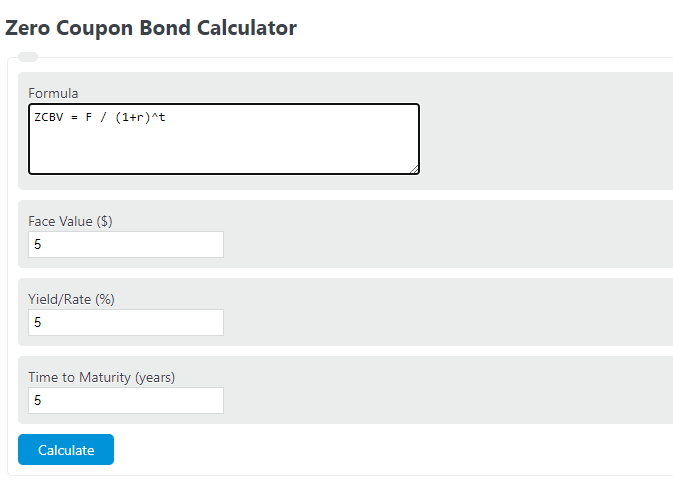
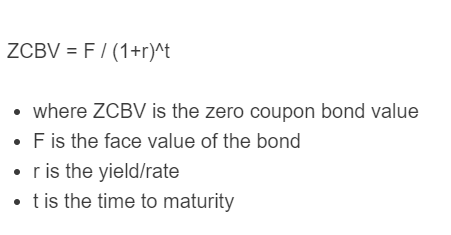
Zero Coupon Bond Formula
A zero-coupon bond is priced by discounting its face value back to the present using the required yield and the remaining time to maturity. Because there are no periodic coupon payments, the entire return comes from the difference between the purchase price and the amount received at maturity.
- ZCBV = current zero-coupon bond value or price
- F = face value (par value)
- r = annual yield as a decimal
- t = time to maturity in years
If the calculator asks for yield as a percent, enter the percentage there, but remember that the formula itself uses the decimal form of the rate.
Rearranged Forms
If you know any three variables, you can solve for the fourth using these equivalent equations:
How to Use the Calculator
- Enter the bond's face value.
- Enter the required yield or rate.
- Enter the time to maturity in years.
- Calculate the missing value to find the bond price, yield, maturity, or face value.
The result tells you what the zero-coupon bond is worth today based on the time remaining and the return investors require.
Example
Assume a bond has a face value of $1,000, a 5% annual yield, and 10 years until maturity.
The bond's present value is $613.91. The investor's gain at maturity comes from the discount between the purchase price and the face value.
What Affects Zero Coupon Bond Value?
- Yield: A higher required yield reduces the current bond price.
- Time to maturity: More years until maturity usually lowers the present value because the discounting period is longer.
- Face value: A larger maturity value increases the bond's current value.
- Market conditions: Changes in interest rates and perceived credit risk affect the yield investors demand.
How to Interpret the Result
- If the calculated price is much lower than face value, the bond has a long maturity, a high yield, or both.
- If market yields rise after purchase, the bond's market price typically falls.
- If market yields fall, the bond's market price typically rises.
- Zero-coupon bonds tend to be more interest-rate sensitive than comparable coupon-paying bonds because all cash flow arrives at the end.
General Form with Multiple Compounding Periods
If the quoted yield compounds more than once per year, a more general version of the pricing formula is:
- m = number of compounding periods per year
This is useful when yields are quoted on a semiannual, quarterly, or monthly basis rather than as a simple annual effective rate.
Common Uses of a Zero Coupon Bond Calculator
- Estimating the fair price of a bond that pays no coupons
- Finding the yield implied by a market price
- Comparing different maturities and discount rates
- Projecting the maturity value from a present investment amount
- Evaluating long-term savings or liability-matching strategies
FAQ
What is a zero-coupon bond?
A zero-coupon bond is a bond that does not make periodic interest payments. Instead, it is purchased at a discount and pays its full face value at maturity.
Why is the price always below face value?
Because the maturity payment is discounted back to today. The farther away the maturity date or the higher the yield, the lower the current price.
Can this calculator solve for yield?
Yes. If you know the face value, current bond value, and time to maturity, you can solve for the annual yield.
What does maturity mean in this formula?
Maturity is the amount of time remaining until the bond pays its face value. It is usually expressed in years.
Is face value the same as market value?
No. Face value is the amount received at maturity, while market value is the bond's present price today.