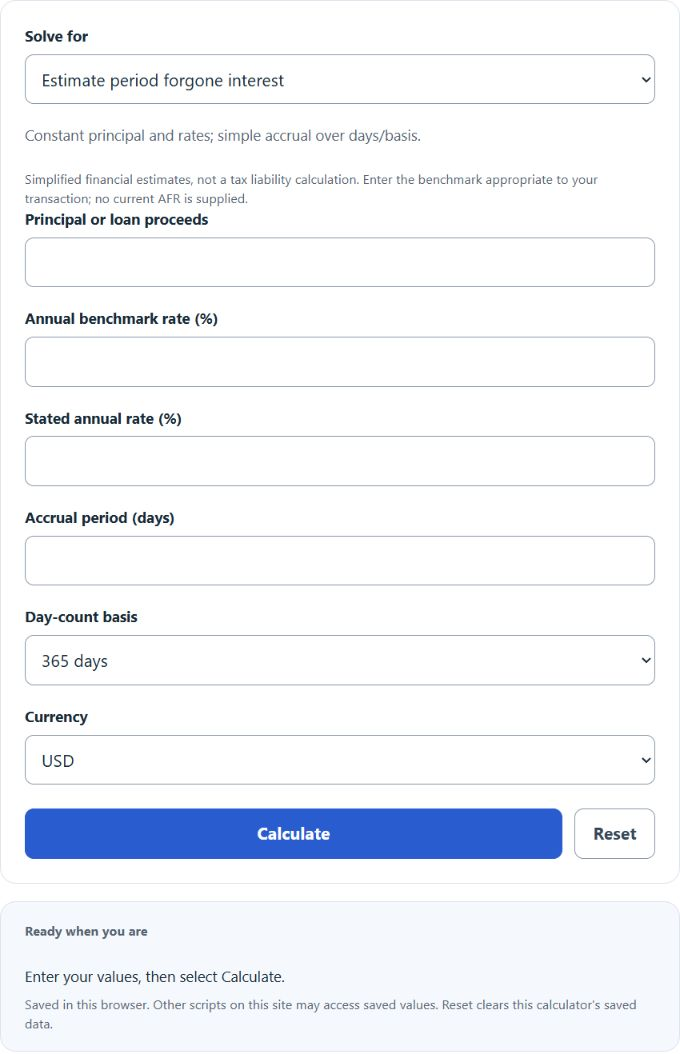
Estimate forgone interest on a below-market loan, a term-loan present-value discount, or the annual rate implied by a balloon repayment.
- All Personal Finance Calculators
- Capitalized Interest Calculator
- Cash Advance Interest Calculator
- Effective Interest Rate Calculator
- Zero Coupon Bond Calculator
- Reverse Interest Calculator
- Money Factor to Interest Rate Calculator
- Daily Interest Calculator
Imputed Interest Formula
The simple period estimate below measures forgone interest under constant principal and rates. Term present value and implied compound rate use different formulas; none alone establishes a tax reporting amount.
- Where I is estimated forgone interest in the selected currency
- P is the constant principal in that currency
- benchmark% and stated% are entered annual rates; no current AFR is supplied
- days/basis is the selected simple-accrual year fraction
For one maturity payment B at time T, PV = B/(1 + r/m)^(mT) and initial discount = max(0, proceeds − PV). Here r is a nominal annual decimal rate and m is compounding periods/year. The effective annual economic rate from one advance P and repayment B is (B/P)^(1/T) −1.
Imputed Interest Definition
U.S. below-market loan rules can treat forgone interest or a present-value discount as transfers and interest even when the contract charges less. Demand/gift and other term loans have different rules. This calculator supplies simplified financial estimates; it does not apply statutory exceptions, changing AFRs, payment schedules, OID allocation or tax reporting rules. See IRS Publication550, Below-Market Loans and 26 U.S.C.7872. Section7872 generally specifies semiannual AFR compounding; use the rate and convention applicable to the transaction.
Example Problem
How to calculate imputed interest?
The first step to calculating an imputed interest amount is to determine the principal balance of the loan or bond.
For this simplified example, the constant principal is $500,000.00 and the stated rate is0%.
Choose an annual benchmark rate appropriate to the purpose of the estimate.
In this hypothetical example, the benchmark rate is4%; this is not a current AFR quote.
Select the actual accrual period and day-count basis. This simple example uses1460days and a365-day basis.
The selected year fraction is1460/365 =4.
Finally, estimate the interest excess using I = max(0, P × (benchmark% − stated%)/100 × days/basis).
I = 500,000*(4/100)*4 = $80,000.00.