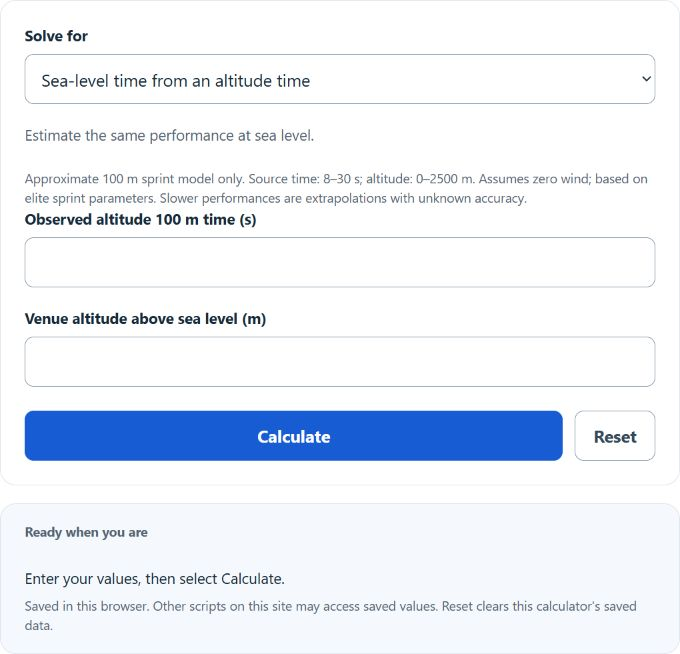
Estimate a sea-level 100 m equivalent from venue altitude, or estimate an altitude performance from a sea-level time, using a disclosed sprint model.
100m Altitude-Adjusted Time Formula or Method
The Mureika altitude factor represents reduced aerodynamic drag for the 100 m. It is separate from endurance altitude models, where oxygen availability changes the relationship.
How the Calculation Works
Only the source time and altitude for the selected calculation are shown. Switching modes preserves the values for switching back.
How to Use This Calculator
- Select the result you want in the Solve for menu.
- Enter only the visible source values and their explicit units.
- Select Calculate and review the primary answer, supporting values, and substituted steps.
- Use Reset before starting a different performance or scenario.
Worked Example
An observed 10.00 s at 1000 m gives a sea-level estimate of about 10.0317 s, displayed as 10.03 s.
Input and Result Guide
| Item | How to use it |
|---|---|
| Altitude | Venue elevation above sea level in metres. |
| 0 m | The model factor is exactly 1. |
| 1000 m | A 10.00 s altitude mark converts to about 10.03 s at sea level. |
| Reverse mode | Divides a sea-level time by the same altitude factor. |
| Scope | 100 m sprint only; 0–2500 m is this tool’s altitude input range. |
Interpreting the Result
Keep timing method, event distance, units, venue conditions, and scoring rules consistent when comparing results.
Assumptions and Limitations
This altitude-only aerodynamic estimate assumes zero wind and elite 100 m sprint parameters. Slower performances are extrapolations with unknown accuracy. The 8–30 s input range is a tool limit, not a validated accuracy range. Do not apply it to endurance running, negative elevations, venues above 2500 m, or official ranking and record decisions.
Common Questions
Why did an input disappear when I changed Solve for?
The hidden field is the requested output. Enter the remaining visible values and the calculator will solve for that target.
Will my last successful calculation be restored?
Yes. After a successful calculation, the calculator saves the source inputs in this browser and recomputes the restored result. Reset clears this calculator’s saved state.
Sources
Mureika, back-of-envelope wind and altitude correction, Equation (13), with wind set to zero. The later 2001 paper uses rounded coefficients.