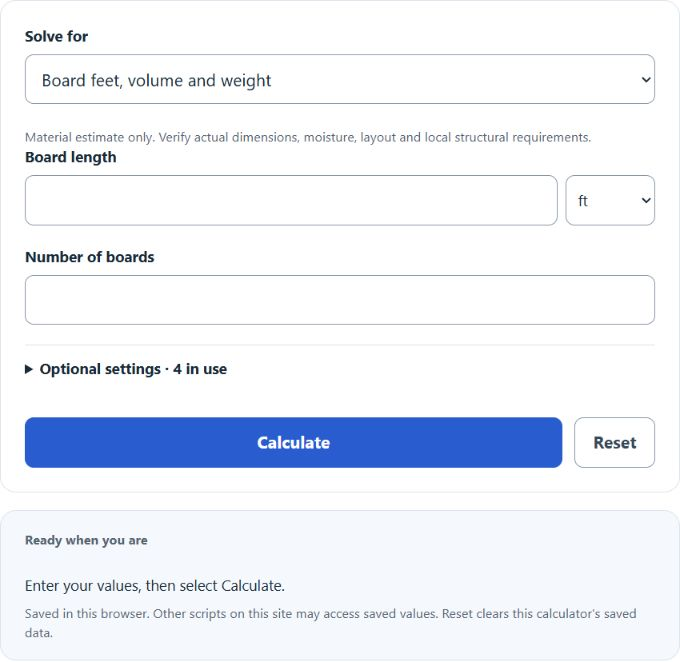
Calculate board feet, volume, weight, area coverage, and wall stud counts for 2×6 lumber boards in any unit.
2×6 Formula
This calculator works in three modes. Each mode uses its own formula.
Board feet, volume, and weight of 2×6 boards:
BF = (T * W * L) / 12
Weight = (1.5 * 5.5 / 144) * L * Density
Boards needed to cover an area:
N = ceil( A * (1 + Waste) / ((Wb + G) * Lb) )
Studs in a 2×6 wall:
Studs = ceil(Lw / S) + 1
- BF = board feet of one board
- T = thickness in inches (2 on a nominal basis, 1.5 on an actual basis)
- W = width in inches (6 nominal, 5.5 actual)
- L = length of one board in feet
- Density = lumber density (about 28 to 36 lb per cubic foot for common softwoods)
- N = number of 2×6 boards needed
- A = area to cover in square feet
- Waste = overage allowance as a decimal (0.10 for 10 percent)
- Wb = actual board width in feet (5.5 in = 0.4583 ft)
- G = gap between boards in feet
- Lb = length of each board you buy, in feet
- Lw = wall length
- S = stud spacing on center
In the board feet mode you enter a board length and a quantity. On a nominal basis a 2×6 gives 1 board foot per foot of length, which is the number most lumber yards price against. Switch to the actual basis (1.5 by 5.5 inches) when you want the true milled volume for weight. Weight comes from the actual cross section times the length times the density you set.
In the coverage mode you enter the surface area, or a length and width, and the board length you plan to buy. The calculator applies the waste percentage to the area requirement before rounding the board count up once. The gap increases the effective coverage width. This is an area estimate, not a cut layout; board direction, seams, edge gaps and offcut reuse may change the quantity.
In the wall mode you enter the wall length and stud spacing. The count is the spaced studs plus one for the final end stud. Plates (one bottom and a double top) are added separately as linear footage when that option is on.
2×6 Lumber Reference Values
These values cover the dimensions, board feet, and approximate weight you will use most often with 2×6 stock. Weight assumes kiln-dried softwood near 30 lb per cubic foot and varies with species and moisture.
| Length | Board feet (nominal) | Board feet (actual) | Approx. weight |
|---|---|---|---|
| 8 ft | 8.0 | 5.5 | 13.8 lb |
| 10 ft | 10.0 | 6.9 | 17.2 lb |
| 12 ft | 12.0 | 8.3 | 20.6 lb |
| 16 ft | 16.0 | 11.0 | 27.5 lb |
Stud counts for a single 2×6 wall at common spacings, before plates and openings:
| Wall length | 16 in OC | 24 in OC |
|---|---|---|
| 8 ft | 7 | 5 |
| 12 ft | 10 | 7 |
| 16 ft | 13 | 9 |
Example Problems
Example 1. You buy six 2×6 boards that are 10 feet long and want the board feet on a nominal basis. Using BF = (2 * 6 * 10) / 12 = 10 board feet per board, six boards give 60 board feet. On the actual basis each board is (1.5 * 5.5 * 10) / 12 = 6.875 board feet, or about 41.25 board feet for all six.
Example 2. You are decking a surface that is 10 by 12 feet, which is 120 square feet, using 12 foot 2×6 boards laid tight. One board covers 0.4583 ft times 12 ft = 5.5 square feet. So N = ceil(120 / 5.5) = 22 boards. Applying 10 percent waste before the final rounding gives ceil(120 * 1.10 / 5.5) = 24 boards.
Frequently Asked Questions
How many board feet is a 2×6? On the nominal basis used for pricing, a 2×6 is exactly 1 board foot per foot of length, so an 8-foot board is 8 board feet. The true milled size (1.5 by 5.5 inches) gives 0.6875 board feet per foot, which is what you use for actual volume and weight.
What is the actual size of a 2×6? A 2×6 measures 1.5 inches by 5.5 inches after it is dried and planed. The 2 by 6 label is the nominal size before milling. Use the actual size for spacing, coverage, and weight, and the nominal size for board-foot pricing.
How many 2×6 studs do I need for a wall? Divide the wall length in inches by the spacing (16 or 24 inches on center), round up, and add one for the end stud. A 12-foot wall at 16 inch spacing needs 10 studs before you add corners, openings, and plates.