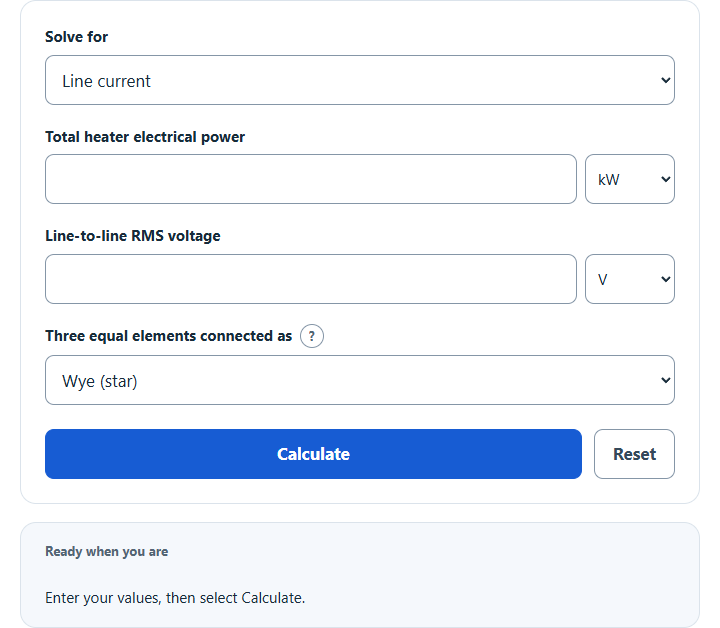
Calculate 3 phase heater amps from kW and line voltage, or find total power or voltage, with element voltage, current and resistance for wye or delta.
Related Calculators
- Amp Drop Calculator
- Amp Calculator
- Ground Resistance Calculator
- Insulation Surface Temperature Calculator
- Heat Rejection Calculator
- All Construction Calculators
Calculator Functions
| Function | What it does | What it requires |
|---|---|---|
| Line current | Finds the amps each supply line carries to a three-phase heater | Requires total heater power, line-to-line voltage and the wye or delta connection |
| Total heater power | Finds the total kW a heater draws from a measured line current | Requires line-to-line voltage, line current and the wye or delta connection |
| Line-to-line voltage | Finds the supply voltage that matches a heater’s power and line current | Requires total heater power, line current and the wye or delta connection |
Power goes in as kW or W, voltage as V or kV and current as A or mA, with preset voltages from 208 V to 600 V. The connection does not change the line current, power or voltage answer. It sets the extra results listed for each of the three equal elements: voltage, current, resistance and power per element.
3 Phase Heater Amps Formulas
| I | RMS current in each line conductor (A) |
| P | Total electrical power of all three elements (W). Multiply kW by 1,000 |
| V | Line-to-line RMS voltage (V) |
| √3 | About 1.732, the ratio of line-to-line voltage to line-to-neutral voltage in a balanced three-phase supply |
For a balanced delta or wye heating load, line amperage is the total circuit wattage divided by the line voltage times 1.73 [1]. A resistance heater has a power factor of 1, so no power factor term appears.
Line current
The main formula applies directly. A 15 kW heater on a 400 V supply draws 15,000 ÷ (1.732 × 400) = 21.65 A per line. The table gives the line current for common heater sizes and supply voltages.
| Heater | 208 V | 240 V | 400 V | 480 V |
|---|---|---|---|---|
| 3 kW | 8.3 A | 7.2 A | 4.3 A | 3.6 A |
| 5 kW | 13.9 A | 12.0 A | 7.2 A | 6.0 A |
| 7.5 kW | 20.8 A | 18.0 A | 10.8 A | 9.0 A |
| 9 kW | 25.0 A | 21.7 A | 13.0 A | 10.8 A |
| 10 kW | 27.8 A | 24.1 A | 14.4 A | 12.0 A |
| 12 kW | 33.3 A | 28.9 A | 17.3 A | 14.4 A |
| 15 kW | 41.6 A | 36.1 A | 21.7 A | 18.0 A |
| 20 kW | 55.5 A | 48.1 A | 28.9 A | 24.1 A |
| 30 kW | 83.3 A | 72.2 A | 43.3 A | 36.1 A |
| 50 kW | 138.8 A | 120.3 A | 72.2 A | 60.1 A |
| 60 kW | 166.5 A | 144.3 A | 86.6 A | 72.2 A |
| 100 kW | 277.6 A | 240.6 A | 144.3 A | 120.3 A |
Total heater power
A heater that draws 36.1 A per line at 480 V is using 1.732 × 480 × 36.1 = 30,013 W, or about 30 kW.
Line-to-line voltage
A 30 kW heater drawing 36.08 A per line is on a supply of 30,000 ÷ (1.732 × 36.08) = 480 V.
Wye and delta element values
Ve and Ie are the voltage across and the current through one element. In a wye connection each element sees the line voltage divided by √3 and carries the full line current. In a delta connection each element sees the full line voltage and carries the line current divided by √3 [1]. For the 15 kW, 400 V heater, a wye element runs at 230.9 V and 21.65 A and needs 10.67 Ω, while a delta element runs at 400 V and 12.5 A and needs 32 Ω. Each element supplies one third of the power, 5 kW.
Limits of This Estimate
- The formulas assume three equal resistive elements on a balanced supply at a power factor of 1. A failed element, an open phase, unequal elements or switching controls change the line currents.
- A heater’s kW rating holds only at its rated voltage. On a different voltage the same elements draw power in proportion to the voltage squared, so the rated kW should not be entered with another voltage.
- The connection setting gives the element values for the power entered. It does not model rewiring: the same three elements moved from wye to delta on the same supply draw three times the power.
- The result is the load current only. It does not size conductors, breakers, fuses or contactors, which follow the electrical code that applies to the installation.
Sources
- Chromalox, Technical Information, Three Phase Equations (Balanced) and Wiring Practices for Electric Heaters: three-phase line amperage from wattage and line voltage, total watts, and the delta and wye element voltage and current relations