How do I use this calculator?
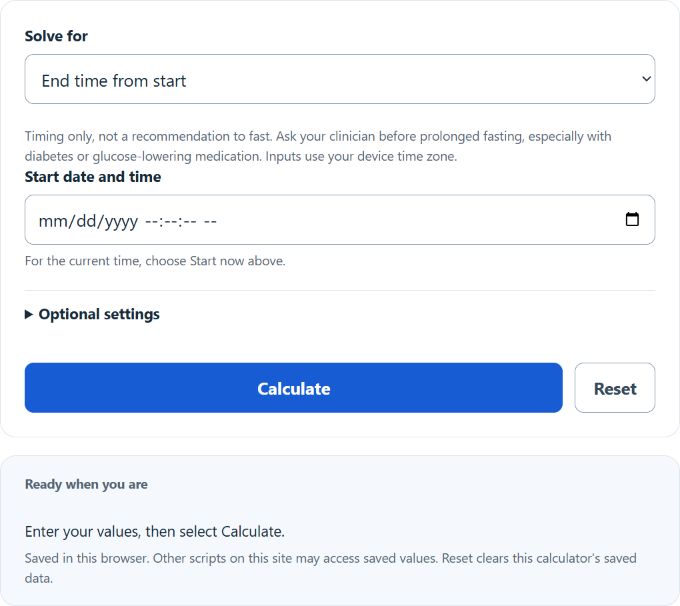
The basic portion of this calculator allows you to calculate the end time of a 36-hour fast or the start time based on the end time.
Calculator Operations:
- Enter the start time of your fast to calculate the end time (which will be 36 hours later).
- Enter the end time of your fast to calculate the start time (which will be 36 hours earlier).
- Choose the solve mode first and complete its visible date-time fields. Start now uses the actual device clock; a blank progress check-in also uses the current device time.
The calculator uses a fixed 36-hour window and lists 12-, 18-, 24-, and 36-hour calendar checkpoints. Progress is measured at the entered check-in time. The optional schedule label is display-only and does not convert time zones.
Use the calculate button when all known values have been entered and use the reset button when you want to clear the values from the calculator.
Calculate a 36-hour window’s exact start or end time, check elapsed and remaining time, and map 12-, 18-, 24-, and 36-hour calendar milestones.
Related Calculators
- BMR Calculator
- AMR (Active Metabolic Rate) Calculator
- Carbs Calculator (Carbohydrates per Day)
- Hours Of Sleep Calculator
- All Health and Medical Calculators
Calculator Functions
| Function | What it does | What it requires |
|---|---|---|
| End time from start | Finds when a 36-hour fast ends | Requires the start date and time |
| Start now — find end time | Finds the end time for a fast that starts at the current minute | Requires no entry |
| Start time from end | Finds when a fast must start to end at a chosen time | Requires the planned end date and time |
| Progress at check-in | Finds the share of the 36 hours completed at a check-in time | Requires the start date and time; a blank check-in uses the current time |
Every function accepts an optional schedule label of up to 100 characters. Results are shown in the time zone of the device and list the clock times 12, 18, 24 and 36 hours after the start.
36-Hour Fast Formula
| End | Date and time the 36 hours are complete |
| Start | Date and time of the last meal |
End time from start
36 hours is one and a half days. A fast that starts at 8:00 AM on a Friday ends at 8:00 PM on Saturday, and one that starts at 8:00 PM on a Friday ends at 8:00 AM on Sunday.
Start now — find end time
The start is the current time on the device, rounded down to the minute, and the end is 36 hours later.
Start time from end
To finish at 8:00 PM on a Saturday, the fast starts at 8:00 AM on the Friday before.
Progress at check-in
36 × 100
Elapsed is the time from the start to the check-in, in hours. A check-in 18 hours after the start is 50% complete, and one at 30 hours is 83.33%. The percentage is shown between 0% and 100%, with the elapsed time, the time left and the next of the four listed clock times.
Limits of This Estimate
- The calculator works out times only. The 12-, 18-, 24- and 36-hour marks are points on the clock and do not show ketosis, a health benefit or that a fast is safe.
- The U.S. National Institute on Aging says there is not enough evidence to recommend any fasting regimen to the public, and that researchers do not yet know whether these eating patterns are safe over the long run (page dated August 14, 2018) [1].
- For people with diabetes who take insulin or certain other diabetes medicines, skipping or delaying meals, or continuing those medicines while fasting, can cause low blood glucose, with symptoms such as shakiness, dizziness, confusion and, when severe, loss of consciousness (page reviewed July 2021) [2]. Ask a clinician before a prolonged fast.
- The 36 hours are counted as elapsed time, so the clock time of the end shifts by an hour when a daylight-saving change falls inside the fast. A local time skipped by a clock change is rejected.
Sources
- National Institute on Aging, Calorie restriction and fasting diets: What do we know?: state of the evidence on fasting
- National Institute of Diabetes and Digestive and Kidney Diseases, Low Blood Glucose (Hypoglycemia): low blood glucose from skipped meals and fasting with diabetes medicines