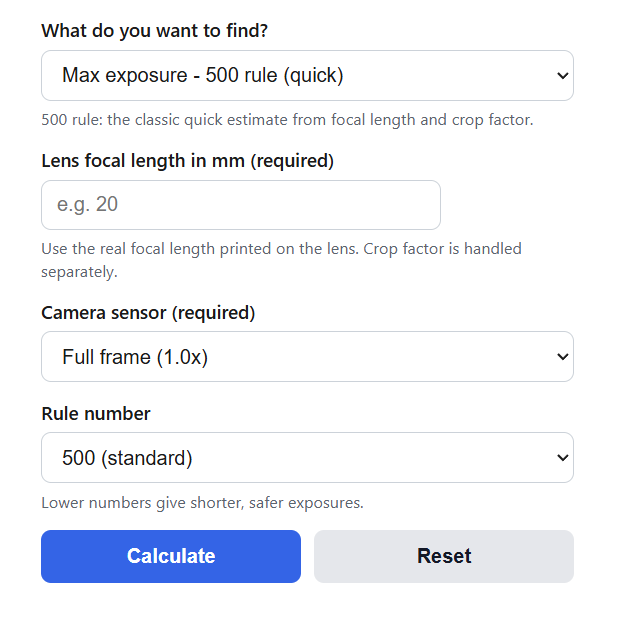
Calculate the longest shutter speed before stars trail using the 500 rule, the NPF rule, and a pixel-level star trail check for your camera and lens.
- All Physics Calculators
- Exposure Time Calculator
- Hyperfocal Distance Calculator
- Exposure Value Calculator
500 Rule Astrophotography Exposure Formula
t = R / (CF * FL)
- t is the maximum exposure time in seconds before stars visibly trail
- R is the rule number (500 standard, 400 or 300 for stricter results, 200 for very high resolution sensors)
- CF is the crop factor of your camera (1.0 full frame, 1.5 APS-C Nikon/Sony/Fuji, 1.6 APS-C Canon, 2.0 Micro Four Thirds)
- FL is the real focal length of your lens in millimeters
The NPF mode of the calculator uses a more accurate formula that accounts for your aperture and the physical size of the pixels on your sensor:
t = K * (35*N + 30*p) / (FL * cos(D))
- N is the aperture f-number (for example 2.8)
- p is the pixel pitch in microns, equal to 1000 times the sensor width in mm divided by the horizontal pixel count
- D is the declination of the target in degrees (0 at the celestial equator, where stars move fastest across the frame)
- K is the sharpness standard (1 for pinpoint stars, 2 for a relaxed limit suited to web sizes)
The star trail check mode inverts the problem. Instead of asking how long you can expose, it takes the shutter speed you plan to use and reports how far the stars will smear across the sensor:
Trail (px) = 15.041 * t * cos(D) * FL / (206.265 * p)
The constant 15.041 is the sidereal drift rate of the sky in arcseconds per second, and 206.265 * p / FL is the image scale of your setup in arcseconds per pixel. A trail of 1 pixel or less is pinpoint. Up to about 3 pixels the motion stays hidden inside the blur disk of the star itself, which is why the NPF rule allows roughly 3 pixels of drift. Beyond about 6 pixels the trailing is obvious at normal viewing sizes.
Pixel Pitch and Declination Reference
The 500 rule was written for film and low resolution sensors, so on modern cameras it overshoots badly. The table below shows the pixel pitch of popular cameras and compares the strict NPF limit against the 500 rule for a 20mm lens at f/2.8. Use the pixel pitch column directly in the calculator if you prefer to enter it by hand.
| Camera | Sensor | MP | Pixel pitch | NPF max (20mm f/2.8) | 500 rule (20mm) |
|---|---|---|---|---|---|
| Sony a7 III | Full frame | 24 | 6.0 µm | 13.9 s | 25 s |
| Sony a7 IV | Full frame | 33 | 5.1 µm | 12.6 s | 25 s |
| Canon R5 | Full frame | 45 | 4.4 µm | 11.5 s | 25 s |
| Nikon Z8 | Full frame | 45.7 | 4.3 µm | 11.4 s | 25 s |
| Sony a7R V | Full frame | 61 | 3.8 µm | 10.6 s | 25 s |
| Sony a6700 | APS-C | 26 | 3.8 µm | 10.6 s | 16.7 s |
| Fujifilm X-T5 | APS-C | 40.2 | 3.0 µm | 9.4 s | 16.7 s |
| Canon R7 | APS-C Canon | 32.5 | 3.2 µm | 9.7 s | 15.6 s |
| OM System OM-1 | Micro 4/3 | 20.4 | 3.3 µm | 9.9 s | 12.5 s |
Notice that every camera in the table hits its NPF limit well before the 500 rule time runs out. That gap is the reason images that follow the 500 rule often still show short trails when viewed at full size.
Star speed across your frame also depends on where you point the camera. Stars near the celestial equator move fastest, while stars near Polaris barely move. The multipliers below show how much longer you can expose compared with the equator limit. Enter the declination in the calculator’s advanced options, using the lowest declination visible in your frame if you shoot wide.
| Target | Approx. declination | Exposure multiplier |
|---|---|---|
| Celestial equator (Orion’s Belt) | 0° | 1.00x |
| Milky Way core (Sagittarius) | 29° | 1.14x |
| Andromeda Galaxy (M31) | 41° | 1.33x |
| Cassiopeia (Schedar) | 56° | 1.79x |
| Big Dipper (Dubhe) | 62° | 2.13x |
| Polaris | 89° | 57x |
Example Problems
Example 1. You shoot a 20mm lens on an APS-C body with a 1.5x crop factor and want the classic 500 rule answer. The effective focal length is 20 * 1.5 = 30mm, so t = 500 / 30 = 16.7 seconds. The nearest standard camera setting below that limit is 15 seconds.
Example 2. You shoot the Milky Way core with a 20mm f/1.8 lens on a 33 MP full frame camera. The pixel pitch works out to 5.12 microns. At the celestial equator the strict NPF limit is (35 * 1.8 + 30 * 5.12) / 20 = 216.6 / 20 = 10.8 seconds. The core sits at a declination of about 29 degrees, so dividing by cos(29) stretches the limit to about 12.4 seconds. For comparison, the 500 rule would have suggested 25 seconds. Running 25 seconds through the star trail check shows roughly 6 pixels of drift, which is obvious trailing.
Frequently Asked Questions
Why do stars still trail when I follow the 500 rule?
The 500 rule predates digital sensors with very small pixels. It was tuned for a time when 6 to 12 MP was normal, so its limits let star motion smear across many pixels on a modern 33 to 61 MP sensor. As the reference table above shows, the accurate NPF limit is often only half the 500 rule time. If your stars are trailing, switch the calculator to NPF mode, or run your current shutter speed through the star trail check to see exactly how many pixels of drift you are accepting.
What declination should I enter if I do not know it?
Leave the field blank or enter 0. That assumes your target sits on the celestial equator, where stars move fastest, so the result is the safest possible limit. If you know your target, use the reference table above or a planetarium app to find its declination and gain extra exposure time. With a wide angle lens the frame spans a large range of declinations, so use the value closest to 0 that appears anywhere in your composition, not the value at the center.
Do these limits apply with a star tracker or when stacking?
A star tracker rotates the camera with the sky, which cancels the drift these formulas measure, so tracked exposures are limited by tracking accuracy and sky conditions instead. Without a tracker, the standard workaround is stacking: expose each frame at the NPF limit, take 10 to 30 identical frames, and combine them in stacking software. Stacking reduces noise as if you had exposed longer, while each individual frame stays within the trail-free limit these formulas set.