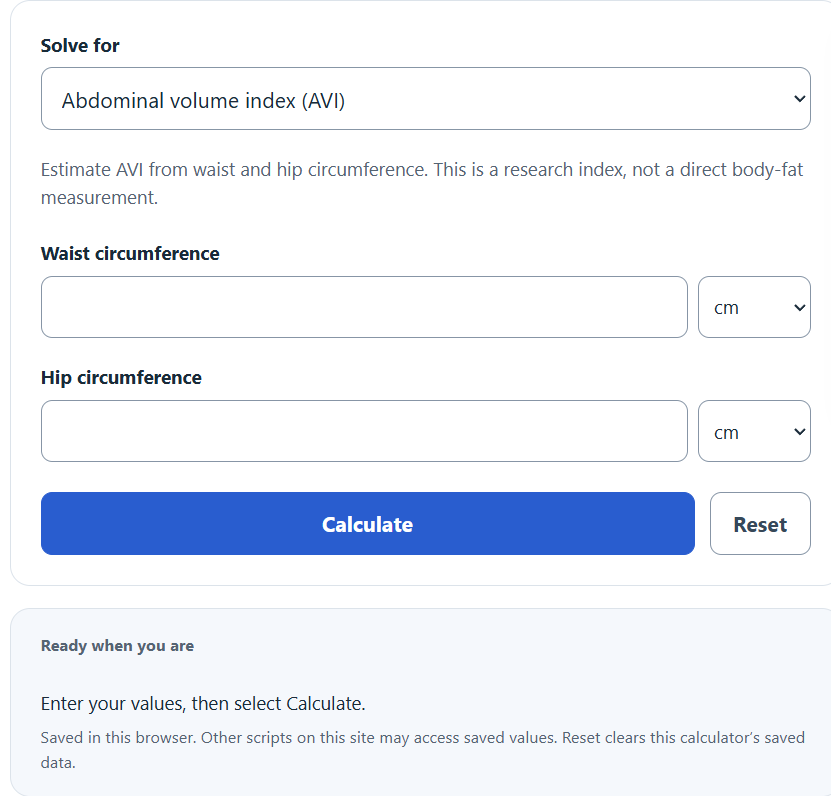
Calculate abdominal volume index and waist-to-height ratio from waist, hip, and height measurements in cm, inches, or mixed units.
Related Calculators
- Abdominal Circumference Percentile Calculator
- Weight Loss Percentage Calculator
- Maintenance Calories Calculator
- Minimum Calories Calculator
- All Health and Medical Calculators
Calculator Functions
| Function | What it does | What it requires |
|---|---|---|
| Abdominal volume index (AVI) | Finds the abdominal volume index, an estimate of abdominal volume in liters | Requires waist circumference and hip circumference |
| Waist-to-height ratio | Finds waist circumference as a share of height and names the adult reference band it falls in | Requires waist circumference and height |
| Waist from height and ratio | Finds the waist circumference that matches a waist-to-height ratio | Requires height and the ratio |
| Height from waist and ratio | Finds the height that matches a waist-to-height ratio | Requires waist circumference and the ratio |
Waist, hip and height can be entered in centimeters or inches, and the formulas work in centimeters. A waist-to-height ratio can be entered as a decimal such as 0.5 or as a percentage such as 50.
Abdominal Volume Index Formulas
(W − H)²) ÷ 1,000 [1]
| AVI | Abdominal volume index (liters) |
| W | Waist circumference (cm) |
| H | Hip circumference (cm) |
Abdominal volume index (AVI)
The index was built from the volume formulas for a cylinder and a cone, and it estimates the overall volume of the abdomen between the pubic bone and the lower end of the breastbone [1]. A waist of 80 cm and hips of 95 cm give (2 × 6,400 + 0.7 × 225) ÷ 1,000 = 12.96. The study that introduced the index measured 746 adults in Durango, Mexico, and found 24.5 liters to be the value that best separated people with obesity in that group [1]. That figure comes from one population and is not a diagnostic threshold.
Waist-to-height ratio
Waist-to-height ratio is a separate measure from AVI. A waist of 80 cm at a height of 170 cm gives 0.4706, or 47.1% of height. The result is placed in one of the bands used in UK guidance for adults with a BMI below 35: 0.4 to 0.49 is healthy central adiposity, 0.5 to 0.59 is increased central adiposity and 0.6 or more is high central adiposity [2]. These are the bands in NICE guideline NG246 as of November 2026. A ratio under 0.4 is below all three.
Waist from height and ratio
At a height of 170 cm, a ratio of 0.5 corresponds to a waist of 85 cm, or 33.5 in. This is the waist at which the increased band begins for that height.
Height from waist and ratio
A waist of 85 cm and a ratio of 0.5 correspond to a height of 170 cm.
Limits of This Estimate
- This calculator provides educational, screening-style estimates and does not diagnose any condition. Anyone with symptoms or concerns should discuss results with a qualified clinician.
- Cutoffs can vary by age, sex, ethnicity and health status, and may not apply to children or during pregnancy.
- AVI is a research index of abdominal size. It does not measure body-fat percentage, and it has no agreed cutoff beyond the single study that proposed it [1].
- The waist-to-height bands are screening references for adults with a BMI below 35 [2]. They are not cutoffs for AVI.
Sources
- Guerrero-Romero and Rodríguez-Morán, Abdominal volume index, Archives of Medical Research, 2003: the AVI formula, what it estimates and the 24.5 liter value in the study group
- National Institute for Health and Care Excellence, Guideline NG246, Identifying and assessing overweight, obesity and central adiposity: waist-to-height ratio bands for adults with a BMI below 35