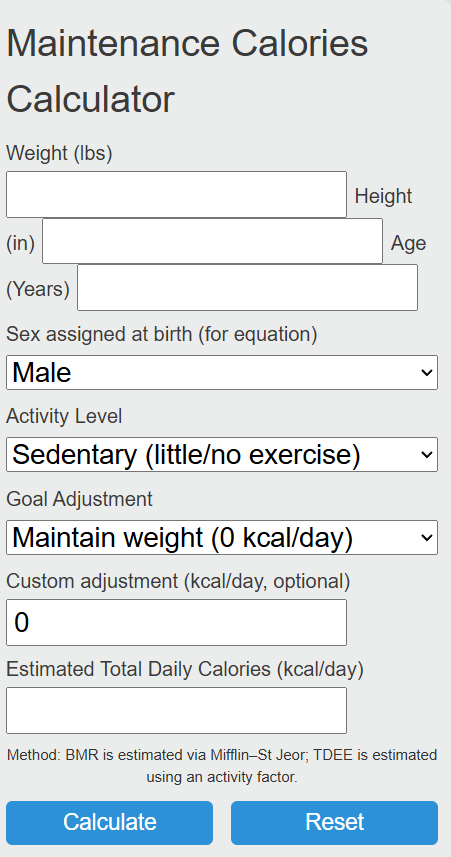
Calculate your maintenance calories and daily calorie target from weight, height, age, sex, activity level, and goal adjustment in kcal/day.
- All Health and Medical Calculators
- Macro Calculator
- Steps to Calories Converter
- Calorie Calculator
- Weight Loss Calculator
Maintenance Calories Formula
The calculator estimates maintenance calories by first finding basal metabolic rate, then multiplying by an activity factor. It uses the Mifflin-St Jeor equation.
- Weightlb = body weight in pounds
- Weightkg = body weight in kilograms
- Heightin = height in inches
- Heightcm = height in centimeters
- Age = age in years
- S = sex constant used by the equation: +5 for male, -161 for female
- BMR = basal metabolic rate, the estimated calories your body uses at rest
- ActivityFactor = multiplier based on your usual activity level
- TDEE = total daily energy expenditure, the estimated calories needed to maintain weight
- GoalAdjustment = selected calorie change for losing, maintaining, or gaining weight
- CustomAdjustment = optional extra calorie change entered by you
- TotalCalories = estimated daily calorie target after all adjustments
- BMI = body mass index, used here for safety checks
The weight and height fields are converted to metric units because the Mifflin-St Jeor equation uses kilograms and centimeters. The sex field changes the constant in the BMR formula. The activity level multiplies BMR to estimate maintenance calories. The goal adjustment and custom adjustment are then added to the maintenance estimate.
If BMI is below 18.5, the calculator blocks calorie-deficit options because weight loss may be unsafe. Very low calorie results can also trigger a warning.
Activity Factors and Calorie Adjustments
Use the activity factor that best matches your normal weekly routine, not just your hardest workout day.
| Activity level | Factor | Typical meaning |
|---|---|---|
| Sedentary | 1.2 | Little or no planned exercise |
| Light | 1.375 | Exercise about 1 to 3 days per week |
| Moderate | 1.55 | Exercise about 3 to 5 days per week |
| Very active | 1.725 | Hard exercise most days |
| Extra active | 1.9 | Very hard training or a physically demanding job |
| Goal option | Daily adjustment | Approximate weekly change |
|---|---|---|
| Maintain weight | 0 kcal/day | No intended change |
| Lose slowly | -250 kcal/day | About 0.5 lb/week |
| Lose faster | -500 kcal/day | About 1 lb/week |
| Gain slowly | +250 kcal/day | About 0.5 lb/week |
| Gain faster | +500 kcal/day | About 1 lb/week |
Example Calculations
Example 1: Maintenance calories
You enter 180 lb, 70 in, age 35, male, and moderate activity.
Convert units:
Estimate BMR:
Apply activity factor:
With no goal or custom adjustment, the result is about 2,725 kcal/day.
Example 2: Weight loss target
You enter 150 lb, 65 in, age 30, female, light activity, and a -250 kcal/day goal adjustment.
Convert units:
Estimate BMR:
Apply activity and goal adjustment:
The result is about 1,677 kcal/day.
FAQ
What are maintenance calories?
Maintenance calories are the estimated calories you need per day to keep your body weight about the same. If you eat near this amount consistently, your weight should stay relatively stable, assuming your activity level stays the same.
Why is this only an estimate?
The formula uses weight, height, age, sex assigned at birth, and activity level. It cannot measure your exact metabolism, muscle mass, medical conditions, medications, or daily movement. Track your body weight for 2 to 4 weeks and adjust if your weight is moving up or down when you expected it to stay stable.
How should you choose a custom adjustment?
Use the custom adjustment when the preset goal does not match your plan. A negative number lowers the calorie target. A positive number raises it. Avoid extreme changes unless you are following medical guidance, especially if the result is very low.