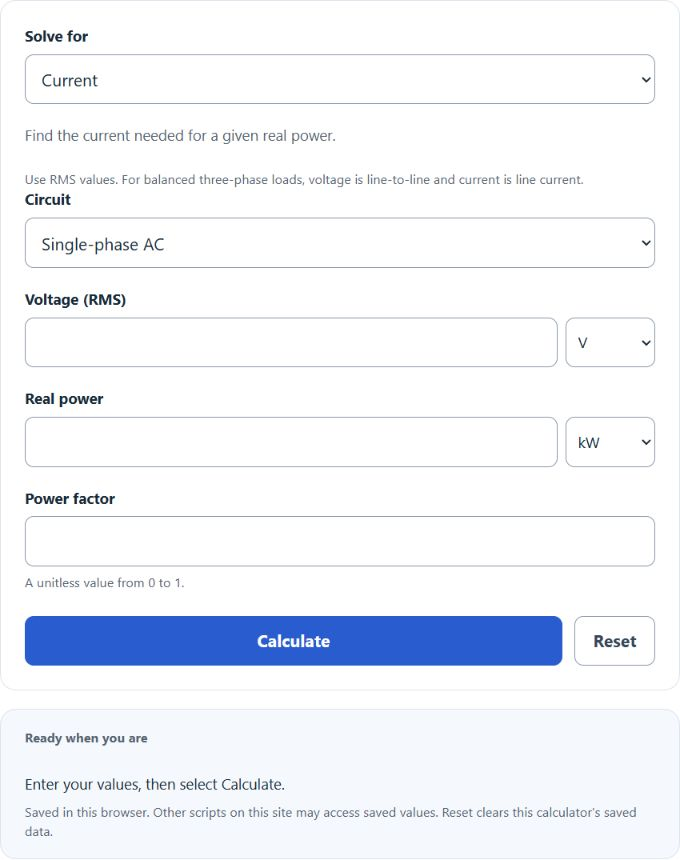
Solve for AC current, voltage, real power, or power factor in single-phase and balanced three-phase RMS circuits, with automatic unit conversions.
- All Physics Calculators
- All Electrical Calculators
- AC to DC Voltage Calculator
- CT Ratio Calculator
- Air Conditioner Current Calculator
- DC Power Calculator
AC Current Formula
The AC current calculator uses RMS voltage and real power. For three-phase circuits, the voltage input is line-to-line RMS voltage.
Single-Phase AC
Three-Phase AC
- I = RMS current, in amps (A)
- P = real power, in watts (W)
- V = RMS voltage, in volts (V). For three-phase, use line-to-line voltage.
- PF = power factor, a unitless value usually between 0 and 1
- sqrt(3) = the three-phase multiplier, approximately 1.732
Select the value to solve for, choose the circuit, and enter the three requested quantities. Input units are converted before calculation. Current is shown in A with mA and kA equivalents, voltage in V with kV, and real power in W with kW and MW. Zero power factor cannot uniquely determine current or voltage.
Common AC Power and Current Relationships
| Circuit type | Real power formula | Current formula | Voltage to enter |
|---|---|---|---|
| Single-phase | P = I × V × PF | I = P ÷ (V × PF) | Line-to-neutral or load voltage |
| Three-phase | P = √3 × I × V × PF | I = P ÷ (√3 × V × PF) | Line-to-line voltage |
Typical Power Factor Values
| Load type | Typical power factor range | Notes |
|---|---|---|
| Resistive heating or incandescent lighting | 0.95 to 1.00 | Current and voltage are nearly in phase. |
| Small motors | 0.60 to 0.85 | Power factor varies with load. |
| Large loaded motors | 0.80 to 0.95 | Usually higher when operating near rated load. |
| Fluorescent or discharge lighting | 0.50 to 0.95 | Depends on ballast or driver design. |
Examples
Example 1: Single-phase current
You have a single-phase load using 2,400 W at 240 V with a power factor of 0.80.
The current is 12.5 A.
Example 2: Three-phase current
You have a three-phase load using 50 kW at 400 V line-to-line with a power factor of 0.90.
The current is approximately 80.19 A.
FAQ
Should you use RMS voltage or peak voltage?
Use RMS voltage. AC power calculations normally use RMS voltage and RMS current because they represent the equivalent heating or power-producing value. Do not enter peak voltage unless you first convert it to RMS.
What voltage should you enter for a three-phase circuit?
Enter the line-to-line RMS voltage for three-phase calculations. The calculator includes the √3 factor, so using line-to-neutral voltage would give the wrong result unless the formula is changed.
Why does a lower power factor increase current?
For the same real power and voltage, a lower power factor means more current is needed to deliver that real power. In the formula I = P ÷ (V × PF), decreasing PF makes the denominator smaller, so the calculated current increases.