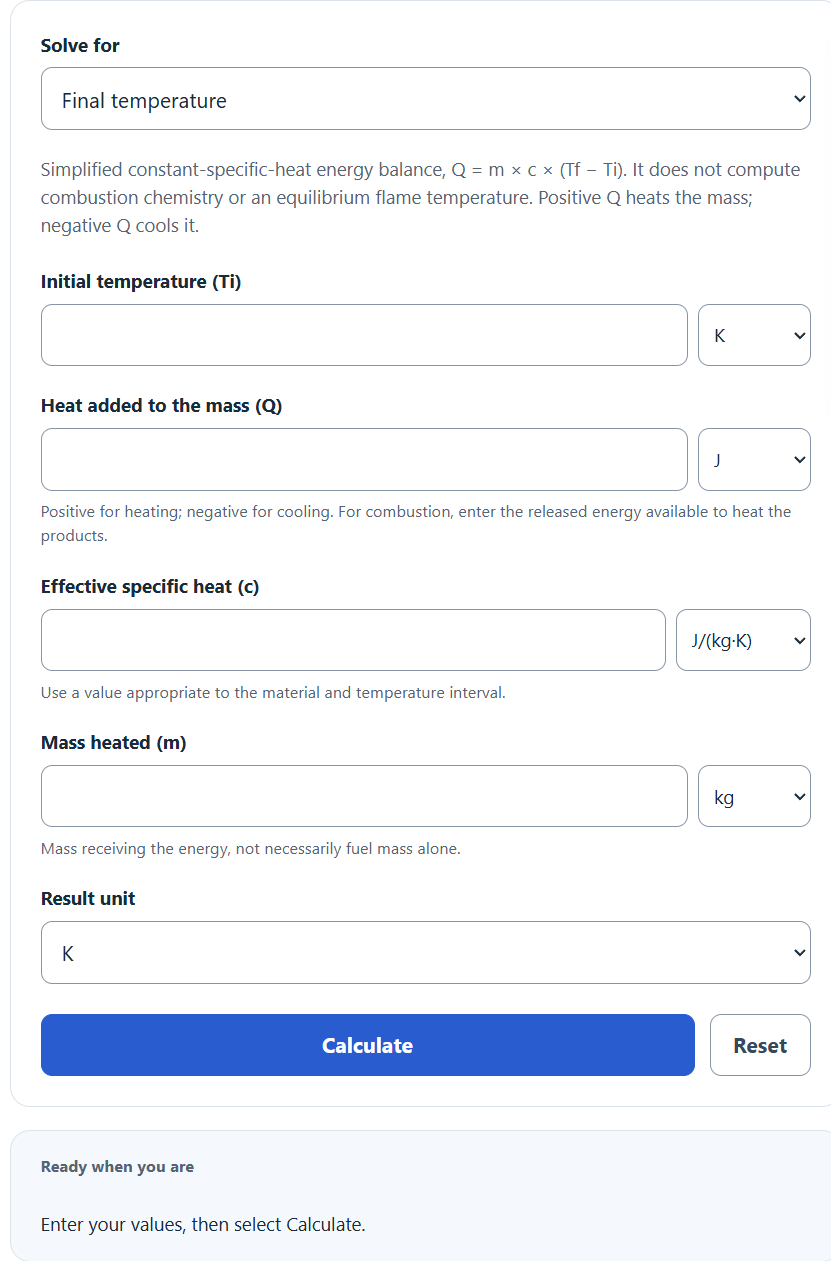
Calculate adiabatic flame temperature, heat added or released, specific heat, mass, or initial temperature from any 4 known values.
- Combustion Air Calculator
- Flame Height Calculator
- All Chemistry Calculators
- Mv To Temperature Calculator
Adiabatic Flame Temperature Formula
This calculator uses a simplified constant-specific-heat energy balance. It assumes the heat added or released goes into raising the temperature of a known mass, with no heat loss to the surroundings.
- Tf = final temperature, often used as the simplified adiabatic flame temperature
- Ti = initial temperature
- Q = heat added or released
- m = mass being heated
- c = effective specific heat capacity
The calculator converts your inputs to SI units before applying the formula: temperature to kelvin, heat to joules, mass to kilograms, and specific heat to J/kg·K. After solving the missing value, it converts the result back to the unit you selected.
- Final temperature: uses Tf = Ti + Q/(m*c).
- Initial temperature: rearranges the formula to solve for Ti.
- Heat added or released: uses the temperature rise and heat capacity to solve for Q.
- Specific heat capacity: solves for the effective c needed to match the temperature change.
- Mass heated: solves for the amount of material heated by the given energy input.
Common Inputs and Unit Conversions
These values can help you check whether your inputs are in a reasonable range for a simplified heat-balance calculation.
| Quantity | Conversion Used | Notes |
|---|---|---|
| Temperature | K = °C + 273.15 | The formula uses temperature differences, but absolute temperature is handled in kelvin. |
| Heat | 1 kJ = 1000 J | Use positive Q for heat added to the mass. |
| Heat | 1 cal = 4.184 J | Small-calorie conversion, not food Calorie. |
| Heat | 1 BTU (IT) ≈ 1055.06 J | Used for English-unit heat inputs. |
| Mass | 1 lb = 0.45359237 kg | The base calculation uses kilograms. |
| Material or Gas | Approximate Specific Heat | Use With Caution |
|---|---|---|
| Air near room temperature | about 1005 J/kg·K | Actual value changes with temperature. |
| Water, liquid | about 4184 J/kg·K | Not a flame gas, but useful for heat-balance checks. |
| Steam near moderate temperature | about 2000 J/kg·K | Varies strongly with temperature and pressure. |
| Combustion products, rough effective value | about 1100 to 1400 J/kg·K | A real adiabatic flame calculation usually needs temperature-dependent properties and equilibrium chemistry. |
Example Section
Example 1: Calculate final temperature
Suppose the initial temperature is 300 K, the heat released is 500,000 J, the effective specific heat is 1200 J/kg·K, and the mass heated is 0.50 kg.
The final temperature is 1133.33 K.
Example 2: Calculate heat released
Suppose the initial temperature is 25 °C, the final temperature is 900 °C, the effective specific heat is 1.2 kJ/kg·K, and the mass heated is 2 kg. The temperature difference is the same in °C and K, so ΔT = 900 – 25 = 875 K.
The heat released is 2,100,000 J, or 2100 kJ.
FAQ Section
Is this the exact adiabatic flame temperature?
No. This is a simplified constant-specific-heat estimate. A full adiabatic flame temperature calculation usually accounts for fuel and oxidizer composition, stoichiometry, product species, dissociation, phase changes, and temperature-dependent heat capacities. This calculator is best for a quick energy-balance estimate.
Should Q be positive or negative?
Use positive Q when heat is added to the mass and the final temperature should be higher than the initial temperature. Use negative Q when heat is removed and the final temperature should be lower. The calculator rejects nonpositive mass or specific heat, temperatures at or below absolute zero, and incompatible signs when solving for mass or specific heat. This constant-specific-heat energy balance is not a chemical-equilibrium flame calculation.
Why does the specific heat need to be “effective”?
In flame calculations, specific heat is not truly constant over a large temperature range. Gases also change composition during combustion. An effective specific heat is an average value chosen to represent the whole temperature interval in the simplified formula.