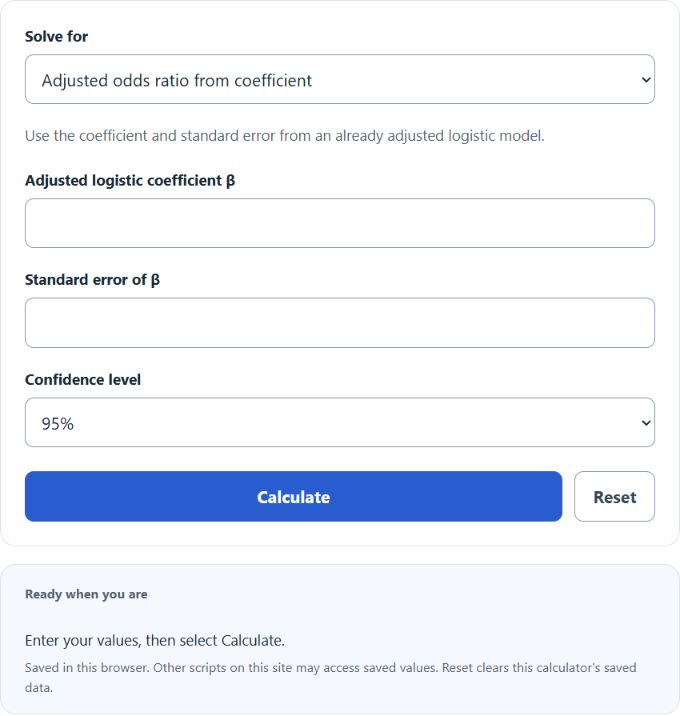
Calculate an adjusted odds ratio and confidence interval from a logistic coefficient or two Mantel-Haenszel strata, with reverse beta and transparent weights.
Related Calculators
- Attributable Risk Percent Calculator
- Bias Percentage Calculator
- Variance Inflation Factor Calculator
- Cohort Study Sample Size Calculator
- All Statistics Calculators
Adjusted Odds Ratio Formula
The adjusted odds ratio depends on the input method. If you have logistic regression output, the calculator exponentiates the regression coefficient. If you have stratified 2×2 tables, it uses the Mantel-Haenszel pooled odds ratio.
From logistic regression coefficient and standard error
- AOR = adjusted odds ratio
- beta = logistic regression coefficient on the log-odds scale
- SE = standard error of the coefficient
- z = critical value for the selected confidence level, such as 1.96 for 95%
- CI = confidence interval for the adjusted odds ratio
- z_stat = Wald test statistic used to estimate the p-value
From stratified 2×2 data using Mantel-Haenszel
- OR_MH = Mantel-Haenszel adjusted odds ratio
- a_i = exposed cases in stratum i
- b_i = exposed non-cases in stratum i
- c_i = unexposed cases in stratum i
- d_i = unexposed non-cases in stratum i
- n_i = total observations in stratum i
- SE_ln = standard error of the log Mantel-Haenszel odds ratio
The From β & SE mode is for logistic regression output. Use it when the model already includes the covariates or confounders you want to adjust for.
The Mantel-Haenszel mode is for stratified count data. It pools the stratum-specific 2×2 tables into one odds ratio adjusted for the stratifying variable.
The Mantel-Haenszel interval uses the Robins–Breslow–Greenland log-variance estimate and the selected confidence-level z value. The default zero-cell convention adds 0.5 to all eight cells if any cell is zero; you can choose no adjustment. Each stratum must contain observations. Odds ratios describe odds, not risks, and do not establish causation. A zero standard error produces a degenerate interval and cannot establish statistical significance.
Confidence Levels and Odds Ratio Interpretation
| Confidence level | Critical value used | Effect on interval width |
|---|---|---|
| 90% | 1.6449 | Narrower interval |
| 95% | 1.9600 | Common default for published results |
| 99% | 2.5758 | Wider interval |
| Adjusted odds ratio result | Typical interpretation |
|---|---|
| AOR = 1 | No difference in odds after adjustment |
| AOR > 1 | Higher adjusted odds in the exposed or comparison group |
| AOR < 1 | Lower adjusted odds in the exposed or comparison group |
| CI includes 1 | Not statistically significant at that confidence level |
| CI does not include 1 | Statistically significant at that confidence level |
Example
Example 1: Adjusted odds ratio from logistic regression output
Suppose a logistic regression model gives:
- beta = 0.693
- SE = 0.250
- Confidence level = 95%
Calculate the adjusted odds ratio:
Calculate the 95% confidence interval:
The adjusted odds ratio is about 2.00. Since the 95% CI does not include 1, the association is statistically significant at the 95% level.
Example 2: Mantel-Haenszel adjusted odds ratio
Suppose you have two strata:
- Stratum 1: a = 30, b = 70, c = 20, d = 80
- Stratum 2: a = 40, b = 60, c = 25, d = 75
For stratum 1, n = 200, so a*d/n = 12.00 and b*c/n = 7.00.
For stratum 2, n = 200, so a*d/n = 15.00 and b*c/n = 7.50.
The Mantel-Haenszel adjusted odds ratio is about 1.86, with a 95% CI of about 1.20 to 2.90.
FAQ
What is an adjusted odds ratio?
An adjusted odds ratio is an odds ratio that accounts for other variables. In logistic regression, this means the coefficient is estimated while other predictors are included in the model. In a stratified analysis, this means the odds ratio is pooled across strata, such as age groups or study sites.
How is an adjusted odds ratio different from an unadjusted odds ratio?
An unadjusted odds ratio compares two groups without controlling for other variables. An adjusted odds ratio attempts to remove the influence of specified confounders. For example, if age is related to both exposure and outcome, adjusting for age can give a more appropriate estimate of the exposure-outcome association.
What does it mean if the confidence interval includes 1?
If the confidence interval includes 1, the result is not statistically significant at that confidence level. An odds ratio of 1 means equal odds, so an interval that crosses 1 includes the possibility of no association.