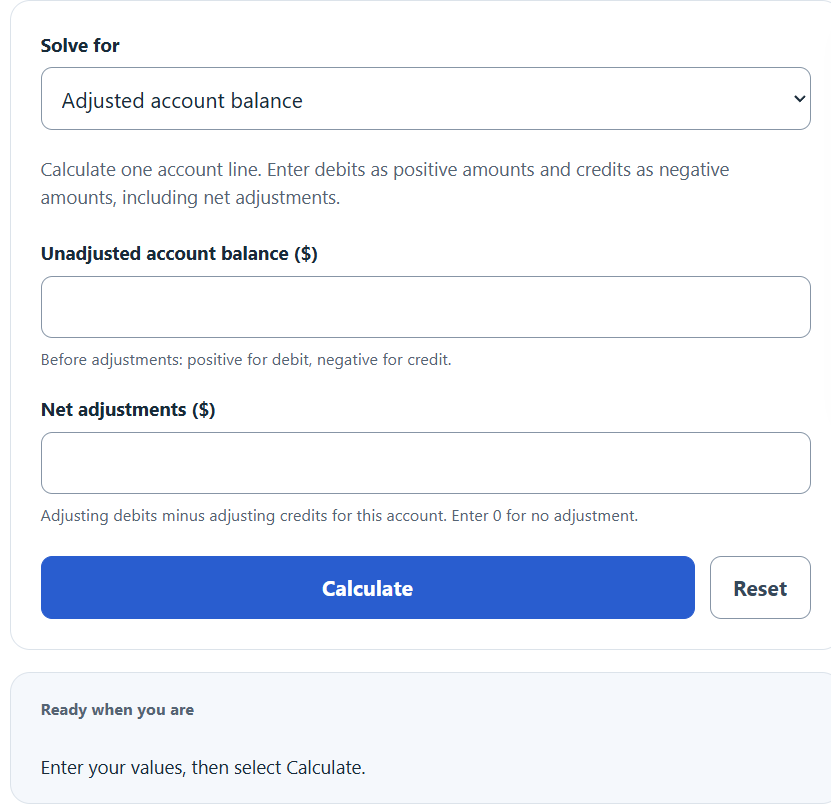
Calculate an adjusted trial balance account line by finding the adjusted balance, unadjusted balance, or net adjustments by choosing the unknown in Solve for and entering the other two values. Enter debits as positive and credits as negative amounts.
Related Calculators
- Budget Variance Calculator
- Gross Sales Calculator
- Salvage Value Calculator
- Target Price Calculator
- All Business Calculators
Adjusted Trial Balance Formula
An adjusted trial balance is a list of all ledger accounts with their updated debit/credit balances after posting adjusting entries. While you don’t add “total adjustments” to a trial balance as a single number, you can calculate each line item using the per-account relationship below.
- Where Badj is the adjusted balance for a single account
- Bunadj is the unadjusted balance for that account (before adjustments)
- Anet is the net effect of all adjusting entries posted to that account (debits minus credits for that account)
To prepare an adjusted trial balance, post each adjusting entry to the appropriate ledger accounts, then list every account’s adjusted debit or credit balance. The adjusted trial balance should still balance (total debits = total credits).
What is an Adjusted Trial Balance?
Definition:
An adjusted trial balance is a report prepared at the end of an accounting period that lists all general ledger accounts and their balances after adjusting entries (such as accruals, deferrals, and corrections) have been posted. It is used to verify that total debits equal total credits and to provide the updated account balances needed to prepare financial statements.
How to Calculate an Adjusted Trial Balance?
Example Problem:
The following example outlines the steps and information needed to calculate an adjusted balance for one account (one line in the adjusted trial balance).
First, determine the unadjusted balance of the account. In this example, Salaries Expense has an unadjusted (debit) balance of $10,000.
Next, determine the net adjustments that apply to that same account. For this example, assume an adjusting entry records an additional $2,500 of salaries expense (net adjustment to Salaries Expense = +$2,500). Note that the full adjusting entry also includes an equal credit to another account (such as Salaries Payable), so the trial balance remains in balance.
Finally, calculate the adjusted balance using the formula above:
Badj = $10,000 + $2,500
Badj = $12,500 (debit balance)
FAQ
Why is an adjusted trial balance important?
An adjusted trial balance helps ensure revenues and expenses are recorded in the correct accounting period and that the ledger remains in balance after adjustments. It also provides the updated account balances used to prepare the financial statements.
What entries are typically included in an adjusted trial balance?
Typical adjustments include accruals for revenues earned but not yet received and expenses incurred but not yet paid, deferrals for revenues received in advance and expenses prepaid, and corrections for any errors made during the initial recording process.
What happens if my adjusted trial balance doesn’t balance?
If the adjusted trial balance doesn’t balance, recheck for errors in the adjusting entries, omissions, or mistyped amounts. Ensuring each debit and credit entry is correctly recorded is crucial to finalizing accurate financial statements.