Calculate air-to-water heat exchanger heat transfer, temperature rise, and LMTD sizing to solve for Q, U, or area from end temperatures.
Related Calculators
- LMTD (Logarithmic Mean Temperature Difference) Calculator
- Vessel Heat Loss Calculator
- Specific Heat Calculator
- Compressed Air Velocity Calculator
- All Physics Calculators
Air To Water Heat Exchanger Formula
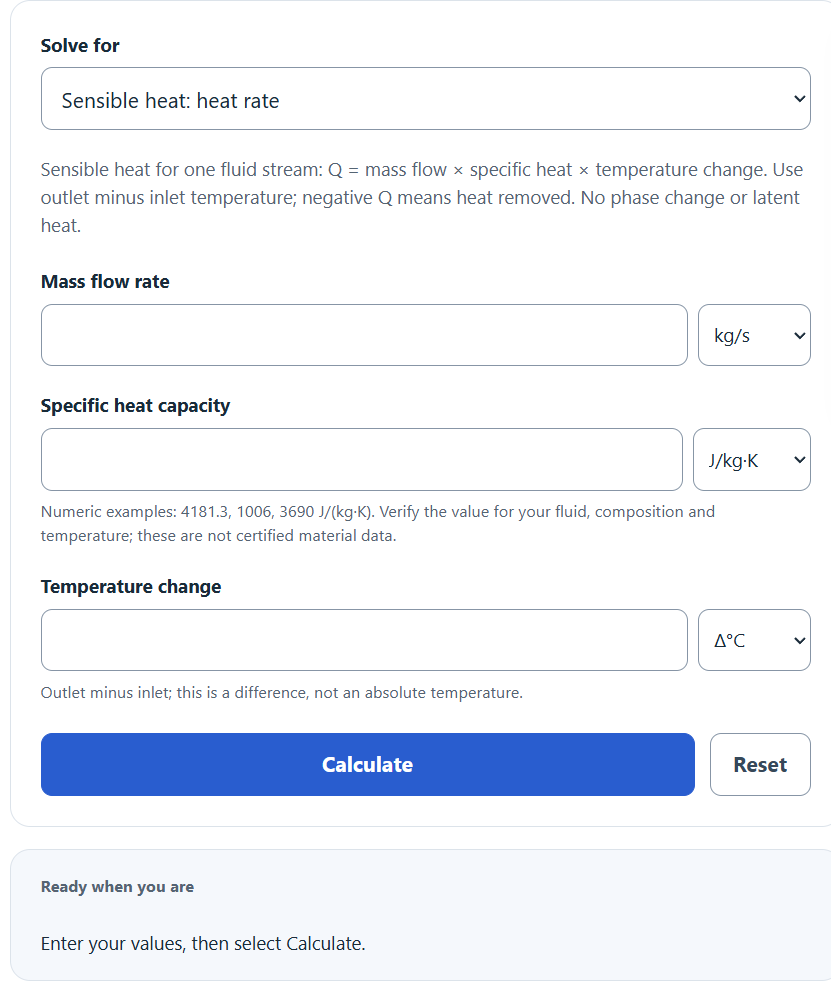
For a single fluid stream without phase change, the following sensible-energy balance uses constant specific heat and signed outlet-minus-inlet temperature change. Choose the quantity under Solve for, enter the displayed inputs, then select Calculate.
Variables:
- Q is the heat transfer rate in watts
- m is the mass flow rate in kilograms per second (kg/s)
- c is the specific heat capacity in joules per kilogram per degree Celsius (J/(kg·K))
- ΔT is the temperature change in degrees Celsius (°C)
To calculate the heat transfer rate, multiply the mass flow rate by the specific heat capacity and the temperature change. Negative heat rate means heat removed from that stream. LMTD modes instead use positive duty: Q = U × A × LMTD, for ideal counterflow or parallel flow. Both terminal hot-minus-cold differences must be positive; equal positive differences give that same LMTD. Crossflow and multipass corrections are not included. Use U and A on the same surface-area basis.
| Watts (W) | BTU/hr |
|---|---|
| 100 | 341 |
| 200 | 682 |
| 300 | 1024 |
| 400 | 1365 |
| 500 | 1706 |
| 600 | 2047 |
| 750 | 2559 |
| 1,000 | 3,412 |
| 1,200 | 4,095 |
| 1,500 | 5,118 |
| 2,000 | 6,824 |
| 2,500 | 8,530 |
| 3,000 | 10,236 |
| 3,500 | 11,942 |
| 4,000 | 13,649 |
| 5,000 | 17,061 |
| 7,500 | 25,591 |
| 10,000 | 34,121 |
| 20,000 | 68,243 |
| 50,000 | 170,607 |
| 1 W ≈ 3.412142 BTU/hr • 1 BTU/hr ≈ 0.293071 W | |
What is an Air To Water Heat Exchanger?
An air to water heat exchanger is a device that transfers heat from air to water. It is commonly used in heating, ventilation, and air conditioning (HVAC) systems to improve energy efficiency and maintain desired temperatures. The heat exchanger works by passing air over a series of coils or plates that contain water. As the air flows over the coils, heat is transferred from the air to the water, thereby cooling the air and heating the water. This process can be reversed to transfer heat from water to air, depending on the application.
How to Calculate Air To Water Heat Exchanger?
The following steps outline how to calculate the heat transfer rate for an air to water heat exchanger.
- First, select Sensible heat: heat rate and determine the mass flow rate (m) in kg/s.
- Next, determine the specific heat capacity (c) in J/(kg·K).
- Next, determine the outlet-minus-inlet temperature change (ΔT) in °C.
- Finally, calculate the heat transfer rate (Q) using the formula Q = m * c * ΔT.
- After inserting the values and calculating the result, check your answer with the calculator above.
Example Problem :
Use the following variables as an example problem to test your knowledge.
Mass flow rate (m) = 2 kg/s
Specific heat capacity (c) = 4186 J/(kg·K)
Temperature change (ΔT) = 10 °C; Q = 2 × 4186 × 10 = 83,720 W.