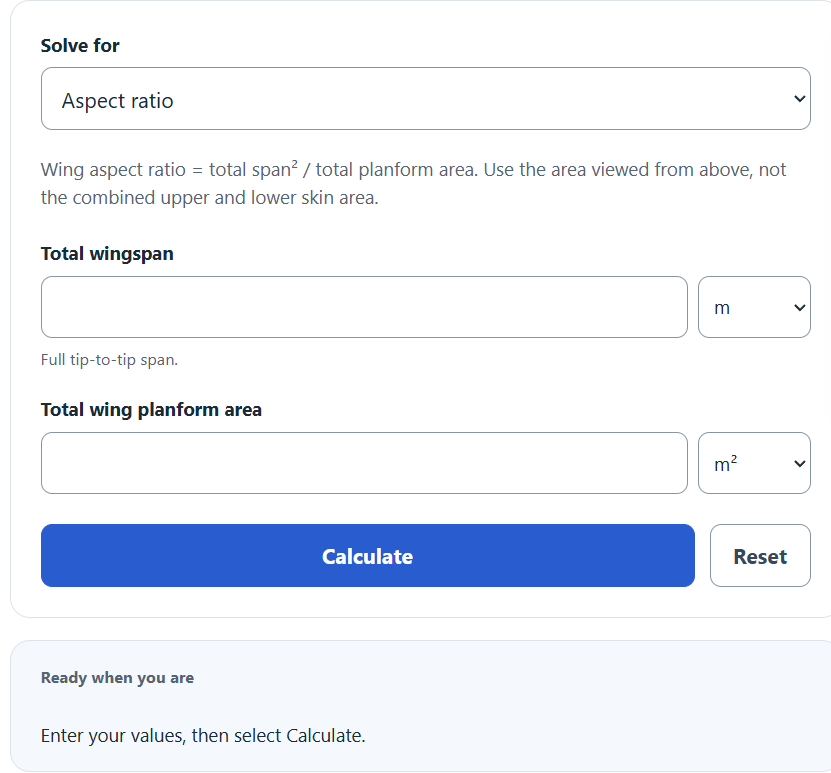
Select aspect ratio, wingspan, or wing planform area under Solve for, enter the two displayed inputs, and select Calculate. Each dimensional input has its own unit control.
Related Calculators
- Air Friction Calculator
- Propeller Slip Calculator
- Density to Pressure Calculator
- G Force To Acceleration Calculator
- All Physics Calculators
Airfoil Aspect Ratio Formula
The airfoil aspect ratio calculator uses wingspan and wing area to calculate the aspect ratio of a wing. Aspect ratio is dimensionless because it compares a squared length to an area.
- AR = aspect ratio
- b = wingspan
- S = total planform wing area viewed from above, not upper plus lower skin area
The calculator has three explicit Solve for options:
- Calculate aspect ratio: enter wingspan and wing area. The calculator squares the wingspan and divides by wing area.
- Calculate wingspan: enter aspect ratio and wing area. The calculator multiplies aspect ratio by wing area, then takes the square root.
- Calculate wing area: enter aspect ratio and wingspan. The calculator squares the wingspan and divides by aspect ratio.
When you use mixed units, the calculator converts wingspan to meters and wing area to square meters before applying the formula, then shows dimensional results in SI units with equivalent values in the other supported units.
Typical Airfoil Aspect Ratio Ranges
Aspect ratio varies by aircraft type and design purpose. Higher aspect ratios usually mean long, narrow wings. Lower aspect ratios usually mean shorter, wider wings.
| Aircraft or wing type | Typical aspect ratio | General meaning |
|---|---|---|
| Fighter aircraft | 2 to 5 | Shorter wings for maneuverability and high-speed performance |
| General aviation aircraft | 6 to 9 | Balanced lift, drag, and structural weight |
| Commercial airliner | 7 to 12 | Efficient cruise performance |
| Glider or sailplane | 15 to 30+ | Long, narrow wings for low induced drag |
Common Unit Conversions Used
| Quantity | Conversion to base unit |
|---|---|
| 1 ft | 0.3048 m |
| 1 in | 0.0254 m |
| 1 cm | 0.01 m |
| 1 ft² | 0.09290304 m² |
| 1 in² | 0.00064516 m² |
| 1 cm² | 0.0001 m² |
Example Problems
Example 1: Calculate aspect ratio
You have a wing with a wingspan of 10 m and a wing area of 20 m².
The aspect ratio is 5.
Example 2: Calculate wingspan
You have an aspect ratio of 8 and a wing area of 12 m².
The wingspan is about 9.798 m.
FAQ
What does a higher aspect ratio mean?
A higher aspect ratio means the wing is long and narrow relative to its area. This generally reduces induced drag, which is useful for efficient cruising and gliding. However, very high aspect ratio wings can be heavier or more flexible, so the best value depends on the aircraft design.
Is aspect ratio affected by the units I use?
No. Aspect ratio is dimensionless, so the final value should be the same as long as the wingspan and wing area use matching length units. For example, meters with square meters or feet with square feet will give a consistent result. If you use different units, convert them before applying the formula.
Can this formula be used for non-rectangular wings?
Yes. The formula uses total wingspan and total planform wing area, so it applies to rectangular, tapered, swept, and elliptical wings. You do not need the chord length unless you are calculating wing area separately.