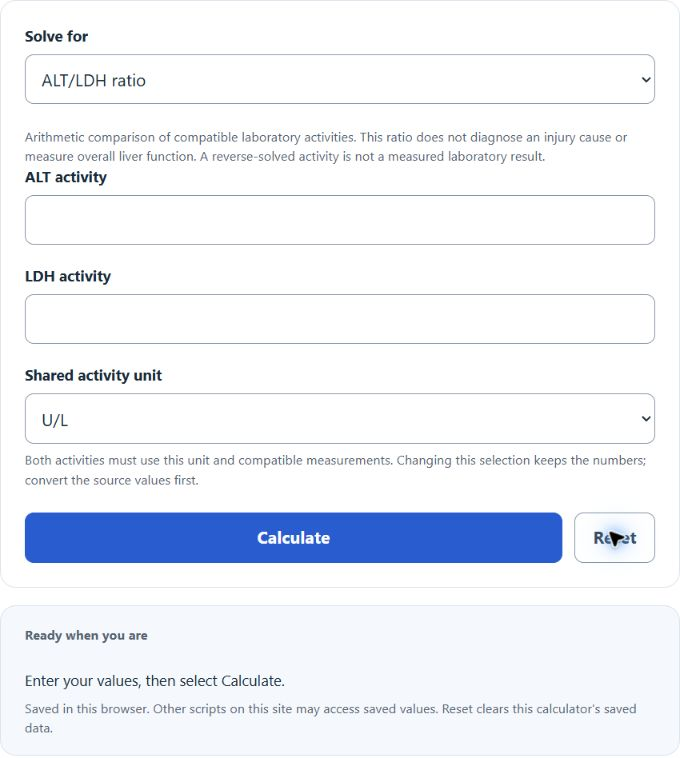
Calculate an ALT-to-LDH activity ratio or reverse-solve one enzyme value, with the method’s narrow clinical limits made explicit.
Related Liver & Gastrointestinal Calculators
- AST/ALT Ratio Calculator
- Child-Pugh Score Calculator
- Albumin/Globulin (A/G) Ratio Calculator
- Lille Score Calculator
- Maddrey Score Calculator
- All Liver & Gastrointestinal Calculators
Adjacent Calculators
- Hemolysis Index Calculator — Check specimen hemolysis separately because it can affect LDH and AST results; a hemolysis index does not calculate ALT/LDH or identify a hepatic cause.
- International Normalized Ratio Calculator — Assess PT/INR as a separate coagulation and synthetic-function context; INR is not part of the ALT/LDH ratio and should not be inferred from enzyme values.
ALT/LDH Ratio Formula
The ALT/LDH ratio compares the measured catalytic activity of alanine aminotransferase (ALT) with the measured catalytic activity of lactate dehydrogenase (LDH). The arithmetic relationship is:
The same relationship can be rearranged when one enzyme activity is unknown:
Variables:
- ALT/LDH Ratio is the unitless result after compatible enzyme activities are divided.
- ALT is the reported alanine aminotransferase activity.
- LDH is the reported lactate dehydrogenase activity.
ALT and LDH must be expressed in the same activity unit before division. U/L and IU/L are treated as equivalent labels in this calculator. If values are reported in different unit systems, convert them first; 1 µkat/L equals 60 U/L. Units cancel only when the numerator and denominator are compatible measurements.
What Is the ALT/LDH Ratio?
The ALT/LDH ratio is a descriptive comparison of two enzyme activities measured in blood. ALT is commonly included in the evaluation of hepatocellular injury. LDH is present in many tissues and is less specific to the liver. Neither measurement nor their ratio directly measures overall liver function.
A ratio also hides the absolute scale of the original results. ALT of 30 U/L with LDH of 100 U/L and ALT of 300 U/L with LDH of 1,000 U/L both produce a ratio of 0.3, even though the measured activities differ tenfold. For that reason, retain the original ALT and LDH results, their laboratory reference intervals, and the collection time when discussing the ratio.
This page uses ALT divided by LDH. Reversing the order produces a different number, so an LDH/ALT result from another source cannot be compared directly without taking its reciprocal.
How to Calculate the ALT/LDH Ratio
Use the calculator for arithmetic only. It can find the ratio or reverse-solve one enzyme activity from a supplied ratio and the other activity.
- Select ALT/LDH ratio, ALT activity, or LDH activity in the Solve for menu.
- Select the shared activity unit shown on the laboratory report. Changing the selection keeps the numeric inputs; both activities must already be in that unit.
- Enter every visible value as a finite number. LDH must be positive. ALT or a forward ratio may be zero for arithmetic. Solving LDH requires positive ALT and a positive ratio; zero divided by zero does not determine LDH.
- Select Calculate and review the displayed ALT, LDH, and ALT/LDH ratio together.
- Compare the source measurements with the reporting laboratory's own reference intervals. Do not assign a cause from the ratio alone.
Worked Examples
Example 1: Calculate the Ratio
Suppose ALT is 120 U/L and LDH is 200 U/L. Both values use the same activity unit.
The arithmetic ALT/LDH ratio is 0.6. This result describes the relationship between those two values; it does not label an injury pattern or identify a diagnosis.
Example 2: Reverse-Solve LDH
Suppose ALT is 120 U/L and a ratio of 0.6 is supplied for an arithmetic check.
The implied LDH activity is 200 U/L. A reverse-solved value is a mathematical result, not a substitute for a measured laboratory value.
Historical Study Context
The best-known ALT/LDH threshold comes from a 1994 retrospective study by Cassidy and Reynolds. The investigators reviewed early enzyme patterns in 97 patients: 51 with acute viral hepatitis A or B, 20 with ischemic hepatitis, and 26 with acetaminophen-related injury. Every included patient had ALT or AST at least five times the upper limit of normal.
Within that selected cohort, the mean ALT/LDH ratios were 4.65 for acute viral hepatitis, 0.87 for ischemic hepatitis, and 1.46 for acetaminophen-related injury. A study threshold of 1.5 separated the viral-hepatitis group from the other two groups with reported sensitivity of 94% and specificity of 84%.
Those results describe one limited retrospective cohort, not a universal reference interval or a modern stand-alone diagnostic rule. The calculator therefore does not classify a result as viral, ischemic, medication-related, normal, or abnormal. Suspected acetaminophen toxicity or acute liver injury requires prompt clinical evaluation rather than interpretation of this ratio.
Interpretation and Limitations
- Keep the original values. The ratio cannot show whether ALT, LDH, both, or neither is outside the laboratory's reference interval.
- Use collection context. Enzyme activities can change over time, so results obtained on different days should not be treated as one simultaneous pair.
- Check specimen quality. Hemolysis can interfere with LDH and other chemistry results. A laboratory comment or hemolysis index may matter before a ratio is interpreted.
- Do not treat the ratio as a liver-function test. Current evaluation of abnormal liver chemistries uses the magnitude and pattern of AST, ALT, alkaline phosphatase, and bilirubin together with history, medications, symptoms, examination, and other testing.
- Do not use a reverse calculation as a laboratory estimate. It only shows which number makes the entered arithmetic relationship true.
Frequently Asked Questions
Is there a normal ALT/LDH ratio?
This calculator does not apply a universal normal range because the ratio is not a routinely standardized stand-alone test. Interpret the measured enzyme activities using the reporting laboratory's methods and reference intervals, then consider the clinical setting.
Can the ratio diagnose viral hepatitis, ischemic injury, or acetaminophen toxicity?
No. A historical study found group differences in a narrowly selected acute-injury cohort, but overlapping results and the study design prevent a ratio from establishing an individual diagnosis. Clinical history, timing, repeat testing, and cause-specific evaluation are required.
Why must ALT and LDH use the same unit?
A unitless ratio is obtained only after compatible quantities are divided. Mixing U/L with µkat/L without conversion changes the number by a factor of 60 and produces an invalid comparison.
What if LDH is reported as zero?
Division by zero is undefined, so the calculator requires LDH to be greater than zero. If a report appears to show zero or an implausible value, confirm the result and reporting unit with the laboratory instead of forcing a calculation.
Primary Sources and Clinical Guidance
- Cassidy WM, Reynolds TB. Serum lactic dehydrogenase in the differential diagnosis of acute hepatocellular injury. J Clin Gastroenterol. 1994.
- Kwo PY, Cohen SM, Lim JK. ACG Clinical Guideline: Evaluation of Abnormal Liver Chemistries. Am J Gastroenterol. 2017.
- Lippi G, et al. Influence of hemolysis on routine clinical chemistry testing. Clin Chem Lab Med. 2006.
- BIPM. Resolution 12 of the 21st CGPM: the katal and the enzyme-activity unit.