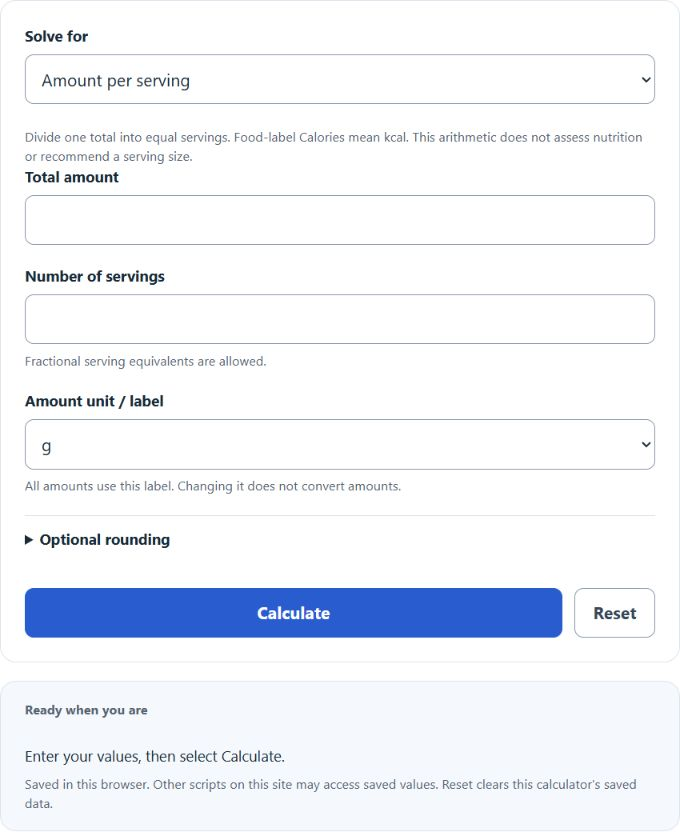
Calculate the amount per serving by dividing a total in grams, ounces, cups or calories by the number of servings, or find the total or serving count.
- All Food and Cooking Calculators
- Percentage Of Calories Calculator
- %DV Calculator (Percent Daily Value)
- Sodium to Potassium Ratio Calculator
Calculator Functions
| Function | What it does | What it requires |
|---|---|---|
| Amount per serving | Finds the size of one equal serving by dividing a total amount by the number of servings | Requires the total amount and the number of servings |
| Total amount | Finds the total needed by multiplying the amount in one serving by the number of servings | Requires the amount in one serving and the number of servings |
| Number of servings | Finds how many servings a total amount yields, with the whole servings and the amount left over | Requires the total amount and the amount in one serving |
Every function uses one amount label for all values: g, oz, mL, cups, Calories (kcal) or currency units. The label is only a label, so changing it does not convert the numbers. An optional rounding increment rounds the serving to the nearest multiple of that increment and shows what the rounded servings add up to.
Amount Per Serving Formulas
| APS | Amount per serving, in the selected unit |
| T | Total amount, in the same unit |
| S | Number of equal servings, greater than zero. Fractions such as 2.5 are allowed |
Amount per serving
A 1,000 g batch divided into 8 servings gives 1,000 ÷ 8 = 125 g per serving. The result also shows one serving as a share of the total, 100 ÷ S, which is 12.5% here. The same division works for calories: on a Nutrition Facts label the calories and nutrient amounts refer to one serving, so eating two servings doubles them, as in the label example where 280 Calories for one cup becomes 560 for two [1].
Total amount
Six servings of 250 g each need 250 × 6 = 1,500 g in total.
Number of servings
A 1,000 g total served 300 g at a time gives 1,000 ÷ 300 = 3.333333 servings. The whole servings are that count rounded down, 3, and the remainder is T − 3 × 300 = 100 g.
Optional rounding
round(APS ÷ step)
With a 5 g increment, the exact 333.333333 g serving from 1,000 g split 3 ways rounds to 335 g. Three rounded servings total 1,005 g, which is 5 g more than the batch. A value exactly halfway between two multiples rounds up. The exact serving is always shown beside the rounded one.
Limits of This Estimate
- The unit label does not convert amounts. Enter every value in the same unit, and note that on food labels “Calories” typically means kilocalories (kcal).
- The serving size printed on a food label reflects the amount people typically eat or drink. It is not a recommendation of how much to eat [1], and this calculator does not assess nutrition or recommend a serving size either. It is for informational purposes only and is not medical advice.
- A fractional result such as 3.333333 servings is a count of serving equivalents, not of whole containers or portions that can be handed out.
Sources
- U.S. Food and Drug Administration, How to Understand and Use the Nutrition Facts Label: label amounts refer to one serving, the two-serving example and what a label serving size means