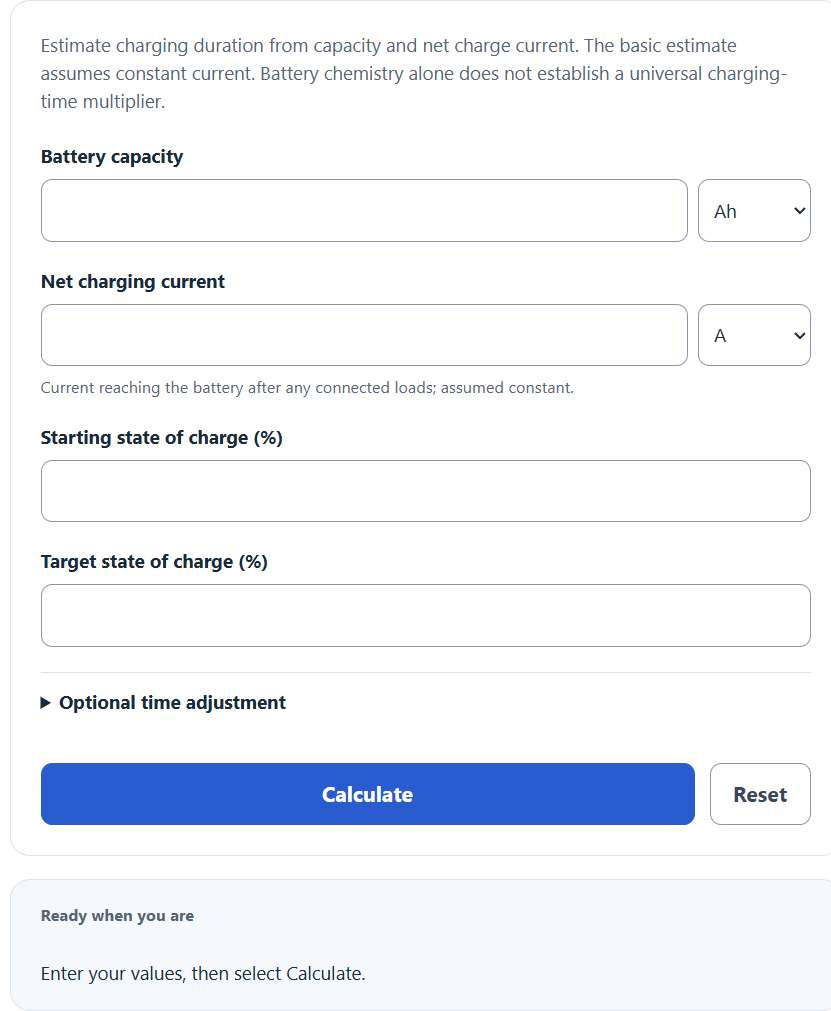
Estimate battery charge time from capacity, net charging current, start/target percentages and an optional time multiplier.
Battery Charge Time Formula
The calculator finds the charge to replace and divides it by constant net charging current. An optional user-supplied multiplier adjusts this ideal estimate; it does not simulate a battery’s charging stages.
Unit conversions used by the calculator:
- Battery Capacity is the rated capacity of the battery, entered in Ah or mAh.
- Start Percent is the current state of charge before charging begins.
- Target Percent is the state of charge you want to reach.
- Charge Needed is the amount of capacity that must be put back into the battery.
- Net charging current is current reaching the battery after connected loads, entered in A or mA.
- Ideal Time is the simple capacity divided by current result before charging losses are included.
- Time multiplier is a user-supplied adjustment of at least 1. Blank means 1, or ideal constant-current time.
- Estimated Charge Time is the final result shown in hours and as a duration in days, hours, and minutes.
The battery capacity and charger current unit selectors let you enter values in either large or small units. The start and target percentages let you estimate partial charging instead of always calculating 0% to 100%. The optional time multiplier can adjust the estimate when supported by information about your setup. No chemistry-specific factor is assumed.
Illustrative Time Multipliers
These multipliers illustrate arithmetic only; they are not verified defaults for any battery chemistry. Actual charge time depends on the battery, charger, temperature and charging stages.
| Illustrative adjustment | Factor | Meaning |
|---|---|---|
| 5% extra time | 1.05 | Adds about 5% over the ideal time. |
| 20% extra time | 1.20 | Adds about 20% over the ideal time. |
| 40% extra time | 1.40 | Adds about 40% over the ideal time. |
Common Capacity and Current Conversions
| Value | Equivalent |
|---|---|
| 1000 mAh | 1 Ah |
| 5000 mAh | 5 Ah |
| 1000 mA | 1 A |
| 2500 mA | 2.5 A |
Example Charge Time Calculations
Example 1: 12 Ah lead-acid battery from 0% to 100%
You have a 12 Ah battery and 2 A net charging current. For illustration, enter a time multiplier of 1.20; this is not a universal lead-acid factor.
The estimated charge time is about 7 hours 12 minutes.
Example 2: 5000 mAh lithium-ion battery from 20% to 80%
You have a 5000 mAh battery and 1000 mA net charging current. For illustration, enter 1.05 as the multiplier; this is not a universal lithium-ion factor.
The estimated charge time is about 3 hours 9 minutes.
FAQ
Why is the estimated charge time longer than capacity divided by current?
Capacity divided by current gives an ideal result. Real charging is not perfectly efficient. Some energy is lost as heat, and many chargers reduce current as the battery gets closer to full. The optional multiplier increases ideal time by the amount you specify, but cannot model tapering or determine a safe charging profile.
Can I use this for a partially charged battery?
Yes. Enter the current charge level in the Start % field and the desired charge level in the Target % field. For example, charging from 40% to 90% uses only 50% of the battery capacity in the time calculation.
Does a higher charger current always mean faster charging?
A higher current usually reduces charge time, but only if the battery and charger are designed for that current. Do not exceed the charging current recommended for the battery. Some chargers also limit current automatically, so the rated charger current may not be used for the entire charge cycle.