Enter positive series resistance and capacitance, then a target percentage from 0% to less than 100%. Choose seconds, minutes or hours in Result unit, then select Calculate. This ideal RC model starts from an uncharged capacitor.
- All Physics Calculators
- Battery Run Time Calculator
- Capacitor Discharge Calculator
- Capacitor Size Calculator
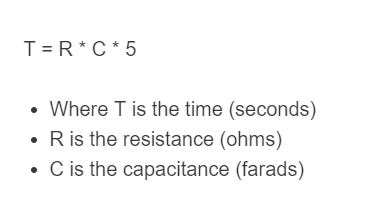
Capacitor Charge Time Formula
The capacitor charge time calculator uses the standard RC charging equation solved for time. It assumes an initially uncharged ideal constant capacitor charging through a positive series resistance toward a constant final DC supply voltage.
The RC time constant is:
- t = charge time
- R = resistance in ohms, Ω
- C = capacitance in farads, F
- P = desired charge level as a percentage of the final voltage
- τ = RC time constant in seconds
- ln = natural logarithm
The calculator first converts resistance to ohms and capacitance to farads. It then converts the desired charge percentage into a decimal fraction and applies the charge-time formula. The result is calculated in seconds, then converted to seconds, minutes, or hours depending on the selected output unit.
Common Capacitor Charge Levels by Time Constant
A capacitor does not charge at a constant rate. It charges quickly at first, then approaches the final voltage more slowly. The table shows common charge levels based on the number of RC time constants.
| Elapsed Time | Approximate Charge | Meaning |
|---|---|---|
| 1τ | 63.2% | One time constant has passed |
| 2τ | 86.5% | Mostly charged |
| 3τ | 95.0% | Often treated as near charged |
| 4τ | 98.2% | Very close to final voltage |
| 5τ | 99.3% | Common full-charge approximation |
Capacitance and Resistance Unit Conversions
| Unit | Base Unit Conversion |
|---|---|
| 1 kΩ | 1,000 Ω |
| 1 MΩ | 1,000,000 Ω |
| 1 mF | 0.001 F |
| 1 μF | 0.000001 F |
| 1 nF | 0.000000001 F |
| 1 pF | 0.000000000001 F |
Example Capacitor Charge Time Calculations
Example 1: Charging to 63.2%
You have a 10 kΩ resistor and a 100 μF capacitor. Find the time to charge to 63.2%.
- R = 10 kΩ = 10,000 Ω
- C = 100 μF = 0.0001 F
- P = 63.2
This is approximately one RC time constant because R*C = 1 second; 63.2% is the rounded one-time-constant voltage percentage.
Example 2: Charging to 95%
You have a 47 kΩ resistor and a 220 μF capacitor. Find the time to charge to 95%.
- R = 47 kΩ = 47,000 Ω
- C = 220 μF = 0.00022 F
- P = 95
Capacitor Charge Time FAQ
Why can the desired voltage be entered as a percentage?
For a simple RC charging circuit, the charge curve depends on the fraction of the final voltage reached, not the actual supply voltage. Charging to 90% of 5 V and charging to 90% of 12 V both take the same time if the resistance and capacitance are the same.
Why does the calculator not allow 100% charge?
In the ideal RC charging equation, a capacitor approaches 100% of the final voltage but never reaches it exactly. The time required for exactly 100% would be infinite. In practical circuits, values such as 99%, 99.3%, or 99.9% are usually used as a full-charge estimate.
What happens if resistance or capacitance increases?
Increasing either resistance or capacitance increases the RC time constant. Since charge time is directly proportional to R and C, doubling the resistance doubles the charge time, and doubling the capacitance also doubles the charge time.