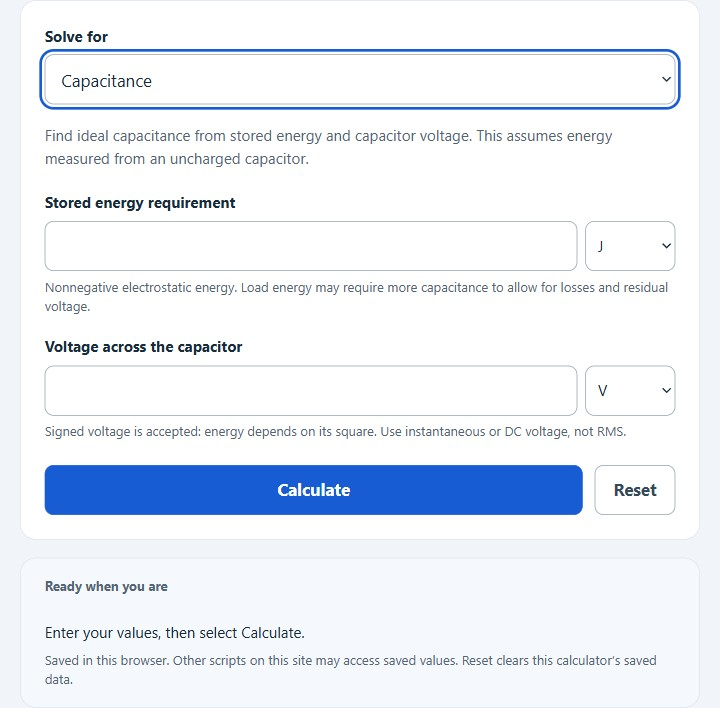
Select capacitance, stored energy, or voltage magnitude, then enter the two requested values. Units include V, kV, J, kJ, F, µF, nF, and pF. The ideal stored-energy model assumes energy relative to an uncharged capacitor; usable load energy also depends on residual voltage and losses.
Capacitor Size Formula
The calculator uses the ideal stored energy formula for a capacitor. Choose the value to solve for and enter the two requested inputs.
- E = electrostatic energy stored relative to zero voltage, in joules (J)
- C = capacitance or capacitor size, in farads (F)
- V = voltage across the capacitor, in volts (V)
Select Stored energy to use voltage and capacitance to find the stored energy.
Select Capacitance to use stored energy and voltage to find the ideal capacitance.
Select Voltage magnitude to use stored energy and capacitance to find the voltage magnitude. Energy does not determine polarity; either sign has the same stored energy.
The calculation uses base units: volts, joules, and farads. Changing an input unit converts the entered quantity. Results show the solved value and equivalent units; signed voltage inputs are preserved because stored energy depends on voltage squared.
Capacitance Unit Conversions
Capacitor values are often written in microfarads, nanofarads, or picofarads instead of farads. These conversions are useful when checking the result.
| Unit | Symbol | Equivalent in farads |
|---|---|---|
| Farad | F | 1 F |
| Microfarad | μF | 0.000001 F |
| Nanofarad | nF | 0.000000001 F |
| Picofarad | pF | 0.000000000001 F |
Common Capacitor Size Ranges
| Application type | Typical capacitance range | Typical note |
|---|---|---|
| Small signal or RF circuits | pF to nF | Used for coupling, tuning, and filtering small signals. |
| General electronics filtering | nF to μF | Common in decoupling and noise reduction. |
| Power supply smoothing | μF to mF | Larger values help reduce voltage ripple. |
| Startup or pulse energy storage | mF to F+ | Used when a circuit needs a short burst of stored energy. |
Example Calculations
Example 1: Find capacitor size
You need 50 J of startup energy at 100 V. Find the required capacitance.
The required capacitor size is 0.01 F, which is the same as 10,000 μF.
Example 2: Find stored energy
A 4700 μF capacitor is charged to 24 V. First convert capacitance to farads:
Then calculate the stored energy:
The stored energy is 1.3536 J.
FAQ
How do I choose the right capacitor size from the result?
The result gives the ideal capacitance from the energy equation. In a real circuit, you usually choose the next standard capacitor value above the calculated value. You should also check the capacitor voltage rating, ripple current rating, tolerance, ESR, and the circuit’s safety requirements.
Why does voltage affect capacitor size so much?
Stored energy depends on voltage squared. If voltage doubles, the same capacitor can store four times as much energy. This means a higher voltage can greatly reduce the required capacitance, but only if the circuit and capacitor rating safely allow that voltage.
Can I use this for AC motor start capacitors?
This calculator is based on stored energy in a capacitor, using E = 0.5CV². AC motor start and run capacitors are usually selected based on motor design, supply frequency, phase shift, current, and manufacturer specifications. Do not use stored energy alone as the final sizing method for an AC motor capacitor.