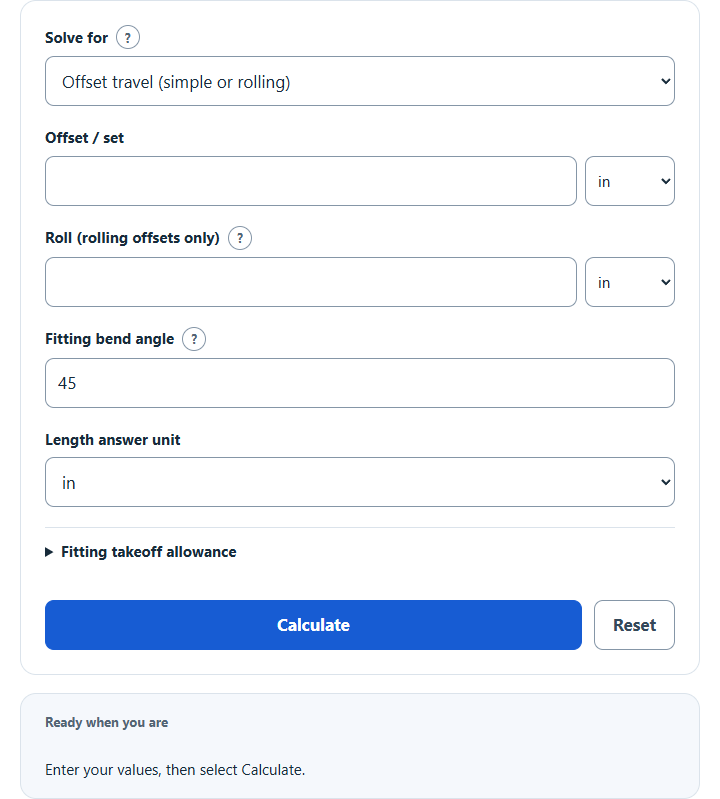
Calculate pipe offset travel and run for 22.5°, 30°, 45° or 60° fittings, including rolling offsets, or find the bend angle from the offset and run.
Related Calculators
- Angle Drop Calculator
- Distance To Angle Calculator
- Vertical Angle Calculator
- Rotation Calculator (new coordinates by rotation)
- All Math and Numbers Calculators
Angle Offset Formula
The Difference between two angles mode uses this formula for an initial and final angle. The result is signed and is not wrapped to a full turn.
Variables:
- (theta_o) is the angle offset
- (theta_f) is the final angle
- (theta_i) is the initial angle
To calculate the angle difference, subtract the initial angle from the final angle. For the pipe modes, true offset c = √(horizontal² + vertical²), travel = c/sin(θ), and run = c/tan(θ). From offset and run, θ = atan2(offset, run). Cut length subtracts two equal fitting takeoffs; blank takeoff means zero, and allowances greater than travel are rejected. Parallel mode assumes identical translated paths; its bank width is the span between outer pipe centres, excluding pipe diameters. Check actual fittings and clearances before cutting.
What is an Angle Offset?
An angle offset is the difference between two angles, typically an initial angle and a final angle. This concept is often used in various fields such as engineering, navigation, and robotics to describe the change in orientation or direction. The angle offset can be positive or negative, indicating whether the final angle is greater or smaller than the initial angle. Understanding angle offsets is crucial for tasks that require precise angular measurements and adjustments.
How to Calculate Angle Offset?
The following steps outline how to calculate the Angle Offset.
- First, choose Difference between two angles under Solve for and enter the initial angle (theta_i).
- Next, determine the final angle ((theta_f)).
- Finally, calculate the angle offset using the formula (theta_o = theta_f – theta_i).
- Select Calculate to see the signed difference. In the example below, 75° − 30° = 45°.
Example Problem :
Use the following variables as an example problem to test your knowledge.
Initial Angle ((theta_i)) = 30 degrees
Final Angle ((theta_f)) = 75 degrees