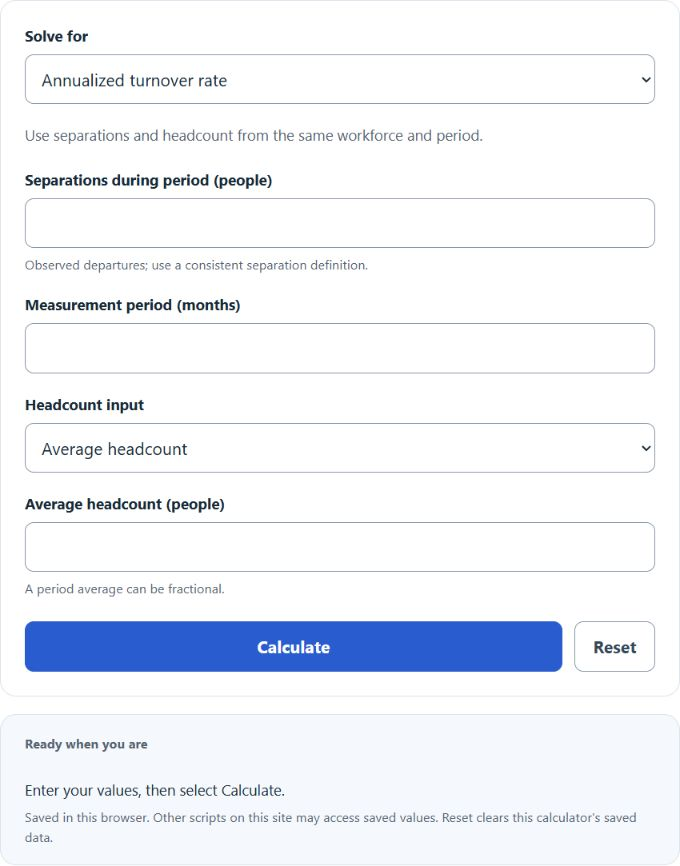
Calculate annualized employee turnover rate, period turnover, average headcount, and annual separations from departures over any measurement period.
Related Calculators
- Sales Growth Calculator
- Annual Profit Calculator
- Cost Volume Profit Calculator
- Price Increase Calculator
- All Business Calculators
Annualized Turnover Formula
The following formula is used to calculate an annualized turnover rate.
Related monthly-rate methodology (different time basis): BLS Handbook of Methods: Job Openings and Labor Turnover Survey (2023)
- Where ATR is the annualized turnover rate (%)
- L is the number of employees who left during the time period (separations)
- E is the average number of employees during the time period
- M is the total number of months in the period
The factor of 12/M scales any sub-annual measurement window up to a full 12-month equivalent. When M equals 12 (a full year of data), the formula simplifies to (L / E) * 100, which is the standard annual turnover rate. This scaling is what distinguishes an annualized rate from a simple period rate and allows HR teams to compare turnover across measurement windows of different lengths on equal footing.
Average headcount (E) is typically calculated by adding the headcount at the beginning of the period to the headcount at the end of the period and dividing by two. For greater accuracy over longer periods, many organizations sum monthly headcounts and divide by the number of months. BLS JOLTS annual-average rates divide the sum of monthly separations by the sum of monthly CES employment levels. That is an employment-weighted monthly rate, not the annualized turnover percentage calculated here.
What Is Annualized Turnover?
Annualized turnover is a workforce metric that expresses the rate at which employees leave an organization over a standardized 12-month period. It converts separation data collected over any time window (a single month, a quarter, six months) into a projected annual percentage, making it possible to compare workforce stability across departments, business units, or time periods regardless of how long each was measured.
The metric counts all separations: voluntary resignations, involuntary terminations, retirements, end-of-contract departures, and transfers out of a business unit. It does not distinguish between the reasons an employee left. That is why organizations often track annualized turnover alongside more specific metrics like the voluntary turnover rate or the regrettable turnover rate to get a complete picture of workforce health.
A company with 500 average employees that lost 25 people during a single quarter (3 months) would have an annualized turnover rate of (25 / 500) * (12 / 3) * 100 = 20%. This does not mean the company will necessarily lose 100 employees over the full year. It means the rate at which people left during that quarter, if sustained for 12 months, would produce turnover equivalent to 20% of the workforce.
Types of Employee Turnover
Not all turnover carries the same organizational impact. HR professionals classify turnover along two independent axes, and understanding the intersection of these categories is critical to interpreting what an annualized rate actually signals about business health.
Voluntary turnover occurs when the employee initiates the departure. Common drivers include better compensation elsewhere, limited advancement opportunities, poor manager relationships, burnout, and relocation. Mercer’s 2025 U.S. survey reported average voluntary turnover of 13.0%, compared with 13.5% in its 2024 survey. Survey benchmarks require matching the workforce, separation definition and measurement period.
Involuntary turnover is employer-initiated and includes performance-based terminations, layoffs driven by restructuring or economic conditions, and end-of-contract separations. This category also captures dismissals for policy violations and reductions in force (RIFs).
Functional turnover describes departures that benefit the organization. When a consistently low-performing employee resigns on their own, it saves the company the time, documentation, and legal exposure involved in a formal termination process. Functional turnover is not a problem to solve; it is a natural, healthy component of workforce renewal.
Dysfunctional turnover occurs when high-performing or hard-to-replace employees leave. This is the costliest form of turnover because it removes institutional knowledge, disrupts team productivity, and triggers expensive replacement cycles. Identifying dysfunctional turnover within the annualized rate is what separates useful workforce analysis from simple headcount accounting.
Turnover Rate Benchmarks by Industry
The BLS Job Openings and Labor Turnover Survey (JOLTS) reported an average total separations rate of 3.3% per month for 2024, down from 3.6% in 2023. Multiplying 3.3% by 12 gives a 39.6% annualized pace. This is a derived comparison, not the official BLS annual-average rate. It equals annual separations divided by average monthly employment only when both use the same monthly observations; a beginning/end headcount estimate need not match.
Industry benchmarks vary with the survey population, voluntary versus total separations, and the measurement period. Seasonal hiring and short-tenure roles can produce different turnover patterns from long-tenure professional workforces. Compare a published benchmark only after checking its source, year, denominator and time basis.
Turnover also varies by job level, tenure, compensation and labor-market conditions. A workforce-wide average can hide different patterns among executives, technical specialists and frontline employees; examine comparable groups before drawing conclusions.
The Financial Cost of Employee Turnover
Replacement costs vary by role, seniority and specialization. Estimate recruiting, training, vacancy and productivity costs using your own organization’s records rather than applying a universal salary multiplier.
Direct costs include job advertising, recruiter fees, background checks, onboarding administration and training. Indirect costs can include lost productivity during a vacancy, reduced output while a new hire learns the role, workload redistribution and lost client relationships or institutional knowledge.
To put this in concrete terms, a 100-person company paying an average salary of $50,000 with a 20% annualized turnover rate would lose approximately 20 employees per year. At an illustrative replacement cost of 75% of salary ($37,500 per departure), the annual cost of turnover reaches $750,000. That figure does not account for the downstream effects on remaining employees, who experience increased workloads and may themselves become flight risks, creating a compounding turnover cycle.
Annualized Turnover vs. Period Turnover Rate
A period turnover rate measures separations over whatever window was observed without any scaling. If 10 people left a 200-person company in one quarter, the period turnover rate for that quarter is simply (10 / 200) * 100 = 5%. The annualized turnover rate takes that same data and projects it across 12 months: (10 / 200) * (12 / 3) * 100 = 20%.
Neither metric is inherently better. Period rates help track trends within an organization, while annualized rates express a standardized pace for planning. Before benchmarking, match the measurement period, workforce and separation definition. Published BLS annual averages describe monthly rates and cannot be compared directly with this calculator’s annualized percentage.
One important caveat: annualizing a very short measurement period (such as a single month) can produce misleading results because it assumes the observed rate will persist uniformly. Seasonal businesses, companies undergoing restructuring, or organizations that conduct annual layoffs in a specific quarter will see their annualized rate fluctuate dramatically depending on which month is measured. For more reliable annualized figures, use at least a full quarter of data, and ideally six months or more.
How the BLS Calculates Turnover
The Bureau of Labor Statistics publishes official turnover data through its Job Openings and Labor Turnover Survey (JOLTS), which samples approximately 21,000 nonfarm business and government establishments each month. The JOLTS program breaks total separations into three categories: quits (voluntary), layoffs and discharges (involuntary), and other separations (retirements, deaths, transfers to other locations within the same company, and separations due to disability).
BLS annual-average separation rates equal 100 times the sum of the 12 monthly separation levels divided by the sum of the 12 monthly CES employment levels. They are employment-weighted monthly rates. In 2024, total separations averaged 3.3% per month; the independently rounded components were 2.1% quits, 1.1% layoffs and discharges, and 0.2% other separations. Rounded components need not sum to the rounded total. The calculator annualizes a period turnover rate using 12/M instead.
Strategies for Reducing Annualized Turnover
Exit interviews and engagement surveys can help organizations identify recurring causes of voluntary departures. Use local evidence to choose retention measures and assess their results over time.
Compensation alignment is the most direct lever. Employees who believe they are paid below market are significantly more likely to leave within 12 months. Regular market benchmarking using salary survey data (not just internal equity reviews) helps identify roles where pay gaps have widened. However, compensation alone is rarely sufficient. Manager relationships and working conditions can also affect retention; investigate these alongside compensation.
Career development pathways reduce turnover among high performers specifically. When top talent cannot see a clear trajectory for growth, they begin looking externally. Structured promotion timelines, skill-building budgets, mentorship programs, and internal mobility platforms all signal that the organization invests in long-term employee development rather than treating roles as static positions.
Onboarding quality affects early-tenure turnover disproportionately. Employees who leave within their first year represent one of the most expensive forms of turnover because the organization incurs full replacement cost with minimal return on investment. Structured 90-day onboarding programs that include role-specific training, social integration with the team, and regular check-ins with a direct manager reduce first-year voluntary departures measurably.