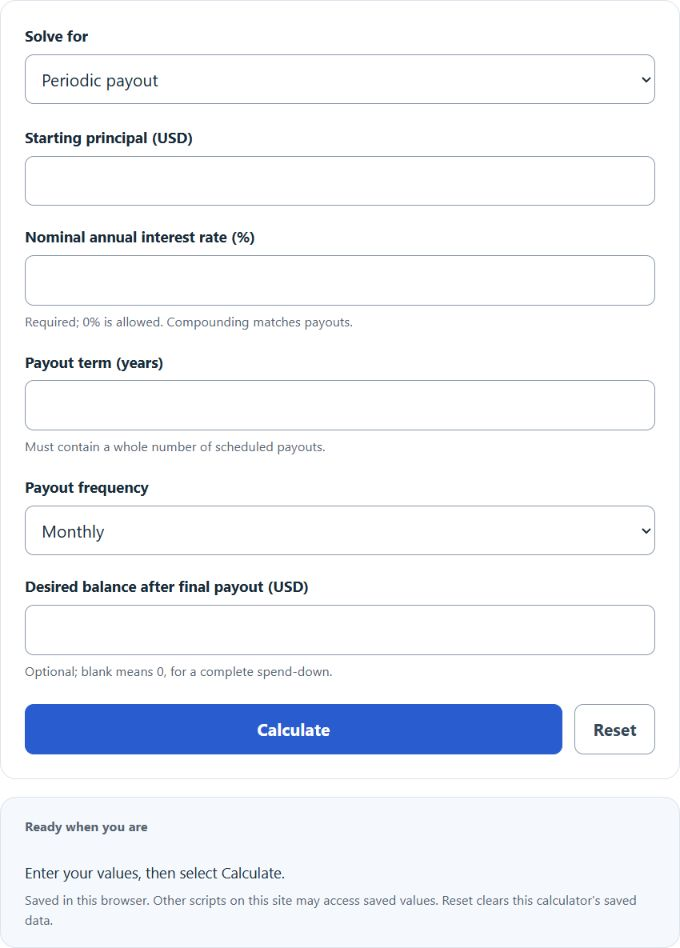
Annuity payout calculator to estimate periodic income, required principal, or payout duration from the interest rate, term, frequency, and ending balance.
Annuity Payout Formula
For a level payout made at the end of each period, the periodic annuity payment is calculated from the starting principal, periodic interest rate, number of payments, and any desired ending balance:
PMT = (PV - FV / (1 + i)^n) * i / (1 - (1 + i)^(-n))
The same relationship can be rearranged to find the principal needed. When the rate is zero, the payout is simply the amount spent down divided by the number of payments.
PV = PMT * (1 - (1 + i)^(-n)) / i + FV / (1 + i)^n
Variables:
- PMT is the periodic annuity payout
- PV is the starting principal or premium
- FV is the desired balance after the final payout
- i is the periodic interest rate, equal to the nominal annual percentage divided by 100 and by payments per year; compounding matches payouts
- n is the total number of payouts
Use the solve-for selector to estimate income, the deposit needed to support a target income, or scheduled payout duration. Payout and principal modes require a whole number of payment periods. Duration mode solves n = ln((PMT − FV × i) / (PMT − PV × i)) / ln(1 + i) when PMT exceeds periodic interest on principal; at zero interest, n = (PV − FV) / PMT. The final payout occurs at the next scheduled payment date and is adjusted to leave the requested ending balance. A fractional algebraic n is not a payment between scheduled dates.
Annuity Payout Reference Table
The table shows approximate monthly income from a $250,000 annuity with no ending balance and level end-of-month payments.
| Annual rate | 10 years | 20 years | 30 years |
|---|---|---|---|
| 0% | $2,083 | $1,042 | $694 |
| 3% | $2,414 | $1,386 | $1,054 |
| 5% | $2,652 | $1,650 | $1,342 |
| 7% | $2,903 | $1,938 | $1,663 |
Example Problems
Example 1: Estimate a monthly payout.
A $250,000 annuity earns 5% annually and pays monthly for 20 years with no balance left at the end.
Using i = 0.05 / 12 and n = 240 gives a monthly payout of about $1,650. The total of the 240 payments is about $396,000.
Example 2: Find the principal required.
You want $2,000 per month for 15 years at 4% annual interest and want $25,000 remaining.
Discounting the payouts and the ending balance gives a required starting principal of approximately $284,118.
Frequently Asked Questions
Does an annuity payout include principal and interest?
Yes. Each level payout can include both a return of the original principal and investment earnings. The mix changes over time even when the payment stays constant.
What happens if I choose a lifetime annuity?
A lifetime annuity uses mortality assumptions and insurer pricing, so it cannot be reduced to a fixed number of payments. Use this calculator for period-certain or self-managed payout estimates, then compare the result with an insurer quote.
Why is the monthly payout higher at a higher interest rate?
A higher assumed return lets more of each payment come from earnings rather than principal. Actual annuity crediting rates, fees, guarantees, and market performance can produce a different payout.