Calculate the ANOVA correction factor CF = (ΣX)²/N from your data or totals, plus the total, between-group and within-group sums of squares.
- All Statistics Calculators
- Sum Of Squares Calculator
- Eta Squared Calculator
- Variance Calculator
- Cochran’s Sample Size Calculator
- Correction Factor Calculator
Calculator Functions
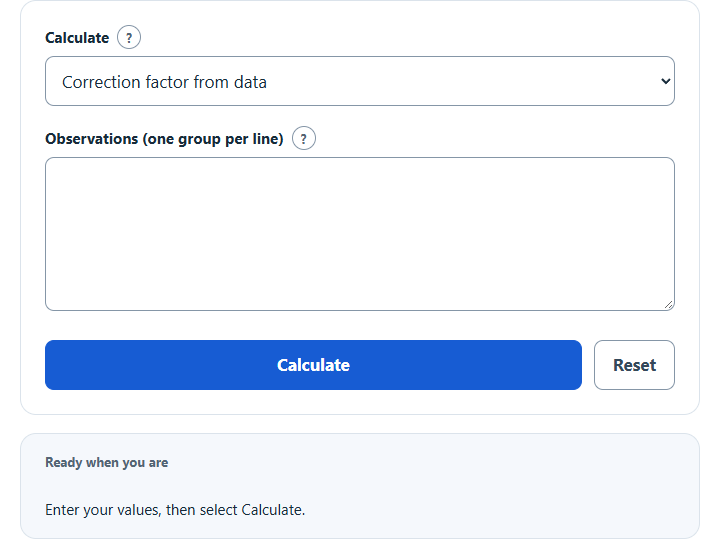
The calculator gives the correction factor CF used in analysis of variance, and from it the total sum of squares. With your observations split into groups, it also gives the between-groups and within-groups sums of squares and their degrees of freedom. Select a function to open it in the calculator.
| Function | Use it when | You enter |
|---|---|---|
| Correction factor from data | You have the observations themselves | The values, one group per line |
| Correction factor from totals | You already know the grand total and how many observations there are | ΣX and N, and ΣX² for the total sum of squares |
In the data function, values on one line can be separated by spaces or commas. A single line is treated as one group, so you get CF and the total sum of squares only.
Correction Factor Formulas
| CF | Correction factor, also called the correction for the mean |
| ΣX | Grand total: the sum of every observation in all groups |
| N | Total number of observations |
The sum of the squared observations, ΣX², is the raw or uncorrected sum of squares. Subtracting CF from it gives the corrected sum of squares, which is the total sum of squares of an ANOVA table and the numerator of the sample variance [2].
Sums of squares from CF
Ti is the total of group i and ni its number of observations, so groups of different sizes work. The within-groups (error) sum of squares is what remains: SS(Within) = SS(Total) − SS(Between). The degrees of freedom are k − 1 between groups, N − k within groups and N − 1 in total, where k is the number of groups.
Worked example
Three groups of five resistance measurements, with group totals 26.7, 38.6 and 42.8, have a grand total of 108.1 from 15 observations [3]. CF = 108.1² ÷ 15 = 779.0407. The squared observations add to 824.39, so SS(Total) = 824.39 − 779.0407 = 45.3493. SS(Between) = (26.7² + 38.6² + 42.8²) ÷ 5 − 779.0407 = 27.8973, which leaves SS(Within) = 17.452.
Limits of This Estimate
- CF and ΣX² are usually large and close together, so rounding either one before subtracting can change the sums of squares noticeably. Keep full precision until the end.
- The group split is for a one-way layout, one grouping factor. Designs with more factors use the same CF but need more sums of squares than this page gives.
Sources
- NIST/SEMATECH e-Handbook of Statistical Methods, 7.4.3.4 One-Way ANOVA Calculations: the correction for the mean and the total, treatment and error sums of squares
- NIST/SEMATECH e-Handbook of Statistical Methods, 7.4.3.1 One-Way ANOVA Overview: raw sum of squares, correction term for the mean and corrected sum of squares
- NIST/SEMATECH e-Handbook of Statistical Methods, 7.4.3.3 The ANOVA Table and Tests of Hypotheses About Means: the resistance data and its ANOVA table used in the worked example