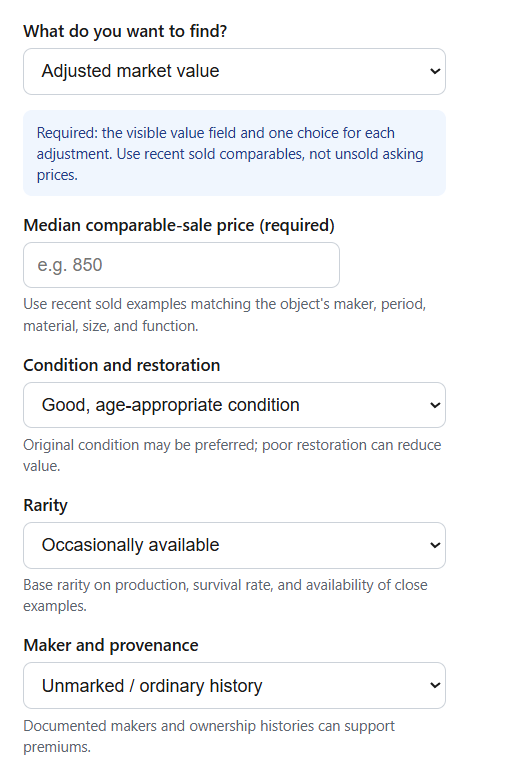
Estimate antique market value, quick-sale range, and net proceeds from sold comparables, condition, restoration, rarity, provenance, demand, and selling fees.
Antique Value Formula
Start with recently sold objects that match the maker or attribution, period, material, size, form, and function. The calculator adjusts that baseline for condition, restoration, rarity, provenance, and demand.
V = B * F1 * F2 * F3 * F4
To find the comparable-sale baseline needed to support a target adjusted value:
B = V / (F1 * F2 * F3 * F4)
Estimated net proceeds after a percentage fee and fixed costs are:
N = V * (1 - f) - C
Variables:
- V is the adjusted market value
- B is the median comparable-sale baseline
- F1 through F4 are the selected category-specific adjustment multipliers
- N is estimated net proceeds
- f is the selling fee as a decimal
- C is fixed selling, repair, shipping, or authentication cost
The result includes an indicative market range and a lower quick-sale range. These are planning estimates, not guarantees; use multiple recent comparables and remove obvious outliers before entering the median.
Antique Value Adjustment Reference
Each selector is centered on a benchmark multiplier of 1.00. A multiplier above 1.00 raises the comparable baseline, while a multiplier below 1.00 reduces it.
| Factor | Benchmark | Adjustment range |
|---|---|---|
| Condition and restoration | Good, age-appropriate condition | 0.42× to 1.15× |
| Rarity | Occasionally available | 0.72× to 1.25× |
| Maker and provenance | Unmarked / ordinary history | 0.70× to 1.30× |
| Current demand | Normal demand | 0.65× to 1.18× |
Example Problems
Example 1: A set of close sold comparables has a median price of $850. The selected adjustments combine to 1.18.
V = 850 * 1.18 = $1,003.00.
Example 2: You want the adjusted value to be $1,500, and the combined adjustments equal 1.25. Find the comparable baseline that would support that result.
B = 1500 / 1.25 = $1,200.00.
Frequently Asked Questions
Is an old object automatically valuable?
No. Age alone does not create demand. Maker, rarity, material, condition, authenticity, usefulness, decorative taste, and recent comparable sales are usually more important.
Should restoration raise or lower antique value?
Professional conservation may stabilize an object, but extensive replacement, refinishing, or inappropriate repairs can reduce originality and value. The effect depends on the category and buyer market.
When should I hire an appraiser?
Use a qualified specialist for high-value objects, uncertain attribution, estate or tax work, insurance scheduling, legal disputes, or any item where authenticity and provenance materially affect value.