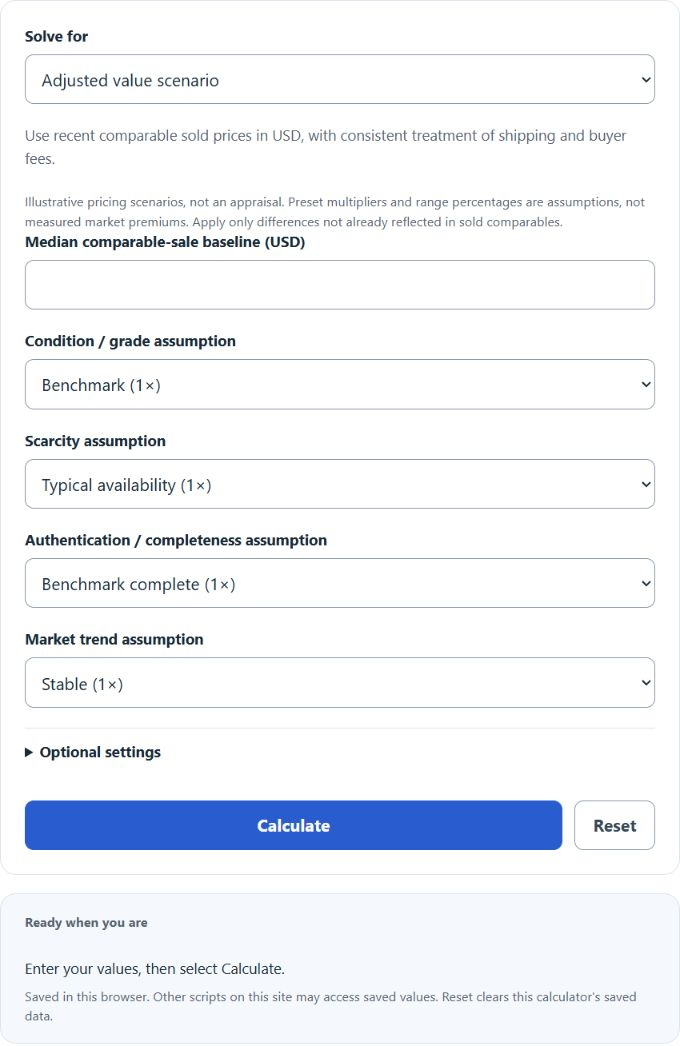
Explore an illustrative collectible value scenario and net proceeds from sold-price comparables and explicit adjustment assumptions.
Collectible Value Formula
Use completed sales for the closest issue, edition, variation, grade, authentication status and date range. Apply adjustments only for differences not already reflected in the comparable baseline. The preset multipliers are illustrative assumptions, not validated category-specific premiums or an appraisal.
V = B * F1 * F2 * F3 * F4
To find the comparable-sale baseline needed to support a target adjusted value:
B = V / (F1 * F2 * F3 * F4)
Estimated net proceeds after a percentage fee and fixed costs are:
N = V * (1 - f) - C
Variables:
- V is the adjusted market value
- B is the median comparable-sale baseline
- F1 through F4 are the selected illustrative adjustment assumptions
- N is estimated net proceeds
- f is the selling fee as a decimal
- C is fixed selling, repair, shipping, or authentication cost
The result shows fixed illustrative bands of 84–116% and 62–80% of the adjusted scenario. These are not measured market ranges, confidence intervals or guarantees. Use multiple relevant recent sales; net proceeds can be negative when entered costs exceed proceeds.
Collectible Value Adjustment Reference
Each selector is centered on a neutral multiplier of 1.00. Values above or below 1.00 scale the baseline by the shown amount. These preserved presets are scenario assumptions; do not treat them as universal grade, rarity or authentication premiums.
| Factor | Benchmark | Adjustment range |
|---|---|---|
| Condition / grade | Mid-grade benchmark | 0.45× to 1.40× |
| Scarcity | Typical availability | 0.70× to 1.35× |
| Authentication and completeness | Uncertified but complete | 0.55× to 1.18× |
| Market trend | Stable | 0.65× to 1.20× |
Example Problems
Example 1: A set of close sold comparables has a median price of $500. The selected adjustments combine to 1.30.
V = 500 * 1.30 = $650.00.
Example 2: You want the adjusted value to be $900, and the combined adjustments equal 1.15. Find the comparable baseline that would support that result.
B = 900 / 1.15 = $782.61.
Frequently Asked Questions
Why should I use sold prices instead of asking prices?
Asking prices show what sellers hope to receive, not what buyers accepted. Completed sales provide stronger evidence of actual market value, especially when several recent results agree.
How much does professional grading matter?
It can matter substantially in categories with recognized grading services because grade and authenticity become easier to compare. The premium depends on the category, grader, population, and price level.
What if there are no exact comparables?
Use the closest related issue or variation and make a conservative adjustment. Widen the estimated range and avoid assigning a large scarcity premium without evidence from population or transaction data.