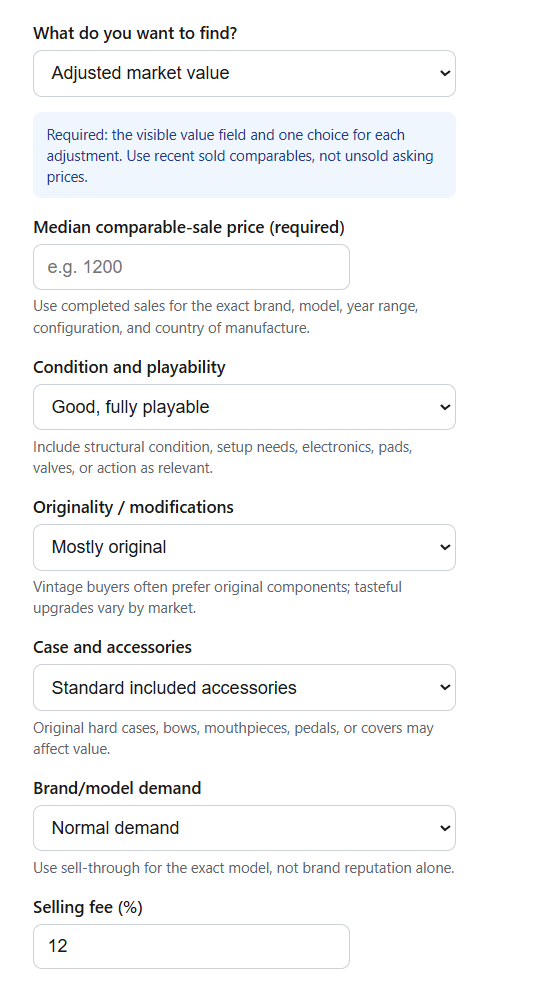
Estimate a musical instrument’s market value, quick-sale range, and net proceeds from sold comps, condition, originality, accessories, model demand, and fees.
Musical Instrument Value Formula
Use completed sales for the exact brand, model, year range, configuration, and country of manufacture. Then adjust for condition, playability, originality, accessories, and current model demand.
V = B * F1 * F2 * F3 * F4
To find the comparable-sale baseline needed to support a target adjusted value:
B = V / (F1 * F2 * F3 * F4)
Estimated net proceeds after a percentage fee and fixed costs are:
N = V * (1 - f) - C
Variables:
- V is the adjusted market value
- B is the median comparable-sale baseline
- F1 through F4 are the selected category-specific adjustment multipliers
- N is estimated net proceeds
- f is the selling fee as a decimal
- C is fixed selling, repair, shipping, or authentication cost
The result includes an indicative market range and a lower quick-sale range. These are planning estimates, not guarantees; use multiple recent comparables and remove obvious outliers before entering the median.
Musical Instrument Value Adjustment Reference
Each selector is centered on a benchmark multiplier of 1.00. A multiplier above 1.00 raises the comparable baseline, while a multiplier below 1.00 reduces it.
| Factor | Benchmark | Adjustment range |
|---|---|---|
| Condition and playability | Good, fully playable | 0.48× to 1.18× |
| Originality / modifications | Mostly original | 0.62× to 1.12× |
| Case and accessories | Standard included accessories | 0.82× to 1.10× |
| Brand/model demand | Normal demand | 0.68× to 1.20× |
Example Problems
Example 1: A set of close sold comparables has a median price of $1,200. The selected adjustments combine to 1.10.
V = 1200 * 1.10 = $1,320.00.
Example 2: You want the adjusted value to be $1,800, and the combined adjustments equal 1.20. Find the comparable baseline that would support that result.
B = 1800 / 1.20 = $1,500.00.
Frequently Asked Questions
Do upgrades increase an instrument’s value?
Some reversible, desirable upgrades help usability, but they rarely return their full installed cost. Vintage buyers may discount non-original pickups, finishes, hardware, keys, or electronics.
How should repair needs be handled?
Estimate the cost of the required setup or repair and either reduce the condition multiplier or enter the amount as a fixed selling cost. Avoid subtracting the same repair twice.
Why can local and online values differ?
Large or fragile instruments are expensive to ship, and playability is often judged in person. Local demand, shipping risk, return policies, and marketplace fees can create different net values.