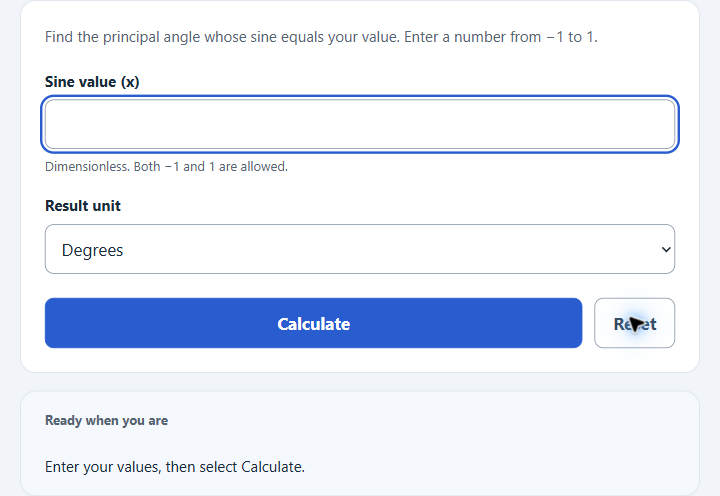
Calculate the arcsin of a number between -1 and 1 and get the angle result in degrees or radians, with the principal value shown clearly.
Arcsin(x) Formula
The arcsin function, also written as inverse sine or sin-1(x), gives the angle whose sine is x. For real-number results, x must be from -1 to 1, including both endpoints.
For a result in radians:
For a result in degrees:
- x is the input value. For real results, it must satisfy
-1 ≤ x ≤ 1. - theta is the angle whose sine equals
x. - theta_rad is the arcsin result measured in radians.
- theta_deg is the arcsin result measured in degrees.
- pi is the constant π, approximately
3.141592653589793.
The calculator first finds the principal value of arcsin(x) in radians. If you choose radians, that value is returned directly. If you choose degrees, the radian value is multiplied by 180 / π. The principal arcsin range is from -π/2 to π/2, or from -90° to 90°.
Common Arcsin Values
| x | arcsin(x) in degrees | arcsin(x) in radians |
|---|---|---|
| -1 | -90° | -π/2 |
| -0.5 | -30° | -π/6 |
| 0 | 0° | 0 |
| 0.5 | 30° | π/6 |
| √2 / 2 ≈ 0.7071068 | 45° | π/4 |
| 1 | 90° | π/2 |
Input Range and Output Range
| Item | Range | Meaning |
|---|---|---|
| Valid real input | -1 ≤ x ≤ 1 | Only these x-values have real arcsin results. |
| Degree output | -90° to 90° | The principal angle in degrees. |
| Radian output | -π/2 to π/2 | The principal angle in radians. |
Example Problems
Example 1: Find arcsin(0.5) in degrees
Use the degree formula:
Since sin(30°) = 0.5, the result is:
arcsin(0.5) = 30°
Example 2: Find arcsin(-1) in radians
Use the radian formula:
Since sin(-π/2) = -1, the result is:
arcsin(-1) = -π/2 ≈ -1.570796 radians
FAQ
What does arcsin(x) mean?
arcsin(x) means the inverse sine of x. It returns the angle whose sine is x. For example, arcsin(0.5) is 30° or π/6 radians because the sine of that angle is 0.5.
Why must x be between -1 and 1?
The sine of a real angle can never be less than -1 or greater than 1. Because arcsin works backward from a sine value to an angle, real-valued arcsin is only defined for inputs from -1 to 1.
Why is there only one answer when more than one angle can have the same sine?
Many angles can share the same sine value, but arcsin returns the principal value. That means the calculator gives the standard answer in the range -90° to 90°, or -π/2 to π/2 radians.