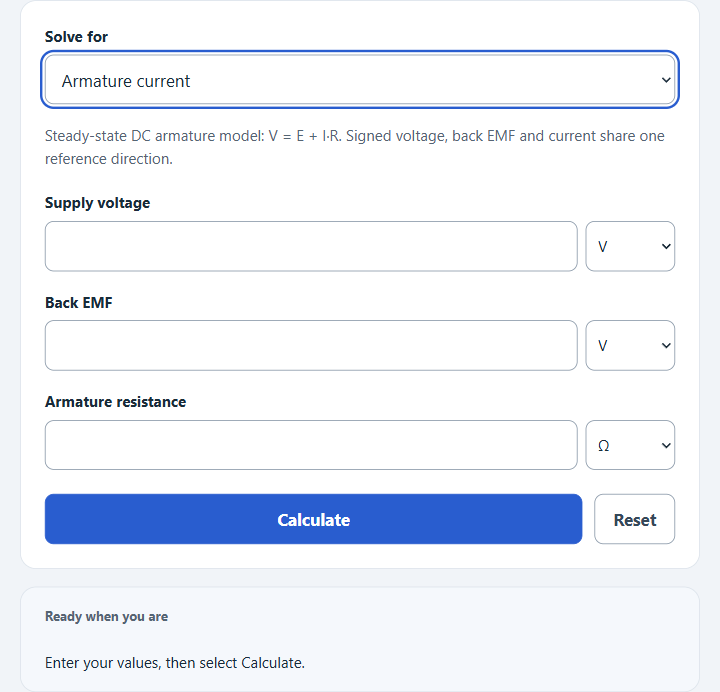
Calculate armature current, back EMF, resistance, stall current, torque, and power for DC motors from voltage, speed, and motor constant.
- All Physics Calculators
- Armature Resistance Calculator
- LED Inrush Current Calculator
- Overload Current Calculator
- Overcurrent Relay Setting Calculator
- Inverter Current Calculator
Armature Current Formula
The following equation is used to calculate the Armature Current.
- Where Ia is the armature current (amps)
- V is the voltage from the source (volts)
- E is the back e.m.f (volts)
- Ra is the armature resistance (ohms)
Choose Armature current under Solve for, subtract the back e.m.f. from the source voltage, then divide by the positive armature resistance. The model is steady-state DC with constant flux; it excludes inductive transients and controller current limits. Other choices solve for voltage, back EMF or resistance, or estimate current from speed, stall current, and torque/power. Electrical conversion efficiency excludes rotational/core losses; shaft efficiency is shown only when the optional inputs support it.
What is an Armature Current?
Definition:
An armature current is defined as the total amperage moving through a system with a given voltage, emf, and resistance.
How to Calculate Armature Current?
Example Problem:
The following example outlines the steps and information needed to calculate Armature Current.
First, determine the source voltage. For this example problem, the source voltage is measured to be 150 volts.
Next, determine the back emf. For this problem, the back emf is measured to be 100 volts.
Next, determine the resistance. The armature resistance is measured as 5 ohms.
Finally, calculate the armature current using the formula above:
Ia = (V-E) / Ra
Ia = (150-100) / 5
Ia = 10 amps