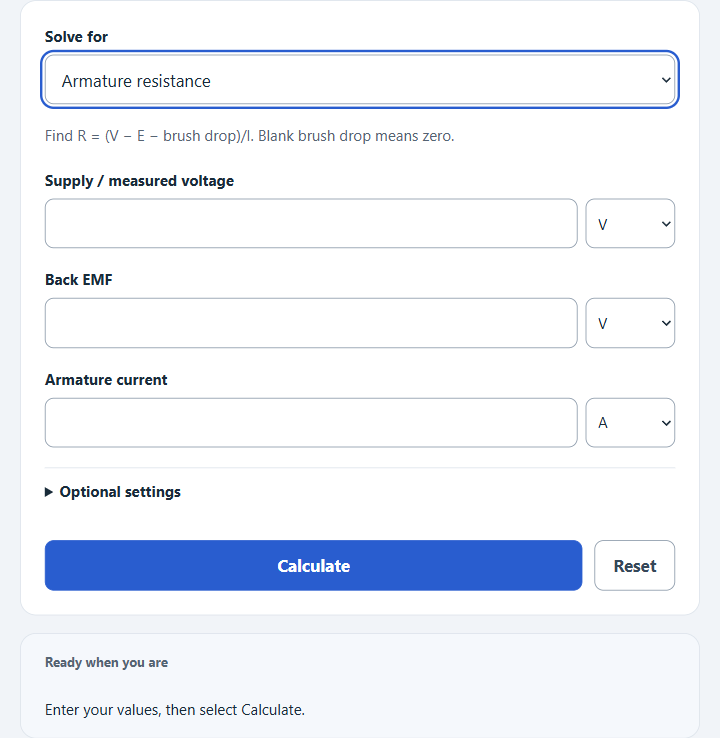
Calculate DC motor armature resistance, back EMF, current, voltage, and copper loss, with standstill and temperature corrections for DC motors.
- All Electrical Calculators
- All Physics Calculators
- DC Motor Torque Calculator
- Solenoid Force Calculator
- Motor Winding Resistance Calculator
- Armature Current Calculator
- Terminal Voltage Calculator
- Resistance Force Calculator
Armature Resistance Formula
Choose the value to solve for and enter the remaining quantities. The following equation calculates armature resistance when brush drop is zero. With a nonzero total brush drop B, use Ra = (V − E − B) / Ia.
- Where Ra is the armature resistance (ohms)
- V is the voltage (volts)
- E is the back e.m.f (volts)
- Ia is the armature current (amps)
To calculate the armature resistance, subtract the back e.m.f from the voltage, then divide by the armature current.
What is Armature Resistance?
Definition:
Armature resistance is the electrical resistance of the motor armature winding at its operating temperature. Temperature correction uses R2 = R1 × [1 + α20(T2 − 20)] / [1 + α20(T1 − 20)], with a coefficient referenced to 20°C. The copper and EC-H19 aluminum presets use 0.00393/°C and 0.00403/°C respectively; use a material-specific coefficient and valid temperature range for other conductors.
How to Calculate Armature Resistance?
Example Problem:
The following example outlines the steps and information needed to calculate Armature Resistance.
First, determine the voltage. In this example, the voltage is a standard 120 volts.
Next, determine the back e.m.f. The back e.m.f. is found to be 104 volts.
Next, determine the current. In this example, the armature current is calculated to be 15 amps.
Finally, calculate the armature resistance using the formula above:
Ra = (V-E) / Ia
Ra = (120-104) / 15
Ra ≈ 1.066667 ohms.