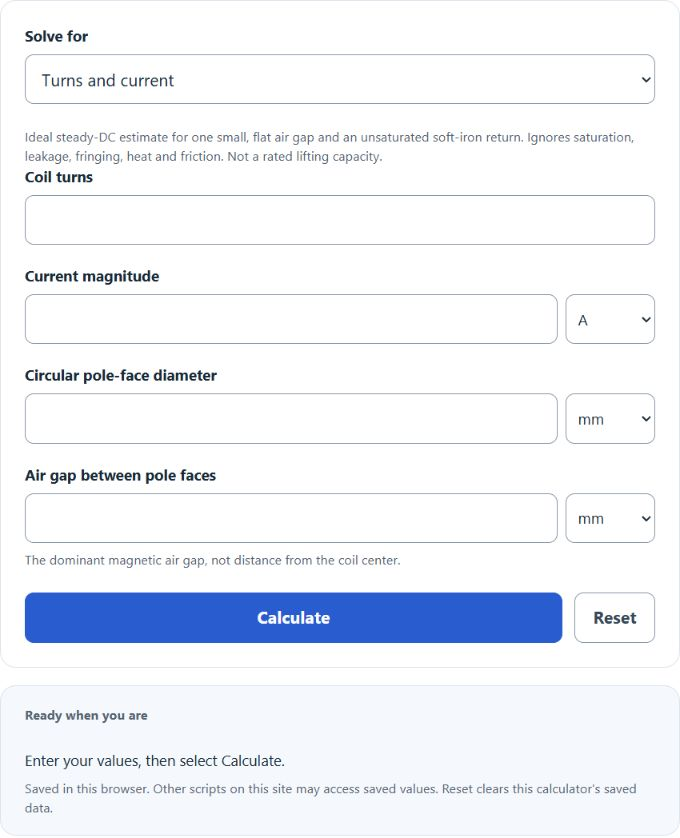
Calculate solenoid pull force from coil turns or ampere-turns, plunger diameter, and air gap, with results in N, lbf, and kgf values.
- All Electrical Calculators
- Electric Field Calculator
- All Physics Calculators
- Magnetic Flux Calculator
Solenoid Force Formula
The following ideal single-air-gap formula estimates pull on an unmagnetized soft-iron plunger with a high-permeability return path. It neglects saturation, leakage, fringing, heating and friction, so it is not a rated lifting capacity.
- Where F is the force (newtons)
- n is the number of turns
- I is the current (amps)
- μ₀ is the vacuum permeability, approximated here as 4π × 10⁻⁷ N/A²
- A is the circular pole-face area, π × diameter² / 4 (m²)
- g is the dominant air gap between pole faces (m)
To calculate the solenoid force, square the product of the number of turns and the current, multiply the result by the constant and area, then divide by twice the pole-face air gap squared.
Solenoid Force Definition
A solenoid force is defined as the total force produced by any given solenoid. Solenoids are coils or wires that produce a magnetic field when electricity is run through them.
Solenoid Force Example
How to calculate solenoid force?
- First, determine the number of turns.
Calculate or measure the total number of turns of the solenoid.
- Next, determine the current.
Measure the current running through the solenoid.
- Next, determine the area.
Measure the area of the metal the magnetic field is acting on.
- Next, determine the distance between the solenoid and metal.
Measure the dominant air gap between the pole faces, not from the coil center.
- Finally, calculate the solenoid force.
Calculate the solenoid force using the equation above.
FAQ
What factors affect the force produced by a solenoid?The force produced by a solenoid is affected by several factors including the number of turns in the coil, the intensity of the current flowing through the coil, the area of the coil, the distance between the solenoid and the metal object, and the magnetic properties of the core material.
Can the direction of the solenoid force be changed?For the unmagnetized soft-iron plunger modeled here, reversing current changes magnetic polarity but does not reverse the attraction: force acts to close the gap and depends on current squared. Permanent-magnet or specially biased actuators require a different model.
How can the strength of a solenoid be increased?The strength of a solenoid can be increased by increasing the number of turns in the coil, increasing the current flowing through the coil, using a material with higher magnetic permeability for the core, or decreasing the gap between the solenoid and the metal object it is acting upon.