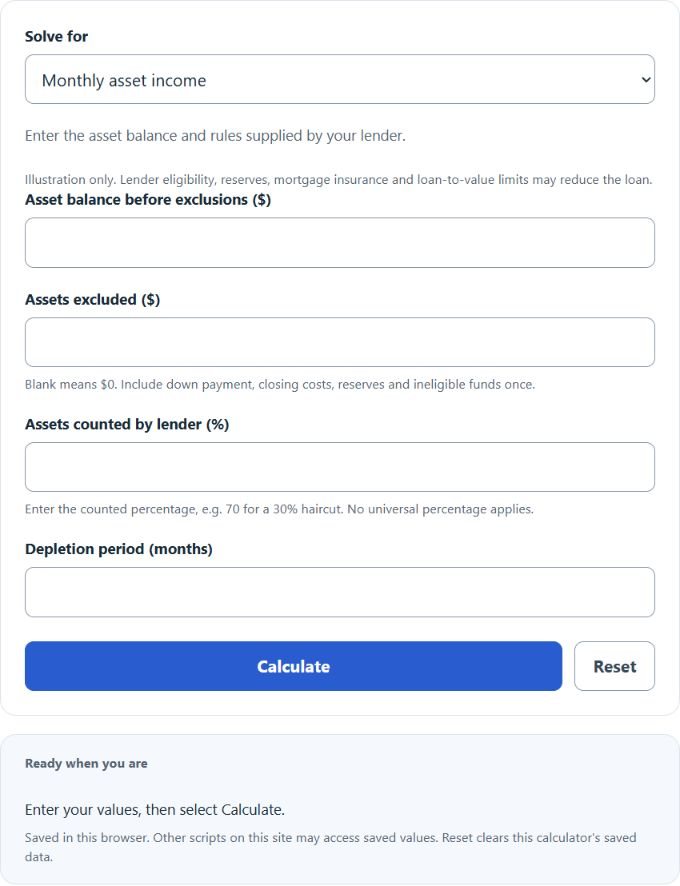
Estimate monthly asset-depletion qualifying income and an illustrative maximum P&I mortgage loan amount from assets, liabilities, haircut, term, and rate.
Asset Depletion Mortgage Formula
The following scenario equation estimates the monthly qualifying income a lender may allow from asset depletion (sometimes called “asset dissipation”). Exact rules (which assets count, haircuts/discounts, and the number of months used) vary by lender and program.
- Where ADM is the estimated monthly qualifying income from asset depletion ($/month)
- A is the total assets available to be considered ($)
- L is the amount subtracted from assets (for example, liabilities you plan to pay off or other amounts excluded) ($)
- DR is the lender’s asset eligibility factor / haircut (a decimal, e.g., 0.70 for 70%)
- T is the lender-supplied number of months used in the depletion calculation; there is no universal divisor
To estimate the monthly asset-depletion income, subtract any excluded amounts from the asset balance, multiply by the eligibility factor, then divide by the number of months used by the lender.
What is an Asset Depletion Mortgage?
Definition:
An asset depletion mortgage is a type of home loan qualification approach that allows a lender to count certain borrower assets as a theoretical monthly income stream by spreading (“depleting”) eligible assets over a set number of months. This can help borrowers without conventional ongoing income (such as some retirees or investors) qualify, but underwriting still depends on lender rules (eligible assets, discounts/haircuts, reserves, and debt-to-income requirements).
How to Calculate Asset Depletion Mortgage?
Example Problem:
The following example outlines the steps and information needed to estimate monthly qualifying income from asset depletion.
First, determine your total asset balance available for consideration. In this example, the borrower has $500,000 in assets.
Next, determine any amounts to subtract. Assume the borrower will subtract $0 for simplicity in this example.
Then, determine the asset eligibility factor (haircut) the lender applies. Suppose the lender counts 70% of these assets (DR = 0.70).
Finally, determine the number of months used for depletion. Use 360 months for this illustration only; actual program divisors and eligibility rules differ.
Now calculate the monthly asset depletion income using the formula above:
ADM = ((A − L) × DR) ÷ T
ADM = (($500,000 − $0) × 0.70) ÷ 360
ADM = $972.22 per month
FAQ
How do lenders apply asset depletion rates?
Lenders typically have specific guidelines or formulas to calculate a borrower's theoretical monthly “income” based on their eligible assets. For example, they may apply different haircuts/discounts to different asset types (such as retirement accounts versus cash) and then spread the eligible amount over a set number of months.
Who benefits from an asset depletion mortgage?
Individuals with significant assets but limited traditional income sources often benefit from asset depletion mortgages. This includes retirees, self-employed individuals with fluctuating incomes, or people with significant savings and investments.
Are all assets considered equally for asset depletion mortgages?
Not all assets are treated the same. Liquid assets such as cash, stocks, and bonds are usually considered, while restricted or non-liquid assets might be discounted or excluded altogether. Different lenders also have different guidelines for what they will accept as qualifying assets.