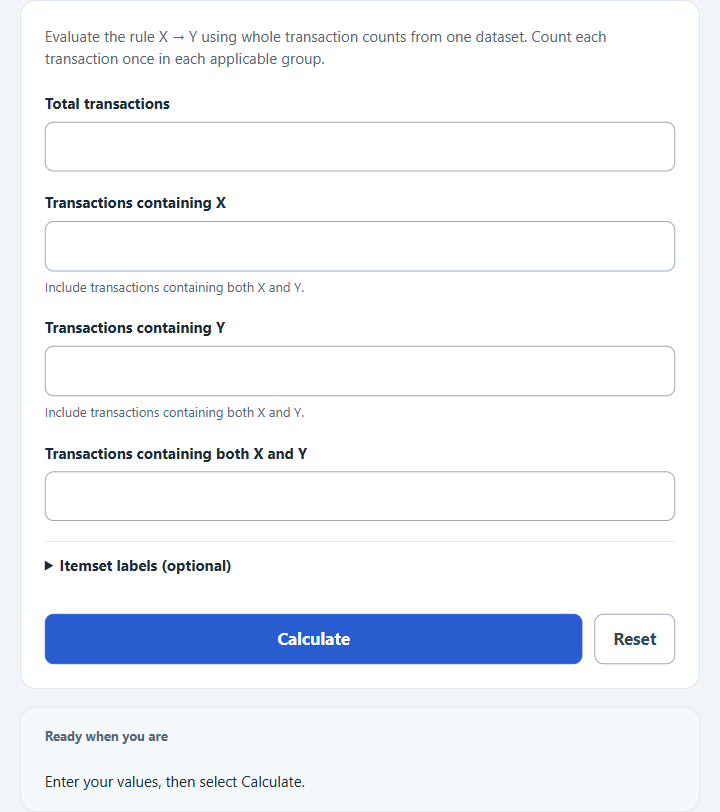
Calculate support, confidence and lift for association rules from total transactions and counts containing X, Y, and both X and Y.
Related Calculators
- Percent Agreement Calculator
- Frequency Index Calculator
- Expected Frequency Calculator
- Percentage to Frequency Calculator
- All Statistics Calculators
Association Rule Formula
The following formula is used to calculate the confidence of the association rule X → Y in a database.
Variables:
- conf(X → Y) is the confidence of the rule X → Y
- X is the antecedent itemset
- Y is the consequent itemset
- S(X ∩ Y) is the support of the intersection of itemsets X and Y (the fraction of transactions containing both X and Y)
- S(X) is the support of itemset X (the fraction of transactions containing X)
To calculate confidence, first determine the support of the intersection of itemsets X and Y (X ∩ Y), which represents the fraction of transactions containing both X and Y. Then, determine the support of itemset X. Divide S(X ∩ Y) by S(X). The result is the confidence of the association rule X → Y, which corresponds to the conditional probability P(Y | X) when supports are computed as proportions of transactions and X occurs at least once. Lift equals confidence divided by support of Y and is undefined if X or Y has zero support. Counts must be whole numbers with both-count no greater than either individual count, and X + Y – both no greater than the total.
What is an Association Rule?
Association rule learning is a rule-based machine learning and data mining technique used to discover relationships between variables in large datasets. An association rule is typically written as X → Y, where X and Y are itemsets. Rules are commonly evaluated using measures such as support, confidence, and lift. This technique is widely used in market basket analysis to find associations between products purchased by customers.