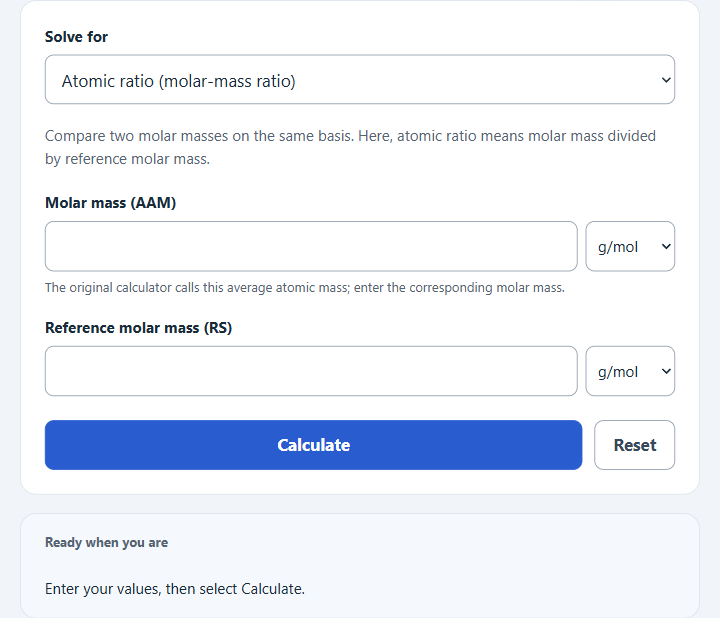
Choose the molar-mass ratio, molar mass (AAM), or reference molar mass to solve for, then enter the two known values. Supports g/mol, kg/mol, and mg/mol.
- All Chemistry Calculators
- All Ratio Calculators
- Average Atomic Mass Calculator
- Mole Ratio Calculator
- Mass Ratio Calculator
Atomic Ratio Formula
This calculator uses atomic ratio to mean a unitless ratio of two molar masses. AAM represents the molar mass corresponding to the original average atomic mass input, and RS is the reference molar mass. This is not an atom-count ratio in a sample or compound. Both masses are converted to consistent units.
Rearranged formulas:
- AR = atomic ratio, unitless
- AAM = average atomic mass
- RS = reference standard or reference molar mass
The calculator first converts average atomic mass and reference standard to the same base unit, grams per mole. It then uses the matching formula for your Solve for selection.
- To calculate atomic ratio: enter average atomic mass and reference standard. The calculator divides AAM by RS.
- To calculate average atomic mass: enter atomic ratio and reference standard. The calculator multiplies AR by RS.
- To calculate reference standard: enter average atomic mass and atomic ratio. The calculator divides AAM by AR.
Unit Conversions Used for Molar Mass Inputs
Both molar mass inputs are converted to grams per mole before the formula is applied.
| Input unit | Conversion to g/mol | Example |
|---|---|---|
| g/mol | multiply by 1 | 12 g/mol = 12 g/mol |
| kg/mol | multiply by 1000 | 0.012 kg/mol = 12 g/mol |
| mg/mol | multiply by 0.001 | 12000 mg/mol = 12 g/mol |
Common Reference Choices and Ratio Meaning
| Reference standard | Typical use | How to read the ratio |
|---|---|---|
| Carbon-12, approximately 12 g/mol | Comparing an atomic mass to carbon-12 | A ratio of 2 means the mass is twice the reference mass. |
| Hydrogen, about 1.008 g/mol | Comparing relative mass to hydrogen | A ratio near 16 means the mass is about 16 times hydrogen. |
| Custom reference molar mass | Using a lab, class, or problem-specific standard | The ratio depends directly on the reference value you enter. |
Example Problems
Example 1: Calculate atomic ratio
You have an average atomic mass of 24 g/mol and a reference standard of 12 g/mol.
The atomic ratio is 2.
Example 2: Calculate average atomic mass
You have an atomic ratio of 3.5 and a reference standard of 12 g/mol.
The average atomic mass is 42 g/mol.
FAQ
Is atomic ratio the same as average atomic mass?
No. In this calculator, the AAM input is a molar mass in units such as g/mol. Atomic mass itself is commonly expressed in unified atomic mass units. The ratio here compares two molar masses and is unitless.
Why do the two mass values need consistent units?
The ratio is only meaningful if both values are on the same unit basis. For example, 12 g/mol divided by 6 g/mol gives 2. If you accidentally compare 12 g/mol to 0.006 kg/mol without converting, the raw division would give the wrong value. The calculator converts supported units before calculating.
Can the atomic ratio be zero or negative?
No. For this calculator, average atomic mass, reference standard, and atomic ratio must be greater than zero. A zero or negative molar mass does not make physical sense for this type of comparison.