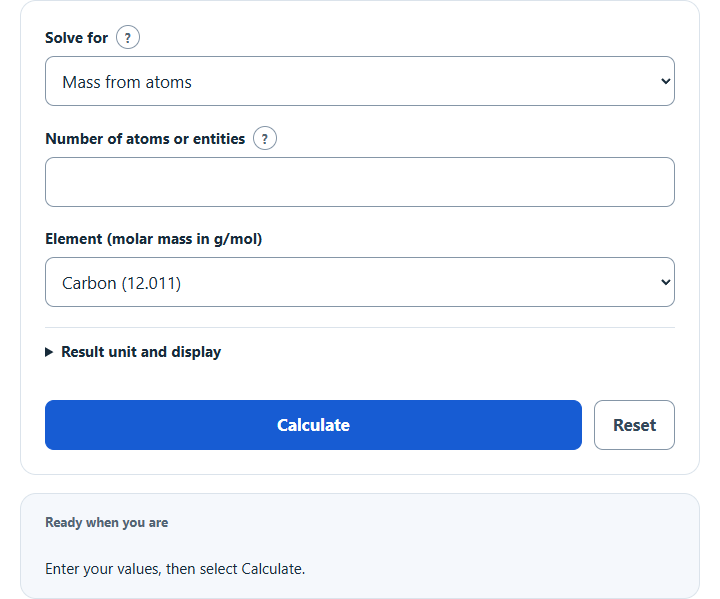
Convert atoms to grams or grams to atoms: enter an atom count or a mass and pick an element, or use a custom molar mass for molecules.
- All Chemistry Calculators
- Average Atomic Mass Calculator
- Grams to Moles calculator
- Moles to Atoms Calculator
Calculator Functions
| Function | What it does | What it requires |
|---|---|---|
| Mass from atoms | Converts a number of atoms of an element to grams | Requires the number of atoms and an element chosen from the list |
| Atoms from mass | Converts a mass of an element to the number of atoms in it | Requires the sample mass and an element chosen from the list |
| Mass from entities | Converts a count of molecules, formula units or atoms to grams for any substance | Requires the count, the molar mass in g/mol and the entity type |
| Entities from mass | Converts a mass of any substance to its number of molecules, formula units or atoms | Requires the sample mass, the molar mass in g/mol and the entity type |
| Molar mass | Finds the molar mass of a substance from one sample | Requires the sample mass and the number of entities in that same sample |
The element list holds 21 elements from hydrogen to uranium, each with its molar mass. Counts accept scientific notation such as 6.02214076e23, and masses go in as g, mg, kg or µg. Optional settings choose the mass unit of the result, show 3, 5 or 7 significant digits, and multiply the entry for several identical samples. Every result also lists the amount in moles and the mass of a single atom or entity.
Atoms to Grams Formulas
| m | Mass of the sample (g) |
| N | Number of atoms, molecules or formula units |
| M | Molar mass of that atom, molecule or formula unit (g/mol) |
| NA | Avogadro constant, exactly 6.02214076 × 10²³ per mole [1] |
The conversion runs through moles. Dividing the count by the Avogadro constant gives the amount in moles, and multiplying moles by the molar mass gives grams. For a single element the molar mass in g/mol has the same number as its standard atomic weight, and the element list uses the abridged values published by the IUPAC atomic weights commission, such as 12.011 for carbon and 15.999 for oxygen [2].
Mass from atoms
The main formula applies with the molar mass of the chosen element. For 2.48 × 10²³ atoms of magnesium, m = 2.48 × 10²³ × 24.305 ÷ (6.02214076 × 10²³) = 10.0 g. One mole of carbon atoms, 6.02214076 × 10²³ of them, has a mass of 12.011 g.
Atoms from mass
A 9.45 g piece of gold holds 9.45 × 6.02214076 × 10²³ ÷ 196.96657 = 2.89 × 10²² atoms. The element list counts single atoms, so hydrogen and oxygen are H and O, not H₂ and O₂ molecules.
Mass from entities
This is the main formula with a molar mass typed in, which covers compounds and any element missing from the list. For 1.204 × 10²⁴ molecules of water at 18.015 g/mol, m = 1.204 × 10²⁴ × 18.015 ÷ (6.02214076 × 10²³) = 36.0 g.
Entities from mass
The formula is N = m × NA ÷ M with a typed molar mass. A 10 g sample of sodium chloride at 58.44 g/mol contains 10 × 6.02214076 × 10²³ ÷ 58.44 = 1.03 × 10²³ formula units. With a compound's molar mass the answer counts whole molecules or formula units, not the atoms inside them: each NaCl unit holds 2 atoms, so that sample has twice as many atoms.
Molar mass
A 4.0 g sample that contains 1.204 × 10²³ atoms has a molar mass of 4.0 × 6.02214076 × 10²³ ÷ (1.204 × 10²³) = 20.0 g/mol. Both the mass and the count must be above zero and must describe the same sample.
Limits of This Estimate
- The element values are standard atomic weights for normal terrestrial material, rounded to about five significant figures. Some carry a wider spread, such as lead at 207.2 ± 1.1 [2], and an isotopically enriched sample needs its own molar mass.
- The Avogadro constant is exact, so the precision of a result is set by the molar mass and by the digits in the entered count or mass.
- A count of molecules or formula units is not a count of atoms. Multiply by the number of atoms in the formula to get total atoms.
Sources
- NIST, CODATA Value: Avogadro constant: the exact value 6.02214076 × 10²³ per mole
- IUPAC Commission on Isotopic Abundances and Atomic Weights, Abridged Standard Atomic Weights 2024: atomic weights of the listed elements and their uncertainties