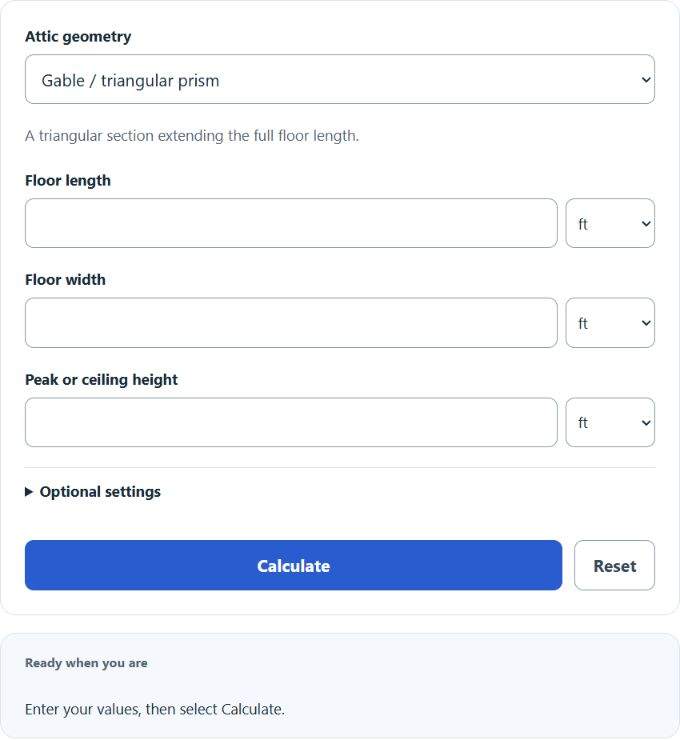
Calculate attic volume for gable, hip, or flat roof geometry in feet or meters, with floor area, metric and imperial conversions, and airflow planning from air changes.
- All Construction Calculators
- All Volume Calculators
- Test Tube Volume Calculator
- Berm Volume Calculator
- Ceiling Height Clearance Calculator
Attic Volume Formula
The attic volume calculator uses a different volume formula depending on the roof or space shape you select.
Gable attic
Hip roof attic
Flat or box-shaped attic
Unit conversions used for the result
- V = attic volume
- L = attic floor length
- W = attic floor width
- H = peak height or ceiling height
- ft³ = cubic feet
- m³ = cubic meters
For a gable attic, the calculator treats the attic cross-section as a triangle, so the volume is half of the full rectangular box.
For a regular equal-pitch hip roof, horizontal sections shrink in both directions toward a centered ridge. The volume is A × B × H × (1/2 − B/(6A)), where A is the longer floor side and B the shorter side. Only a square footprint reduces to a single pyramid.
For a flat or box-shaped attic, the calculator uses the full rectangular volume because the ceiling height is assumed to be consistent across the space.
Each dimension accepts feet or meters and converts the quantity when its unit changes. The primary result follows the floor-length unit, with cubic feet, cubic meters, US gallon equivalents and floor area shown. Optional user-supplied air changes per hour add airflow = volume × ACH / 60 in CFM. No automatic fan-size recommendation is made.
Common Attic Shape Multipliers
| Attic type | Multiplier | When to use it |
|---|---|---|
| Gable | 0.5 | Use for a triangular attic under a simple two-slope roof. |
| Hip roof | 1/2 − B/(6A) | Use for a centered ridge along the longer side and equal pitch on all four sides. A=max(L,W), B=min(L,W). |
| Flat / box | 1.0 | Use for a rectangular attic, storage space, or room with a mostly even height. |
Attic Volume Reference Values
| Floor footprint | Height | Gable volume | Hip roof volume | Flat volume |
|---|---|---|---|---|
| 30 ft × 20 ft | 6 ft | 1,800 ft³ | 1,400 ft³ | 3,600 ft³ |
| 40 ft × 28 ft | 7 ft | 3,920 ft³ | 3,005.33 ft³ | 7,840 ft³ |
| 50 ft × 32 ft | 8 ft | 6,400 ft³ | 5,034.67 ft³ | 12,800 ft³ |
Example Calculations
Example 1: Gable attic
You have a gable attic with a floor length of 40 ft, a floor width of 28 ft, and a peak height of 7 ft.
The attic volume is 3,920 ft³.
Example 2: Flat attic space
You have a flat or box-shaped attic space with a length of 30 ft, a width of 20 ft, and a ceiling height of 5 ft.
The attic volume is 3,000 ft³.
FAQ
How do you measure attic height?
For a gable or hip attic, measure from the attic floor to the highest point of the roof framing, usually the ridge or peak. For a flat or box-shaped attic, use the ceiling height. If the height changes across the space, use an average height or divide the attic into smaller sections and add the volumes together.
Why is gable attic volume half of length times width times height?
A simple gable attic has a triangular cross-section. A triangle has half the area of a rectangle with the same base and height, so the attic volume is half of the full box volume.
Is the hip roof result exact?
The hip result is the ideal geometric volume for the stated equal-pitch rectangular model, before framing and obstructions. Complex roofs with dormers, multiple ridges, valleys or unequal slopes should be divided into suitable sections.