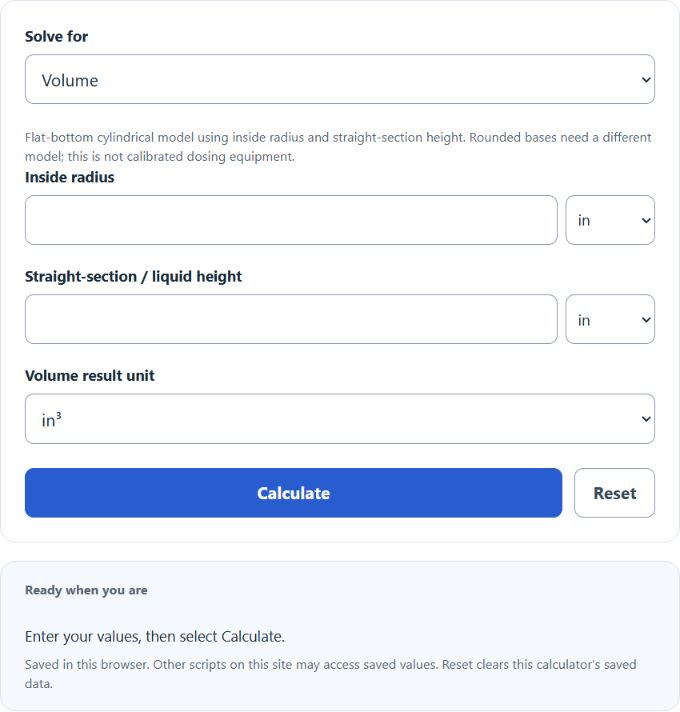
Calculate test tube volume, radius, or height from two inputs using a cylindrical model with inch, cm, ft, or m units for straight-sided tubes.
- All Chemistry Calculators
- All Volume Calculators
- Berm Volume Calculator
- Pipe Volume Calculator
- Head Gasket Volume Calculator
Test Tube Volume Formula
This calculator estimates the volume of a test tube by treating it as a right circular cylinder. For the most accurate result, use the inside radius of the tube and the inside height or liquid height, depending on whether you want total capacity or the amount currently inside.
| Variable | Meaning |
|---|---|
| V | Test tube volume |
| r | Inside radius of the test tube |
| h | Height of the tube or height of the liquid column |
For manual calculation, use matching radius and height units. The calculator converts each selected input unit independently, so mixed inputs are supported, and lets you select the result unit.
How to Calculate Test Tube Volume
- Measure the inside radius of the tube.
- Measure the internal height of the tube, or the liquid height if the tube is only partially filled.
- Square the radius.
- Multiply by pi.
- Multiply by the height to get the volume.
If you know the diameter instead of the radius, convert it first:
Then use the main volume equation.
Example
Suppose a test tube has an inside diameter of 1.5 cm and a liquid height of 12 cm.
So the tube contains about 21.21 mL of liquid at that fill height.
Capacity vs. Liquid Volume
The same equation can be used for two different purposes:
- Total capacity: use the full internal height of the test tube.
- Current liquid volume: use only the height of the liquid inside the tube.
This distinction matters when estimating fill level and capacity. The geometry estimate does not replace calibrated volume measurement.
Measurement Tips
- Use internal dimensions, not external dimensions.
- Match each measurement to its selected unit; the calculator handles conversion.
- Small radius errors can create large volume errors because the radius is squared in the formula.
- For narrow tubes, a caliper usually gives a better diameter measurement than a ruler.
- If you measure diameter, divide it by two before entering the value as radius.
Rounded-Bottom Test Tubes
Some real test tubes have a rounded bottom instead of a perfectly flat cylindrical end. In that case, the simple cylindrical formula gives an approximation. If the tube has a hemispherical bottom with the same radius as the tube body, a more detailed model is:
This full-capacity formula applies to an ideal hemispherical base plus a straight cylinder; h measures only the straight section, and the hemisphere must be completely included. The calculator above uses only the cylindrical model. A partially filled curved base needs a spherical-cap model. Use calibrated glassware for dosing or precise laboratory measurements.
Common Conversions
Common Questions
Should I enter diameter or radius?
Enter the radius. If you only have the diameter, divide it by two first.
What happens if I mix units?
Select the correct unit for each input. The calculator converts them before applying the equation. For manual calculation, convert to matching units first.
Why does the result change so much when radius changes a little?
Because the cross-sectional area depends on the square of the radius, even a small change in radius has a strong effect on volume.
Can this formula be used for partially filled tubes?
For a flat-bottom cylindrical interior, use the liquid height. Liquid occupying a rounded base requires the appropriate curved-base model.