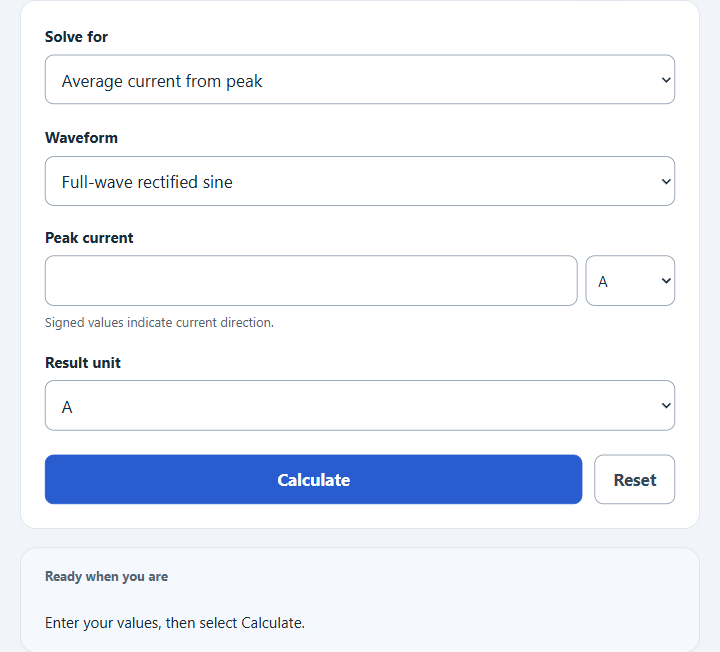
Choose the value to calculate for rectified sine, unipolar triangle or sawtooth, DC, or ideal PWM current. PWM assumes constant on-current and zero off-current; these are mean, not RMS, values.
- All Physics Calculators
- All Electrical Calculators
- Peak Current Calculator
- RMS Current Calculator
- Average Voltage Calculator
- Neutral Current Calculator
- Current Per Phase Calculator
Average Current Formula
The following formula is used to calculate the average (mean/DC) current of a full-wave rectified sine wave from its peak current.
- Where Iave is the Average Current (mean value) (amps)
- Ip is the peak current (amps)
For a full-wave rectified sine wave, multiply the peak current by 2/π (≈ 0.637) to get the average current. For comparison, an unrectified sine wave averaged over a full cycle has an average of 0, and a half-wave rectified sine wave has an average of Ip/π (≈ 0.318·Ip).
How to Calculate Average Current?
The following two example problems outline how to calculate the Average Current.
Example Problem #1:
- First, determine the peak current (amps). In this example, the peak current is measured to be 115 A (full-wave rectified sine wave).
- Finally, calculate the Average Current using the formula above:
Iave = Ip · (2/π)
Inserting the values from above and solving the equation with the input values gives:
Iave = 115 · (2/π) ≈ 73.21 (amps)
Example Problem #2:
Using the same process as example problem 1, we first define the variables outlined by the formula. In this case, the values are:
peak current (amps) = 251
Entering these values into the formula above gives :
Iave = 251 · (2/π) ≈ 159.79 (amps)