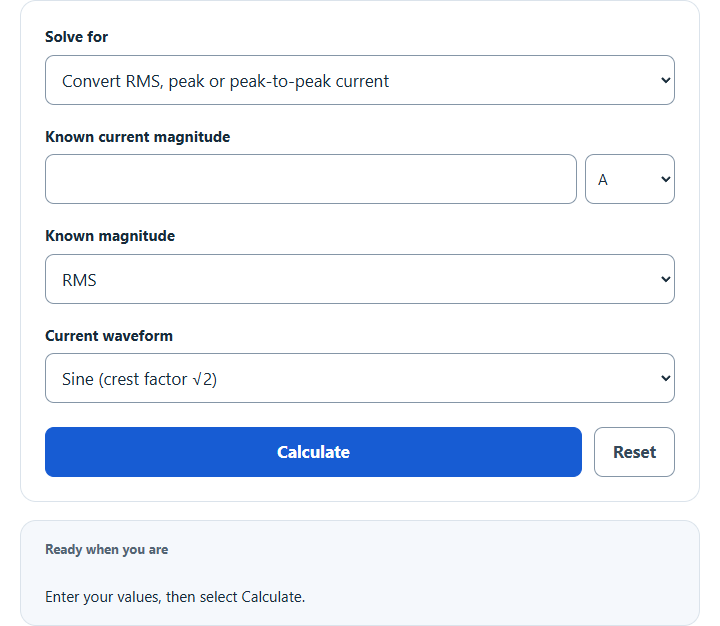
Convert RMS current to peak or peak-to-peak current and back for sine, square or triangle waves, or find peak current from voltage and resistance or power.
- All Physics Calculators
- All Electrical Calculators
- RMS Current Calculator
- Full Load Current Calculator
- RMS Wattage Calculator
- Average Current Calculator
Peak Current Formula
For a sinusoidal AC waveform, peak current relates to RMS current by a factor of √2 (about 1.4142).
- Ipeak = peak current (amperes)
- Irms = RMS (root-mean-square) current (amperes)
- Ipp = peak-to-peak current (amperes)
- Vrms = RMS voltage (volts)
- R = resistance (ohms)
- P = real power (watts); true PF = P / (Vrms × Irms), greater than 0 and no more than 1
The Convert RMS, peak or peak-to-peak current mode uses the selected current crest factor: √2 for a sine wave, 1 for a symmetric square wave, and √3 for a symmetric triangle wave. Custom crest factor is peak magnitude divided by RMS and must be at least 1. It does not establish symmetry by itself. Peak-to-peak conversion assumes equal positive and negative peak magnitudes.
The load modes first find RMS current, then apply the selected current crest factor. Use Vrms / R for an ideal constant resistor; its current follows the voltage waveform. Otherwise enter real power, RMS voltage and true power factor. These formulas cover a single-phase load or one matched voltage-current pair, not a general three-phase line current.
Reference Values
The rounded reference factors below apply to a zero-centered sine wave. Examples are approximate; calculations use unrounded factors.
| Conversion | Factor | Example |
|---|---|---|
| Irms to Ipeak | × 1.4142 | 10 A → 14.14 A |
| Ipeak to Irms | ÷ 1.4142 | 14.14 A → 10 A |
| Ipeak to Ipp | × 2 | 14.14 A → 28.28 A |
| Irms to Ipp | × 2.8284 | 10 A → 28.28 A |
Illustrative steady sine-wave currents for ideal single-phase resistive loads (PF = 1). These are not universal appliance measurements or inrush ratings:
| Load | Vrms | Irms | Ipeak |
|---|---|---|---|
| 60 W resistive lamp model | 120 V | 0.50 A | 0.71 A |
| 1500 W heater | 120 V | 12.5 A | 17.68 A |
| 3000 W kettle | 230 V | 13.04 A | 18.45 A |
| 5500 W resistive element model | 240 V | 22.92 A | 32.41 A |
Example Problems
Example 1. A heater draws 12.5 A RMS from a 120 V supply. Find the peak current.
Ipeak = √2 × 12.5 = 1.4142 × 12.5 = 17.68 A.
Example 2. A 230 V RMS source feeds a 50 Ω resistor. Find Irms and Ipeak.
Irms = 230 / 50 = 4.6 A. Ipeak = √2 × 4.6 = 6.51 A.
FAQ
Does this work for non-sinusoidal waveforms? Yes, select the actual current waveform or a known custom crest factor. The √2 factor applies only to a sine wave; symmetric square and triangle factors are 1 and √3. Offset or asymmetric signals require actual minimum and maximum values for peak-to-peak current.
Does it apply to inductive or capacitive loads? Use the actual current crest factor. The V/R method is for a pure constant resistor. The real-power method uses Irms = P / (Vrms × true PF). True PF includes distortion; cos(phase angle) alone is insufficient for nonsinusoidal waveforms. At PF = 0, real power cannot determine RMS current; this tool requires PF greater than zero.
Why is peak current important? RMS current governs resistive heating; peak current, duration, waveform and manufacturer limits can also matter for components and protective devices. Insulation design also depends on voltage stress. This tool does not select fuses or component ratings. A zero-centered 10 A RMS sine current has a peak magnitude of about 14.14 A.
What is peak-to-peak current? It is the full swing from the negative peak to the positive peak, equal to twice the peak value for a symmetric sine wave.