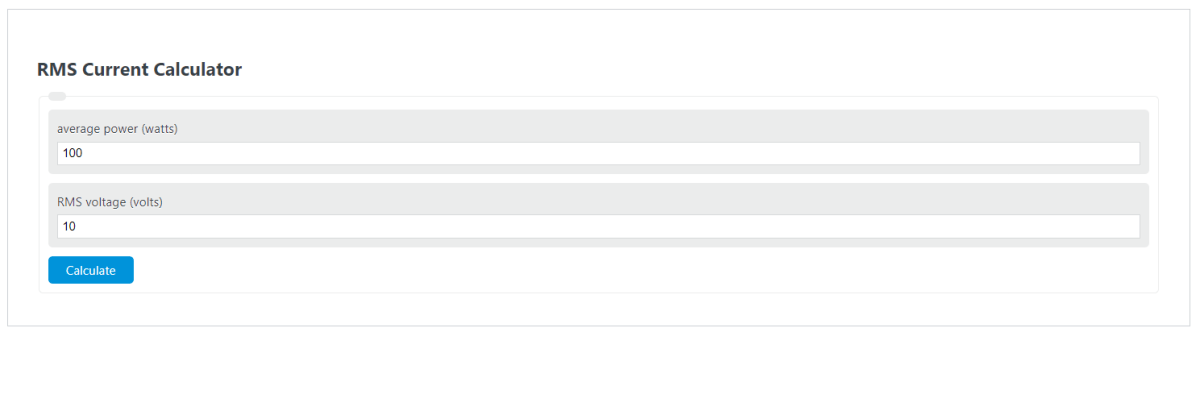
Calculate RMS current from power and voltage, convert RMS, peak, and peak-to-peak current for common waveforms, or analyze equally spaced current samples.
- All Physics Calculators
- All Electrical Calculators
- RMS Voltage (VRMS) Calculator
- RMS Wattage Calculator
- Peak Current Calculator
- Average Current Calculator
- Neutral Current Calculator
- dBm to RMS Voltage Calculator
RMS Current Formula
RMS current is the effective current in an electrical circuit. It represents the amount of alternating current that would produce the same heating effect as an equivalent direct current. For a single-phase AC circuit, RMS current depends on the real power, the RMS voltage, and the power factor of the load.
For purely resistive loads or steady DC circuits, the power factor is 1, so the equation simplifies to:
This RMS Current Calculator is most useful when you know any two of the main electrical values and need to solve for the third. It can help with load analysis, wiring checks, breaker sizing estimates, inverter and transformer planning, and quick validation of measured circuit values.
Variable Definitions
| Parameter | Meaning | Typical Units |
|---|---|---|
| RMS Current | The effective current delivered to the load | A, mA, kA |
| Real Power | The actual power converted into useful work or heat | W, kW, MW |
| RMS Voltage | The effective AC voltage applied to the load | V, mV, kV |
| Power Factor | The ratio between real power and apparent power | Unitless |
Why RMS Current Matters
RMS current is the value normally used for practical electrical design because heating, conductor loading, fuse operation, and many equipment ratings are based on effective current rather than peak current. If the RMS current is too high, wires can overheat, voltage drop can increase, and protective devices may trip unexpectedly.
- Higher RMS current usually means greater conductor heating.
- Lower power factor increases current for the same real power.
- Correct RMS values help match loads to breakers, cables, and power supplies.
How to Use the RMS Current Calculator
- Enter the known values for real power and RMS voltage, or provide any other supported pair of values.
- Enter the power factor. If the load is purely resistive, use a power factor of 1.
- Make sure the units are consistent before calculating.
- Click calculate to solve for the missing electrical quantity.
If you are working with motors, compressors, transformers, or inductive electronics, the power factor is often less than 1. In those cases, ignoring power factor will underestimate the true RMS current.
Related Power Relationships
RMS current is directly tied to apparent power and real power. These relationships explain why a poor power factor causes more current to flow even when the useful power stays the same.
When the power factor drops, the circuit must draw more current to deliver the same real power. That extra current increases copper losses, heating, and system stress.
Rearranged Forms of the Formula
If you need to solve for a different value, the same relationship can be rearranged as follows:
These forms are helpful when you are troubleshooting field measurements or checking whether a current reading is reasonable for a known power and voltage level.
Examples
Example 1: A load uses 120 watts at 6 volts with a power factor of 1. Find the RMS current.
The RMS current is 20 A.
Example 2: A device consumes 1800 watts from a 120 volt source with a power factor of 0.75. Find the RMS current.
The RMS current is 20 A. This example shows how a lower power factor can significantly increase the current draw for the same useful power output.
RMS Current vs Peak Current
Do not confuse RMS current with peak current. AC waveforms reach a maximum instantaneous current that is higher than the RMS value. For a sinusoidal waveform, the relationship is:
If you only know peak current or peak voltage, convert those values to RMS before using this calculator. Entering peak values directly will produce incorrect results.
Common Mistakes
- Using apparent power instead of real power. If the formula is based on real power, be sure the watt value is actual power, not volt-amperes.
- Ignoring power factor. This is one of the most common reasons RMS current is underestimated in AC systems.
- Entering peak voltage instead of RMS voltage. Household and industrial voltage ratings are usually listed in RMS terms.
- Mixing units. Convert kilowatts to watts, millivolts to volts, and milliamps to amps as needed.
- Using a single-phase formula for a different system type. Three-phase circuits require a different current relationship.
Practical Applications
The RMS current formula is commonly used in electrical and electronics work for:
- sizing wires and overcurrent protection,
- checking motor and appliance load current,
- estimating inverter or generator output requirements,
- validating bench power supply settings,
- analyzing heating elements and resistive loads,
- comparing the effect of changing power factor on current draw.
Frequently Asked Questions
Is RMS current the same as average current?
Not necessarily. For AC circuits, RMS current reflects the effective heating value, while average current depends on waveform shape and the time interval being considered.
Can this calculator be used for DC circuits?
Yes. For a steady DC circuit, the effective current is the actual current, and the power factor is treated as 1.
Why does current increase when power factor decreases?
Because more total current is required to deliver the same real power when the voltage and current are less effectively aligned.
What if my power factor is unknown?
If the load is mainly resistive, using a power factor of 1 is usually appropriate. For inductive or motor-driven equipment, use the nameplate value or a measured estimate whenever possible.