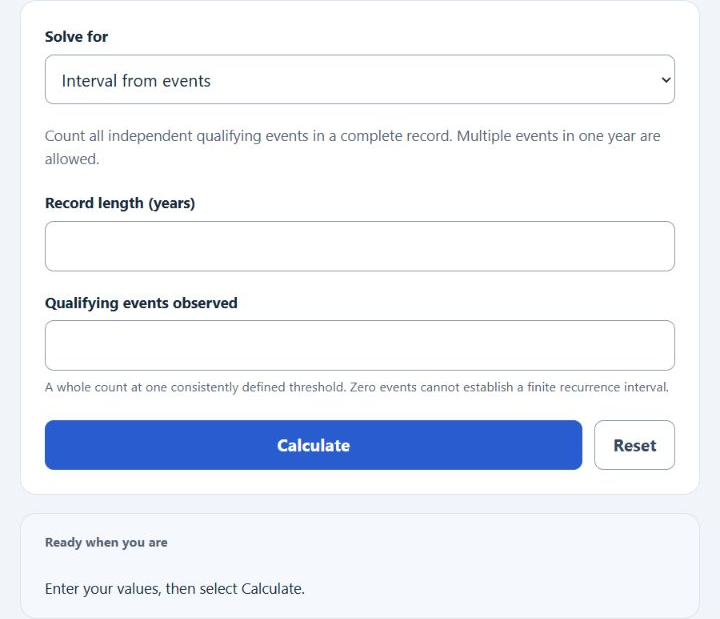
Estimate the mean interval from a complete event record, or calculate risk using either a Poisson event model or an independent-year annual-probability model. Choose the model that matches how the supplied interval was defined; they are not interchangeable.
Related Calculators
- Frequency Density Calculator
- Hurst Coefficient Calculator
- Earthquake Return Period Calculator
- Empirical Probability Calculator
- Probability of Success After N Trials Calculator
- All Statistics Calculators
Average Recurrence Interval Formula
The average recurrence interval, or ARI, is the estimated average time between events of a specified size or greater. The calculator distinguishes an interval estimated from event counts, Poisson event risk over time, and annual-probability risk over whole years.
- ARI = average recurrence interval, in years
- Y = years of record
- E = number of qualifying events observed during the record
- AEP = annual chance of at least one event under a constant-rate Poisson model, as a decimal
- e = Euler’s number, approximately 2.71828
- ARI = average recurrence interval, in years
- AEP_annual = annual exceedance probability under the annual-return-period convention
- T_annual = reciprocal of annual exceedance probability, at least 1 year
- Risk_annual = chance of at least one exceedance over independent years
- T_annual = annual-probability return period, in years
- n = whole years assessed; zero years gives zero elapsed-time risk
In Interval from events mode, enter record length and a whole count of independent qualifying events. The calculator estimates ARI = years/events and reports a Poisson annual probability. Zero observed events cannot establish a finite interval or prove zero future risk.
In Poisson event risk, risk = 1 − exp(−n/ARI), using a constant event rate and allowing fractional years. In Annual-probability risk, risk = 1 − (1 − 1/T_annual)^n, using independent whole years with unchanged annual probability. The models differ most for frequent events.
Annual Return Period and Exceedance Probability Values
ARI is often described as a “return period,” but it does not mean the event happens exactly once every stated number of years. It is a long-term average.
| Annual return period | Annual AEP (1/T) | Annual probability interpretation |
|---|---|---|
| 2 years | 50% | 1 in 2 chance per year |
| 10 years | 10% | 1 in 10 chance per year |
| 25 years | 4% | 1 in 25 chance per year |
| 50 years | 2% | 1 in 50 chance per year |
| 100 years | 1% | Often called a 100-year event |
| 500 years | 0.2% | 1 in 500 chance per year |
Example Time Horizons
These are arbitrary periods for exploring probability, not recommended design lives for particular structures. Appropriate engineering criteria must come from the applicable project requirements.
| Illustrative period | Time horizon |
|---|---|
| Example A | 10 years |
| Example B | 25 years |
| Example C | 50 years |
| Example D | 75 years |
| Example E | 100 years |
Average Recurrence Interval Examples
Example 1: Calculate ARI from a record
You have 50 years of data and 5 qualifying flood events.
The estimated mean event interval is 10 years. Under the Poisson assumptions, the annual chance of at least one event is:
Example 2: Calculate risk over a design life
In Annual-probability risk mode, assess a return period of 100 years (1% annual probability) over 50 independent years.
The chance of at least one 100-year event in 50 years is about 39.5%.
Average Recurrence Interval FAQ
Does a 100-year event happen once every 100 years?
No. A 100-year event has about a 1% chance of being equaled or exceeded in any single year. It can happen in back-to-back years, or it might not happen for much longer than 100 years. The 100 years is a long-term average interval, not a schedule.
What is the difference between ARI and AEP?
ARI is expressed as a time interval, such as 10 years or 100 years. AEP is expressed as an annual probability, such as 10% or 1%. The conversion depends on the model: a Poisson mean event interval gives AEP = 1 − exp(−1/ARI), while an annual-probability return period is defined by AEP = 1/T. These are different conventions. A larger interval gives a smaller annual probability within either model.
Why is the design-life risk higher than the annual probability?
The annual probability applies to one year only. Over many years, the chance of seeing at least one event accumulates. For example, a 1% annual event has about a 39.5% chance of occurring at least once in 50 years, assuming each year’s occurrence is independent.