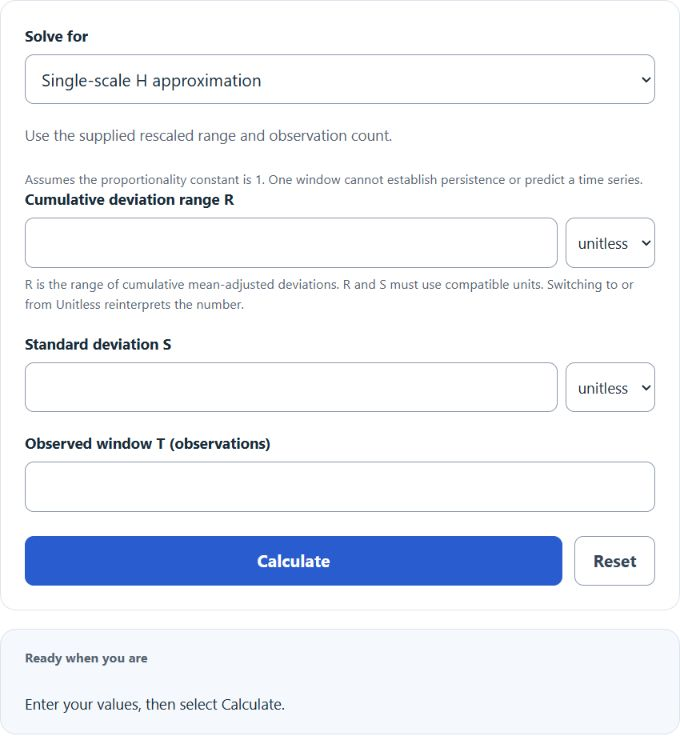
Choose a single-scale H approximation, range, standard deviation, or model-implied window, then enter the known values. The simplified model assumes a proportionality constant of 1.
Related Calculators
- Standard Error Regression Calculator
- Variable Error Calculator
- RMS Error Calculator
- Coefficient Of Dispersion Calculator
- All Statistics Calculators
Hurst Coefficient Formula
The calculator preserves a simplified single-scale rescaled range approximation with proportionality constant fixed at 1. One window does not establish persistence or provide a statistical Hurst exponent estimate:
Select the value to calculate. The corresponding rearranged form is:
- H = Hurst coefficient, unitless
- R = range of cumulative deviations
- S = standard deviation
- T = window size, measured as the number of observations
To calculate H, enter R, S, and T. The calculator divides R by S, takes the logarithm of that ratio, then divides by the logarithm of T.
To calculate R, enter H, S, and T. The calculator raises T to the power of H, then multiplies by S.
To calculate S, enter H, R, and T. The calculator divides R by T raised to the power of H.
To calculate T, enter H, R, and S. The calculator raises the ratio R/S to the power of 1/H.
R and S must use compatible units because the ratio R/S needs to be unitless. If you select length units, the calculator converts R and S to common units before calculating.
Interpreting Hurst Coefficient Values
The interpretations below concern an appropriately estimated exponent under a stochastic model with 0 < H < 1. They cannot be inferred from this calculator’s single-window output and are not predictions of the next movement.
| H value | Common interpretation | What it suggests about the series |
|---|---|---|
| 0 < H < 0.5 | Anti-persistent | Increases are more likely to be followed by decreases, and decreases by increases. |
| H = 0.5 | Random walk-like | The series has little evidence of long-term dependence. |
| 0.5 < H < 1 | Persistent | Increases tend to be followed by increases, and decreases by decreases. |
| H near 1 | Strong persistence | The series may show strong trend-following behavior over the tested scale. |
Input Requirements and Unit Notes
| Input | Requirement | Note |
|---|---|---|
| Hurst coefficient, H | Unitless | When H = 0, R = S leaves every T greater than 1 possible; R ≠ S has no solution. |
| Range, R | Positive value | Use the same type of unit as S, such as meters with meters or feet with feet. |
| Standard deviation, S | Positive value | S cannot be zero because R/S is used in the formula. |
| Window size, T | Number of observations | Observed T inputs must be whole counts of at least 2. Solving for T yields a continuous model value greater than 1, which may be fractional. |
Example Calculations
Example 1: Calculate the Hurst coefficient
Suppose the range of cumulative deviations is 12, the standard deviation is 3, and the window size is 16 observations.
The Hurst coefficient is approximately 0.5000.
Example 2: Calculate the range of cumulative deviations
Suppose H = 0.7, S = 2.5, and T = 20 observations.
The range of cumulative deviations is approximately 20.3545.
FAQ
What does the Hurst coefficient measure?
The Hurst coefficient measures long-term dependence or memory in a time series. A value below 0.5 suggests mean-reverting or anti-persistent behavior. A value near 0.5 suggests random walk-like behavior. A value above 0.5 suggests persistent behavior, where movements tend to continue in the same direction.
Why does the calculator use R divided by S?
The rescaled range method compares the range of cumulative deviations, R, with the standard deviation, S. Dividing R by S normalizes the range so it can be compared across different scales or units. In a full analysis, the Hurst coefficient is estimated from how rescaled range changes across several window sizes; this calculator does not perform that analysis.
Is this the same as a full Hurst exponent estimate?
This calculator uses a single-scale approximation with constant 1: H ≈ log(R/S) / log(T). A full rescaled range analysis calculates R/S across several window sizes and estimates H from a log-log slope with a fitted intercept. This calculator fixes the proportionality constant at 1 and performs only an algebraic check, not a multi-scale estimate or evidence of persistence.