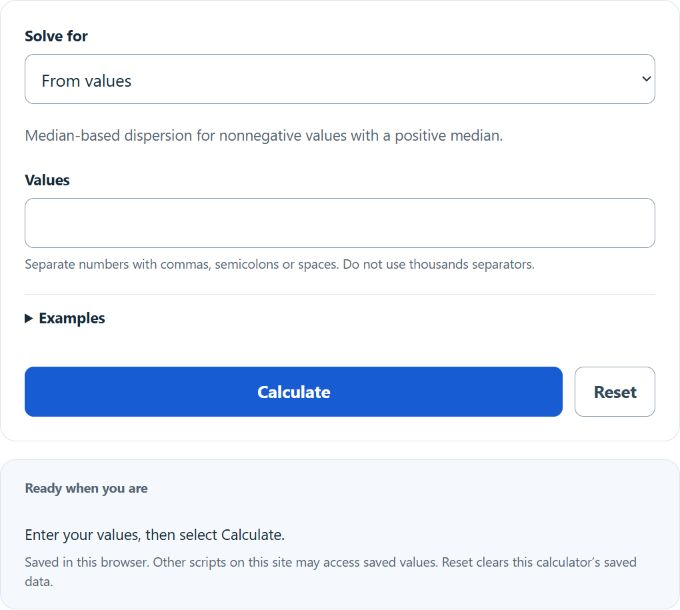
Calculate coefficient of dispersion from values or assessed and sale prices to measure how tightly numbers cluster around the median.
Related Calculators
- Modified Z Score Calculator
- Coefficient Of Variation Calculator
- SS Between Calculator
- HSD (Honestly Significant Difference) Calculator
- Standard Error Of Difference Calculator
- All Statistics Calculators
Coefficient of Dispersion Formula
The following formula is used to calculate the Coefficient of Dispersion (COD) for a given set of values.
Variables:
- COD (%) is the Coefficient of Dispersion expressed as a percentage
- ( x_i ) are nonnegative values on the same basis, or assessed-value / sale-price ratios
- ( M ) is the positive median of the dataset
- ( n ) is the number of values in the dataset
To calculate the Coefficient of Dispersion, first find the median of the dataset. Then, calculate the sum of the absolute differences between each value and the median. Divide this sum by the product of the number of values and the positive median, then multiply by 100 to get COD (%). The unmultiplied ratio is fractional COD.
What is the Coefficient of Dispersion?
The Coefficient of Dispersion (COD) is a statistical measure used to quantify the relative dispersion of a dataset. In real-estate ratio studies it describes the dispersion of assessed-value / sale-price ratios. This calculator uses nonnegative values with a positive median; it does not rate investment risk or assessment compliance. The COD is calculated as the average absolute deviation from the median, expressed as a percentage of the median. A lower COD indicates that the values are closely clustered around the median, while a higher COD suggests greater variability.
How to Calculate the Coefficient of Dispersion?
The following steps outline how to calculate the Coefficient of Dispersion.
- First, list all the values in the dataset.
- Next, calculate the median of the dataset.
- Then, find the absolute difference between each value and the median.
- Sum all the absolute differences.
- Finally, divide the sum of absolute differences by the product of the number of values and the positive median, then multiply by 100 for COD (%).
- After inserting the values and calculating the result, check your answer with the calculator above.
Example Problem :
Use the following variables as an example problem to test your knowledge.
Values: 10, 20, 30, 40, 50
The median is 30 and the average absolute deviation is 12, so fractional COD is 0.4 and COD (%) is 40%. In the assessed / sale-price mode, enter matching lists with strictly positive sale prices. Examples are illustrative.