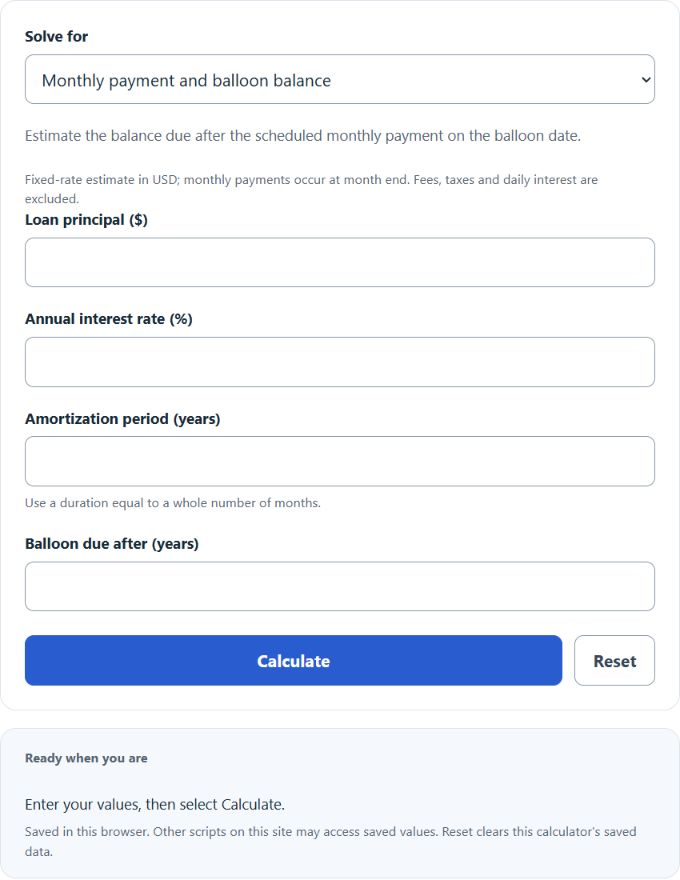
Use this balloon loan calculator to find the regular payment, remaining balloon balance, interest paid, or maximum principal from a payment budget.
Balloon Loan Formula
The regular payment is calculated over the amortization period:
M = P * [r(1 + r)^n] / [(1 + r)^n - 1]
After k scheduled month-end payments, the additional balloon balance is:
B_k = P(1 + r)^k - M * [(1 + r)^k - 1] / r
At zero interest, M = P / n and B_k = P × (1 − k / n). Enter durations equal to whole months. This fixed-rate estimate uses unrounded payments and excludes fees, taxes and daily interest.
Variables:
- P is the original principal
- M is the regular monthly payment
- r is the monthly interest rate
- n is the full amortization period in months
- k is the number of payments made before the balloon date
- B_k is the remaining balloon balance
The payment-budget mode rearranges the payment formula to find the principal supported by the chosen monthly payment. The calculator then applies the balance formula to estimate what remains due at the balloon date.
Balloon Loan Term Reference
For the same principal and rate, a longer amortization lowers the regular payment but leaves a larger balance at an early balloon date.
| Amortization | Balloon due | Monthly payment | Remaining-balance pattern |
|---|---|---|---|
| 30 years | 5 years | Lowest of these examples | Large balance remains |
| 20 years | 5 years | Higher | Smaller balance remains |
| 10 years | 5 years | Higher still | About half the term remains |
| 5 years | 5 years | Fully amortizing | Near zero balloon |
Example Problems
Example 1: Calculate a five-year balloon.
A $100,000 loan has a 7% rate, payments amortized over 30 years, and a balloon due after five years. The calculator first finds the 30-year monthly payment. It then calculates the balance after 60 payments, which becomes the estimated balloon amount.
Example 2: Find the principal from a payment budget.
Suppose the maximum regular payment is $900, the rate is 7%, and the amortization period is 20 years. The payment formula is rearranged to find the principal. The calculator then shows the balance still due at the selected balloon date.
Frequently Asked Questions
Is the balloon payment just one regular payment?
No. It is the remaining principal balance due at the balloon date, often plus accrued interest or contract fees. It can be much larger than the regular installment.
Why is the balloon balance so high?
Early payments on a long amortization schedule contain more interest and less principal. If the balloon date arrives after only a small part of the amortization period, much of the original balance remains.
What happens at the balloon date?
The borrower normally must pay the balance, refinance it, sell the financed asset, or follow another option allowed by the contract. Future refinancing is not guaranteed.