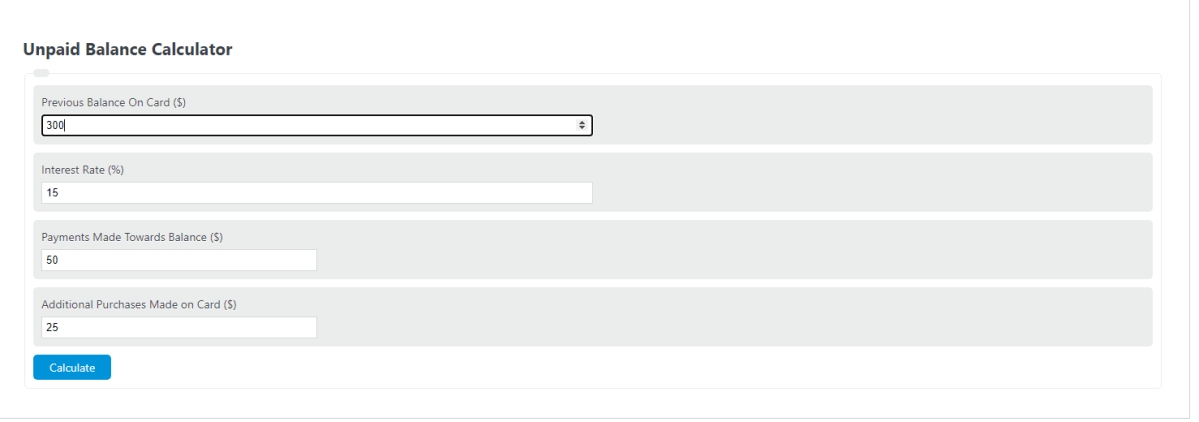
Calculate a credit card unpaid balance, interest rate, payments made, or purchases by entering any three values and solving the missing one.
Unpaid Balance Formula
The unpaid balance is the amount still owed after applying the billing-period interest to the previous balance, subtracting payments, and adding any new purchases made during the same period. This calculator is useful for estimating the next balance on a credit card or revolving account when you know the prior balance activity.
In this formula:
- UB
- Unpaid balance after interest, payments, and new purchases are accounted for.
- PB
- Previous balance carried into the current billing period.
- i
- Periodic interest rate written as a decimal.
- r
- Periodic interest rate entered as a percent.
- P
- Total payment made toward the balance during the period.
- AP
- Additional purchases or charges made during the period.
How to Calculate the Unpaid Balance
- Start with the previous balance from the prior billing cycle.
- Convert the interest rate from a percent to a decimal if needed.
- Apply the period’s interest to the previous balance.
- Subtract the payment amount made during the cycle.
- Add any new purchases or charges.
If you want the process broken into parts, first compute the interest charge and then add or subtract the other activity.
How to Use the Calculator
- Enter the previous balance exactly as it appeared at the start of the billing period.
- Enter the interest rate for that same period, not a rate from a different timeframe.
- Enter payments made during the period.
- Enter additional purchases or charges added during the period.
- The calculator will estimate the resulting unpaid balance.
For the most accurate manual calculation, the interest rate should match the same billing period as the balance activity. If you only know the annual percentage rate and want a quick monthly estimate, you can approximate the monthly rate as follows:
Example
Assume a previous balance of $300, a periodic interest rate of 15%, a payment of $50, and $25 in new purchases.
In this case, the estimated unpaid balance is $320.
What Increases or Decreases the Result
- Higher previous balances generally increase the unpaid balance.
- Higher interest rates increase the finance portion of the balance.
- Larger payments reduce the unpaid balance.
- More new purchases increase the amount still owed.
Important Notes
- This is a simplified balance estimate and is most useful for quick planning.
- Actual card statements may differ if the issuer uses average daily balance methods, daily compounding, grace periods, late fees, cash advance fees, promotional rates, or transaction timing rules.
- If there were no new purchases, enter zero for additional purchases.
- If no payment was made, enter zero for the payment field.
- If the result is zero, the balance was fully covered for this simplified period.
- If the result is negative, it may indicate an overpayment or account credit.
Unpaid Balance vs. Other Balance Terms
Unpaid balance refers to the amount still owed after the current period’s activity is considered. This is not always the same as a minimum payment, statement balance, or current real-time balance shown by a card issuer. Those figures can represent different points in the billing cycle.
Common Mistakes to Avoid
- Using an annual rate when the calculator expects a period rate.
- Forgetting to convert a percent rate into decimal form for manual calculations.
- Leaving out new purchases, fees, or other charges that affect the balance.
- Subtracting payments twice.
- Using values from different billing periods in the same calculation.
When This Calculator Is Most Useful
This calculator is helpful when estimating the next amount owed on a revolving balance, comparing payment scenarios, checking whether a payment meaningfully reduces the carried balance, or planning how much new spending can be added before the next statement period ends.