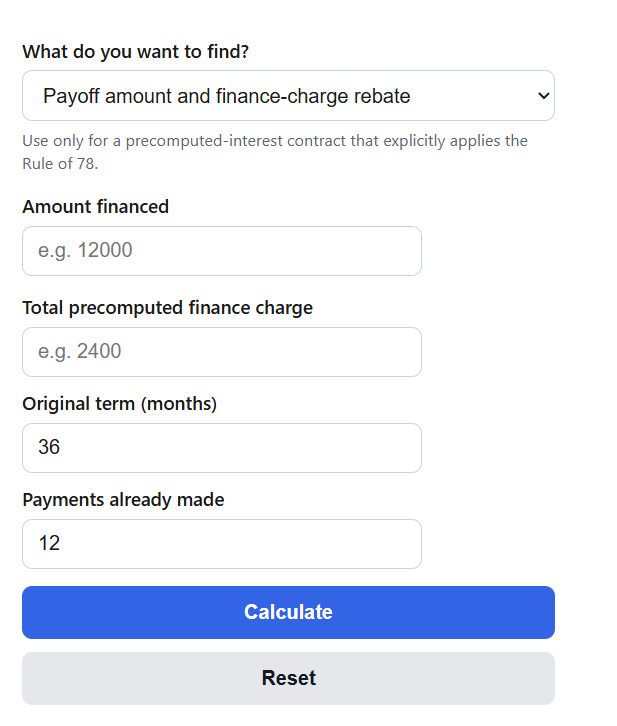
Use this Rule of 78 calculator to estimate unearned finance-charge rebates, earned charges, scheduled installments, and an early payoff amount.
Rule of 78 Formula
The sum of the monthly digits for an N-month contract is:
S = N(N + 1) / 2
If m payments remain, the unearned finance-charge rebate is:
U = F * [m(m + 1)] / [N(N + 1)]
 Payoff = m * Payment - U
Variables:
- N is the original number of monthly payments
- m is the number of payments remaining
- F is the original precomputed finance charge
- U is the unearned finance charge
The method assigns larger finance-charge weights to early months and smaller weights to later months. The calculator estimates the rebate and payoff immediately after a whole scheduled payment. Target-rebate mode solves the quadratic relationship for the approximate payoff month.
Rule of 78 Payoff Reference
The method front-loads the earning of a precomputed finance charge. That makes timing especially important for an early payoff.
| Payment timing | Remaining-month weights | Unearned-charge pattern | Borrower effect |
|---|---|---|---|
| Very early | Large | Large rebate, but much finance charge is already front-loaded | Payoff can exceed a simple-interest balance |
| Middle of term | Moderate | Rebate declines rapidly | Difference narrows |
| Near maturity | Small | Little unearned charge remains | Payoff approaches scheduled balance |
| At maturity | Zero | No rebate remains | Scheduled contract is complete |
Example Problems
Example 1: Estimate a payoff after 12 payments.
A 36-month contract finances $12,000 and includes a $2,400 precomputed finance charge. The installment is ($12,000 + $2,400) ÷ 36 = $400. After 12 payments, 24 remain. The unearned charge is $2,400 × [24 × 25] ÷ [36 × 37]. Subtract that rebate from the remaining scheduled payments to estimate the payoff.
Example 2: Find the month associated with a rebate.
Enter the same contract and a target rebate. The calculator solves m(m + 1) from the rebate ratio, converts remaining months into payments already made, and rounds to the nearest whole payment.
Frequently Asked Questions
Is the Rule of 78 the same as simple interest?
No. Simple interest is based on the outstanding principal over time. The Rule of 78 allocates a precomputed finance charge using declining monthly weights, which earns more of the charge early.
Can every lender use this method?
No. Its use is restricted or prohibited for some loan types and jurisdictions. It is also prohibited for most federal student loans. Check the contract and applicable law.
Why can the official payoff differ?
The lender may use exact dates, additional fees, late charges, insurance refunds, or a legally required rebate method. Request a dated payoff statement before sending funds.