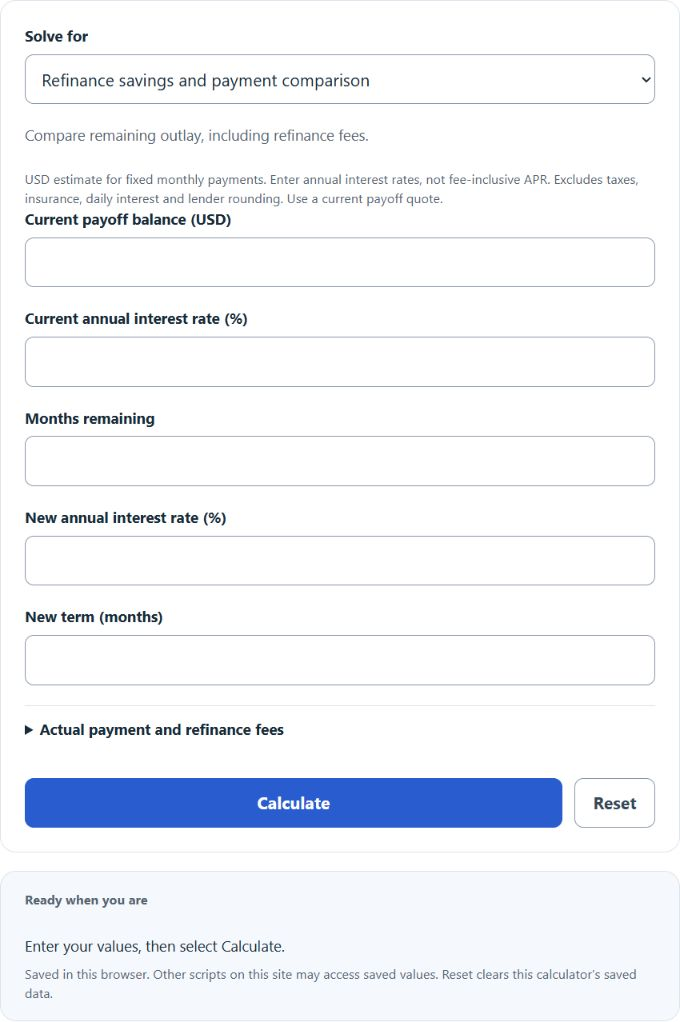
Use this loan refinance calculator to compare old and new payments, total remaining cost, fees, savings, break-even time, and the maximum new annual interest rate.
Loan Refinance Formula
The current and proposed loans are each modeled with the fixed-payment formula using the contractual annual interest rate, not fee-inclusive APR. When the monthly rate is zero, M = P / n.
M = P * [r(1 + r)^n] / [(1 + r)^n - 1]
When fees are paid upfront and monthly payment savings are positive, simple fee payback is shown below. This cash-flow measure is not an economic break-even: differing payoff dates and remaining balances matter. The calculator reports it only when it falls within both modeled loan terms.
BE = F / (M_current - M_new)
Variables:
- M is a monthly payment
- P is the outstanding or refinanced principal
- r is the monthly interest rate
- n is the remaining number of payments
- BE is the break-even time in months
- F is the upfront refinance cost
The calculator compares remaining outlay, not the original cost of the current loan. Fees can be paid upfront or added to the new principal. Maximum-rate mode solves for the highest new annual interest rate whose estimated total outlay is no greater than continuing the current loan.
Loan Refinance Decision Reference
Use both the total-cost comparison and the break-even period. A payment reduction created only by extending the term may not produce true savings.
| Refinance change | Payment effect | Total-cost effect | Break-even effect |
|---|---|---|---|
| Lower rate, same term | Lower | Usually lower | Faster |
| Lower rate, longer term | Often much lower | May be higher | Can look favorable too early |
| High upfront fees | No direct payment effect | Higher | Slower |
| Fees financed | Slightly higher | Higher | No separate upfront recovery |
Example Problems
Example 1: Lower the rate without extending the term.
You have an $18,000 balance at 11% with 48 months remaining. A new 48-month loan is offered at 7% with $500 in upfront fees. The calculator compares the two payments and total remaining outlays, then divides the upfront fee by the monthly payment savings to estimate the break-even month.
Example 2: Find the highest acceptable new rate.
Keep the current loan, new term, and fee assumptions, then select maximum new annual interest rate. The calculator searches for the rate at which the new loan’s remaining outlay matches the current loan’s remaining outlay.
Frequently Asked Questions
Should I use my statement balance or payoff balance?
Use a current payoff quote when possible. A payoff amount can include interest through a specific date, fees, or a prepayment charge that is not included in the statement principal balance.
Is a lower monthly payment always a refinance savings?
No. Extending the term can lower the payment while increasing total interest. Compare total remaining outlay and how long you expect to keep the new loan.
How should financed fees be treated?
Financed fees increase the new principal and therefore the payment and interest. Upfront fees do not increase principal but must be recovered through future monthly savings.