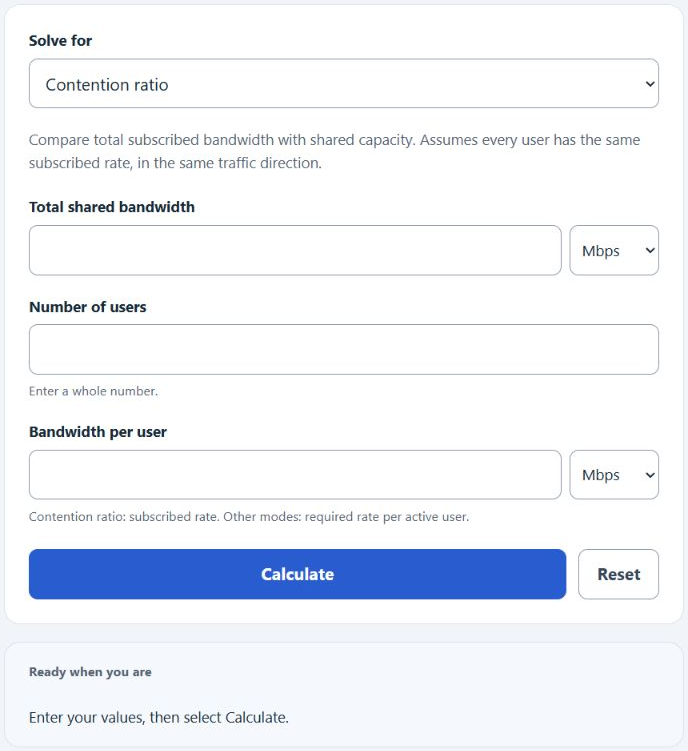
Select Contention ratio to compare users × subscribed rate per user with shared capacity. The calculator also finds equal bandwidth per active user, total bandwidth needed, or maximum whole users. Enter the requested values and select Calculate.
Bandwidth per User (Shared Bandwidth) Formula
Contention ratio = total subscribed bandwidth / shared capacity = users × subscribed rate per user / shared capacity, assuming equal subscribed rates and the same traffic direction. A ratio of 2:1 means subscribed rates total twice the capacity. The other modes use shared bandwidth formulas. If total bandwidth is split evenly across users, each user gets the total bandwidth divided by the number of users.
- BPU = bandwidth per user
- TB = total shared bandwidth
- U = number of users
Select one of the shared-bandwidth modes and enter the two requested values:
- Bandwidth per user: divides the total bandwidth by the number of users.
- Total bandwidth: multiplies the required bandwidth per user by the number of users.
- Number of users: divides the total bandwidth by the bandwidth needed per user and rounds down to a whole user.
Bandwidth units are converted internally to Mbps. Each bandwidth input has its own unit control; changing a unit converts its value. Result bandwidth units can also be selected.
Bandwidth Unit Conversions
| Unit | Equivalent in Mbps | Example |
|---|---|---|
| Gbps | 1 Gbps = 1000 Mbps | 2 Gbps = 2000 Mbps |
| Mbps | 1 Mbps = 1 Mbps | 500 Mbps = 500 Mbps |
| Kbps | 1 kbps = 0.001 Mbps | 5000 kbps = 5 Mbps |
| bps | 1 bps = 0.000001 Mbps | 1,000,000 bps = 1 Mbps |
Illustrative Bandwidth Planning Ranges
The ranges below are illustrative planning assumptions, not application requirements or recommended minimums. Check each service’s current specifications and your actual traffic.
| Activity | Illustrative Bandwidth Per User | Notes |
|---|---|---|
| Email and basic browsing | 1 to 5 Mbps | Usually low demand unless large files are involved. |
| Video calls | 3 to 10 Mbps | Higher quality calls need more bandwidth. |
| HD video streaming | 5 to 25 Mbps | Depends on resolution and compression. |
| Large downloads or cloud backups | 25 Mbps or more | Can temporarily consume much more than normal usage. |
Example
Example 1: Calculate bandwidth per user
You have 500 Mbps of total bandwidth shared by 25 users.
Each user gets 20 Mbps if the bandwidth is divided evenly.
Example 2: Calculate total bandwidth needed
You want 15 Mbps per user for 40 users.
You need 600 Mbps of total bandwidth to provide 15 Mbps per user.
FAQ
Does shared bandwidth mean every user always gets the same speed?
No. The formula assumes an even split, which is useful for planning. In real networks, actual speed can vary based on router settings, congestion, signal quality, server limits, and what each user is doing.
Should the number of users be a whole number?
Yes. User inputs must be positive whole numbers. Maximum whole users rounds the capacity down automatically and shows the unrounded user-equivalent value separately. A result of zero means the total cannot supply even one user at the requested rate.
Is bandwidth the same as internet speed?
Bandwidth is the maximum data rate available, usually measured in Mbps or Gbps. Internet speed as experienced by a user also depends on latency, network congestion, Wi-Fi quality, device performance, and the service being accessed.